


Categorization:Harness Component
In laptops, tablets, camera modules, VR/AR devices, and other space-limited electronic products, cables must not only meet signal transmission requirements but also consider installation space, bend paths, connector sizes, and high-speed signal integrity. The I-PEX CABLINE®-UA II series employs a 0.3mm terminal pitch and a Vertical Right Angle structure, with a mating height of approximately 1.27±0.1mm, and offers configurations such as 26Pin, 32Pin, 40Pin, and 50Pin; the official page also showcases the I-PEX 83033-100B-01-D with a 26Pin, 300mm, 1-1 structure. This ultra-thin coaxial cable is 300MM long, and the connector model used at the cable end is 20497-026T-30, corresponding to the 26Pin CABLINE®-UA II application. For engineers, the value of this kind of solution lies in achieving high-density signal wiring within limited space through the combination of ultra-thin coaxial cables and compact connectors; for purchasers, confirming specific material numbers, Pin counts, cable lengths, and connector models is an important basis for alternative selection and BOM verification. Our company can provide I-PEX 83033-100B-01-D compatible alternative cable solutions, which can be developed for compatibility based on actual device structures, cable specifications, and termination requirements.
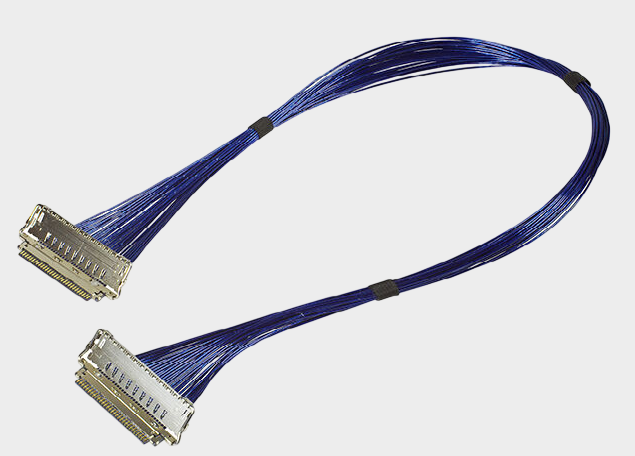
In ultra-fine coaxial cables, the outer material is not simply responsible for the function of "protecting the core wire." The dielectric constant, loss characteristics, temperature resistance, and flexibility of the insulating medium all affect high-speed signal transmission. PTFE (polytetrafluoroethylene) has a lower and stable dielectric constant, lower dielectric loss, and good chemical and high-temperature resistance, and has therefore been widely used as the dielectric material for high-performance coaxial cables for a long time. The data from Micro-Coax also indicates that the dielectric material can directly or indirectly affect transmission loss, propagation speed, temperature range, power capability, phase/amplitude stability, and cable flexibility, and PTFE is a common dielectric material in high-performance coaxial cables. For ultra-fine coaxial cables, the size itself is already very small, and if the dielectric properties, thickness control, or size stability of the insulating layer material are insufficient, it may further affect the characteristic impedance and integrity of high-speed signals. Therefore, when engineers choose ultra-fine coaxial cables, they cannot just look at "how big the AWG is, and how big the outer diameter is," but also need to pay attention to the dielectric medium material and its structural stability. It should be noted that what is often said in the industry as "PTFE sheath" is sometimes actually a general term for the insulation/medium structure of the wire material, and the specific outer sheath material of the wire material should be determined according to the actual Cable Construction specification, and not judged solely by appearance.
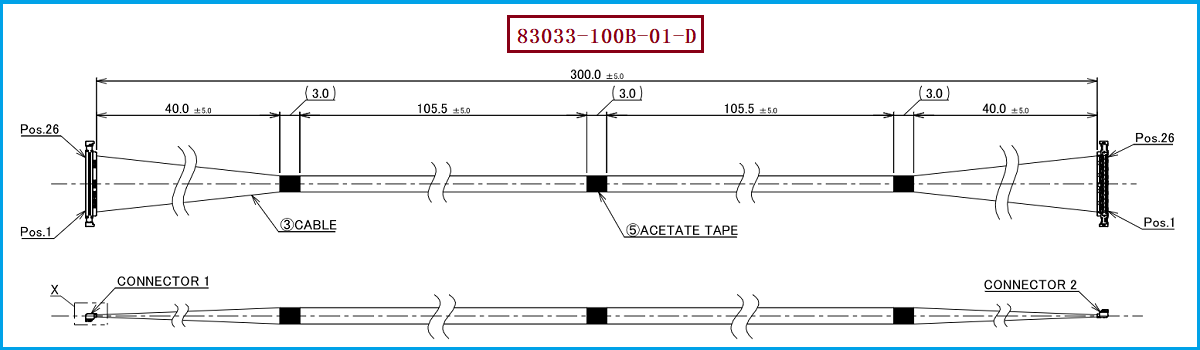
I-PEX 83033-100B-01-D belongs to a 26Pin, 300MM CABLINE®-UA II 1-1 structured cable assembly, while the official CABLINE®-UA II documentation indicates that its Micro-Coax is suitable for AWG42, AWG44, and AWG46 specifications, and provides a reference transmission capability of 5Gbps/lane NRZ. Therefore, when carrying out compatibility and replacement development, it cannot be simply understood as "the connector can be plugged in to replace". For engineers, it is necessary to simultaneously confirm the center conductor, insulating medium, shielding structure, wire diameter, characteristic impedance, insertion loss, return loss, crosstalk, and termination process; especially for 300MM cable length, in high-speed signal scenarios, the cable itself has already become part of the signal path, and impedance consistency and shielding continuity will directly affect the signal integrity of the system. The advantages of low dielectric loss materials such as PTFE are also to help cables balance electrical performance and mechanical flexibility under miniaturized conditions. For purchasers, when making supplier replacements, it is recommended to take "connector model + pin count + cable length + AWG + impedance + termination structure" as a set of complete technical conditions, rather than just comparing prices based on the original material number.
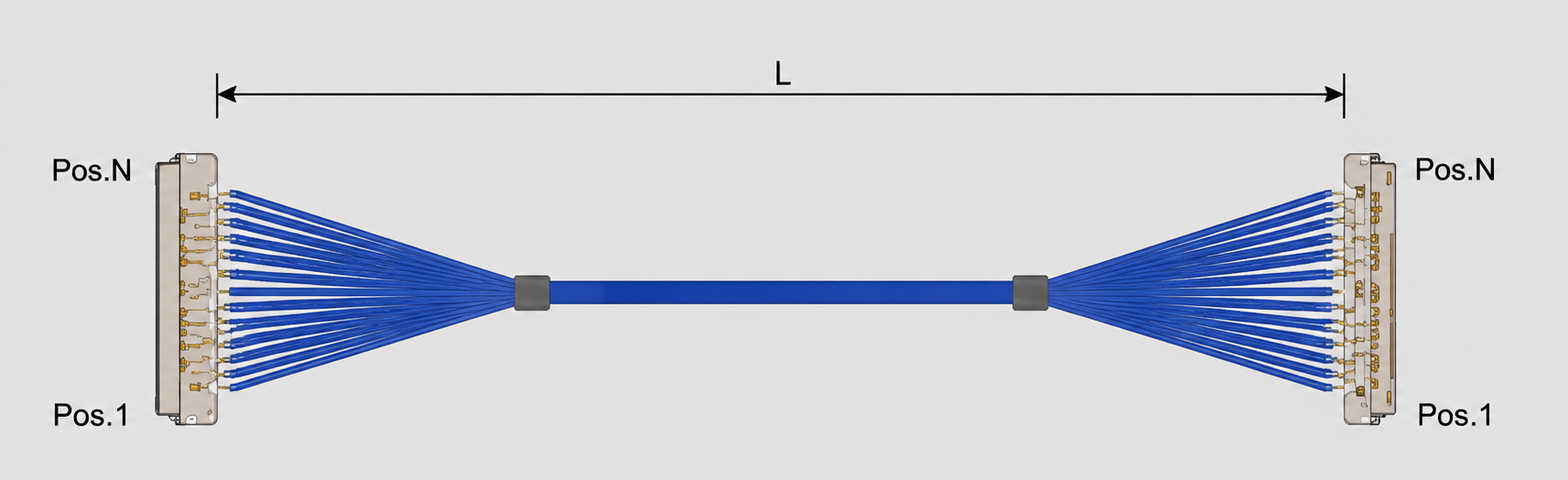
If the original equipment design uses I-PEX 83033-100B-01-D, it is recommended to first confirm the 26Pin, 300MM, 1-1 structure, and the interface relationship with the CABLINE®-UA II series. At the same time, check the matching situation of the cable end 20497-026T-30. The official I-PEX page lists the 26Pin 1-1 cable assembly models of CABLINE®-UA II, where 100mm, 200mm, and 300mm correspond to 83031, 83032, and 83033, respectively. In addition, this series of connectors uses a 0.3mm Pitch and supports AWG42/AWG44/AWG46 Micro-Coax. If domesticization, second supplier, or cost optimization alternatives are to be considered, it is recommended to maintain consistency in connector mating dimensions, Pin definition, wire length of 300MM, and termination form, and then determine AWG and impedance according to actual applications. The company can provide compatible alternative cable assembly solutions for I-PEX 83033-100B-01-D, and can develop ultra-fine coaxial cables for engineering samples, bulk procurement, and domestic substitution of equipment cables.
“Without the consent or authorization of this site, no one shall reproduce, reprint, distribute, cite, change, broadcast or publish the content in whole or in part in any form, nor shall there be any other violation of the copyright of this site.