


Categorization:Harness Component
In notebook, display module, camera equipment, VR/AR, and other small high-speed electronic devices, engineers often suspect signal attenuation in ultra-fine coaxial cables when image anomalies, unstable data transmission, increased error rates, and frequent link drops occur. In fact, signal attenuation of cables is not just a simple matter of "the thinner the wire, the more likely it is to attenuate." It is related to factors such as cable structure, length, conductor size, insulating medium, shielding structure, impedance consistency, connector termination, and high-speed signal frequency. Taking the I-PEX CABLINE®-UA II series as an example, its connectors adopt a 0.3mm Contact Pitch and Vertical Right Angle structure. The official lists 5Gbps/lane NRZ as the reference transmission capability and supports AWG42, AWG44, and AWG46 Micro-Coax. Specifically, for the I-PEX 83032-100B-01-D, it is an ultra-fine coaxial cable with a 26Pin, 44AWG, L=200mm, and 1-1 structure, with the cable ends using 20497-026T-30, compatible with AWG#44 wire. For engineers, when signal attenuation is severe in the actual system, they should first confirm that the cable length, AWG, impedance, termination quality, and system operating rate are consistent with the original design requirements, rather than simply replacing with thicker cables.
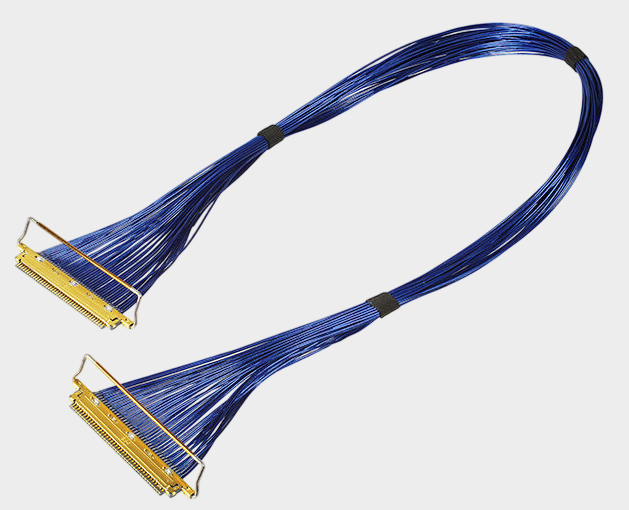
Extremely thin coaxial cable bundles can achieve high-density and high-speed signal connections within limited spaces, but as the transmission frequency increases, conductor loss, dielectric loss, and insertion loss caused by connectors and termination structures become more pronounced. For 26P, 44AWG Micro-Coax cable bundles like 83032-100B-01-D with a length of 200mm, the transmission characteristics of the cable itself must match the connectors and the system's high-speed channels. If the actual length of the cable bundle is further increased, or if the cable structure, outer diameter, shielding, and impedance control change, greater insertion loss and signal integrity risks may arise. At the same time, extremely thin coaxial cable bundles often pass through bends, rotating axes, or narrow channels within the device, and if the bend radius is too small or the cable is locally compressed, it may also alter the cable's electrical characteristics. Therefore, in response to the question "What to do when the signal attenuation of extremely thin coaxial cable bundles is severe?" engineers need to analyze the cable specification, cable bundle length, bend status, connector termination, and PCB high-speed routing as a complete signal channel, rather than just looking at a single parameter. I-PEX officially also emphasizes that the CABLINE®-UA II miniaturized Plug can be used to pass through rotating axes, and demonstrates application examples of 26Pin cable bundles passing through Φ2.65mm inner hole rotating axes or hoses.
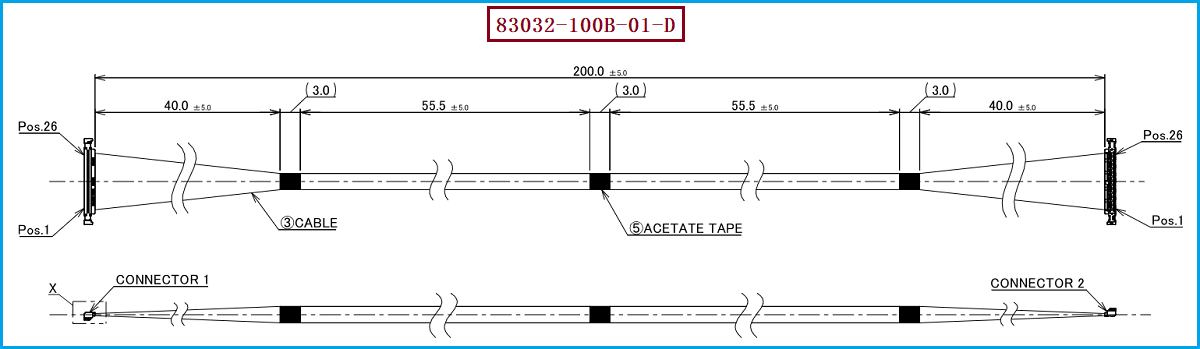
From the perspective of alternative harness development, maintaining the key structural parameters of the original model is an important foundation for reducing the risk of signal performance variation. The I-PEX 83032-100B-01-D corresponds to 26Pin, 44AWG Micro-Coax, 200mm, 1-1 structure, and the matching harness end connector is 20497-026T-30. The official I-PEX CABLINE®-UA II documentation explicitly lists 20497-026T-30 as a 26Pin Plug Housing, supporting series for AWG42/AWG44/AWG46 Micro-Coax. Therefore, when carrying out compatibility replacement, it is advisable to maintain consistency in 26Pin, 0.3mm Contact Pitch, AWG#44, 200mm length, and the end termination structure. At the same time, verify the conductor, insulation layer, shielding layer, outer diameter, and high-speed transmission characteristics of the alternative wire material. If the customer's original system has passed the SI test, the alternative harness should also pay further attention to insertion loss, return loss, crosstalk, and other indicators. Confirm the signal quality of the alternative solution at the target rate through sample testing, rather than solely judging whether it can be replaced based on appearance size or connector model.
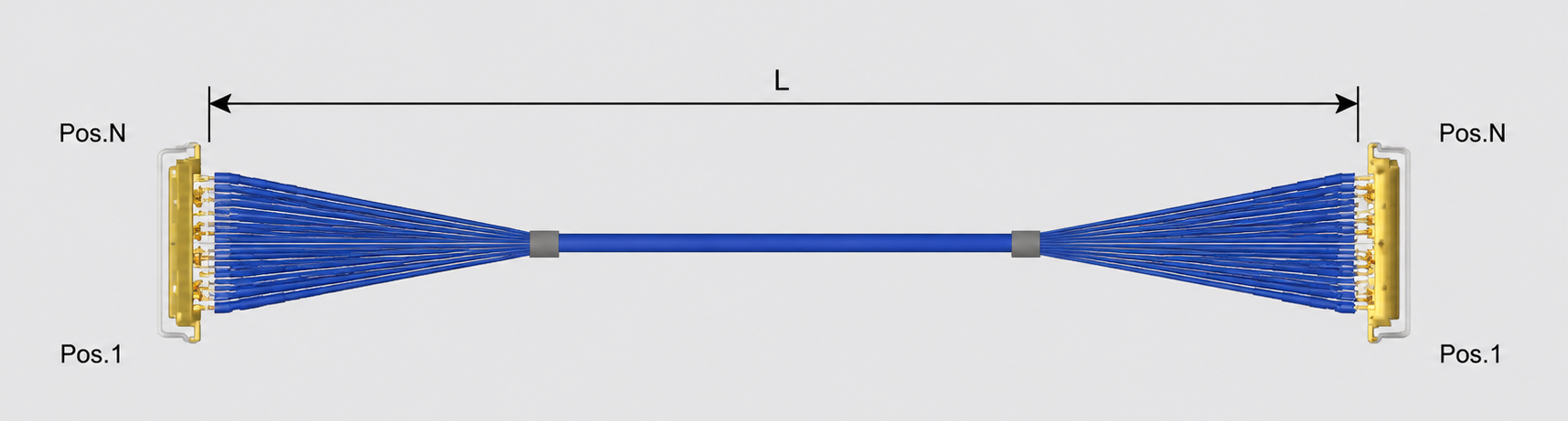
For purchasers and engineers, if there are changes in delivery, cost, or supply channel requirements for the existing 83032-100B-01-D, alternative selection can be made according to the logic of "Connector series—Pin number—AWG—length—termination structure—application rate". In the CABLINE®-UA II official samples, there are also 26Pin, 44AWG, 1-1 structures such as 83031-100B-01-D (100mm) and 83033-100B-01-D (300mm), while the 83032-100B-01-D is the middle 200mm specification, so it cannot be replaced directly based on "same as 26Pin". It is necessary to further check the length and cable structure. If it is necessary to develop compatible alternative products, it should also be confirmed that the Receptacle on the customer's PCB, actual installation space, bending path, and high-speed signal requirements correspond. Our company can provide: I-PEX 83032-100B-01-D compatible alternative cable solution, which can be developed for extremely fine coaxial cable matching around key conditions such as 20497-026T-30, 26Pin, AWG#44, 200mm, 1-1, and provide alternative solution references for engineering verification, sample production, and bulk procurement.
“Without the consent or authorization of this site, no one shall reproduce, reprint, distribute, cite, change, broadcast or publish the content in whole or in part in any form, nor shall there be any other violation of the copyright of this site.