


Categorization:Harness Component
As module devices gradually transition from ordinary low-speed signals to high-speed, high-frequency transmission, the problems engineers face are no longer just whether "the wire can transmit the signal." Instead, it is whether the signal can reach the receiving end with stability and a complete waveform. When high-speed signals propagate along the transmission line, if there is a significant change in the characteristic impedance along the transmission path, signal reflection will occur; and when the reflection is added to the original signal, it may cause waveform distortion, overshoot, ringing, and a decrease in eye diagram margin. In severe cases, it may even affect the system's error rate. The value of extremely thin coaxial cables lies in their relatively stable coaxial structure, which forms a controlled transmission environment between the signal conductor and the reference shielding structure, thereby helping engineers reduce the risk of reflection caused by impedance discontinuity. The I-PEX CABLINE®-CA is a 0.4mm Pitch horizontal mount ultra-thin coaxial cable connector platform designed for high-speed, miniaturized connections. The official high-speed transmission reference capability is 32 Gbps/Lane PAM4, and corresponding signal integrity test data is provided.
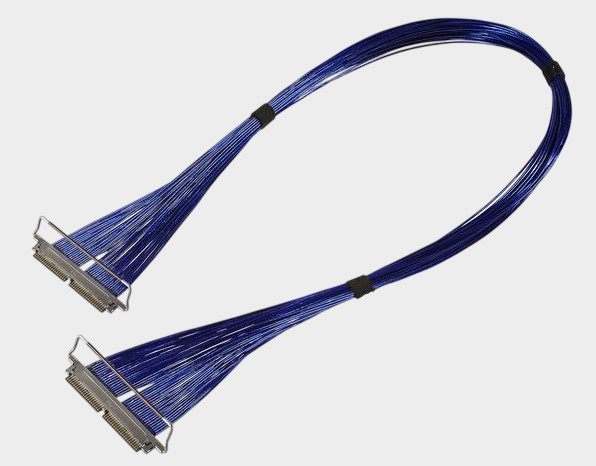
From the perspective of engineering design, solving high-frequency signal reflection cannot be simply achieved by "making the wire thinner." The key is to ensure that the high-speed transmission paths between the wire, the termination area, the connector, and the PCB are as impedance continuous as possible. The internal signal conductor, insulating medium, and shielding layer of the extremely thin coaxial cable form the transmission structure. When the manufacturing parameters such as conductor size, medium material, and shielding structure are stable, the characteristic impedance can be maintained near the target range; however, when the cable enters the connector end, it is necessary to minimize the impedance突变 caused by structural changes. Therefore, for engineers, evaluating an extremely thin coaxial cable assembly cannot only focus on AWG and outer diameter but also pay attention to impedance consistency, termination technology, and connector matching. Taking I-PEX 82866-100B-02-D as an example, this model is a CABLINE-CA 60Pin extremely thin coaxial cable assembly, using a 40AWG Micro-Coaxial Cable, with a length of 300mm, and wire position defined as 1-N, corresponding to the cable end connector body as 20634-160T-02. The stable manufacturing of such high-density cable assemblies essentially requires transmission consistency for each high-speed signal channel.
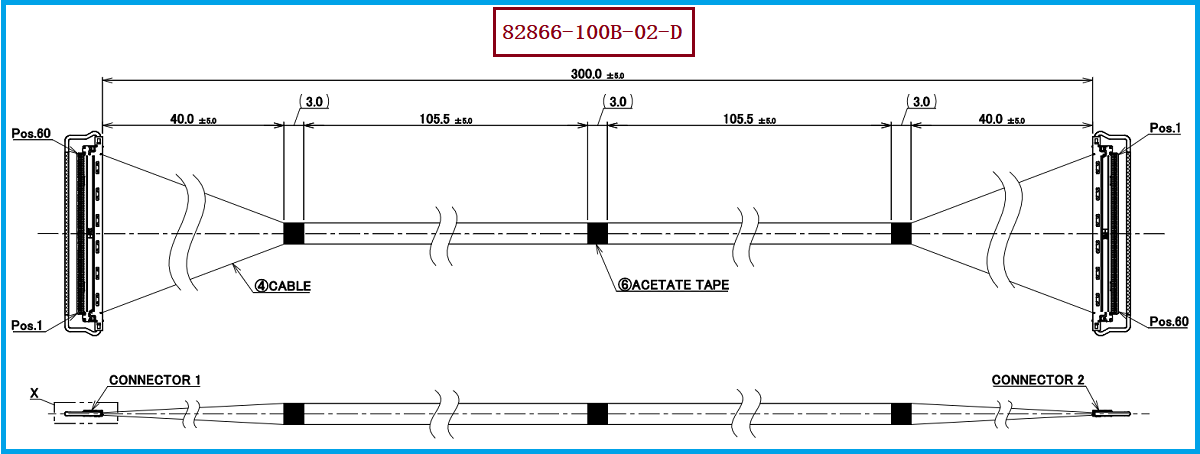
In terms of specific products, the I-PEX 82866-100B-02-D belongs to the CABLINE®-CA 60Pin Harness, corresponding to "60pin, Micro-Coaxial, 40AWG, L=300mm, 1-N" in the I-PEX official model information. The same series includes the 60Pin, 100mm 82865-100B-02-D and the 200mm 82146-100B-02-D, which can be selected according to the different internal spaces of different devices. The 20634-160T-02 is the CABLINE-CA 60Pin Plug Housing, with the matching PCB end Receptacle being 20525-060E-02. For engineers, this means that the replacement harness must simultaneously ensure the Pin number, wire length, wire diameter, pin definition, connector structure, and high-speed signal performance; especially for this model, which uses the 1-N pin definition, it cannot be replaced simply by following the 1-1 sequence. For purchasers, these parameters should be regarded as complete procurement specifications, rather than merely using "60Pin ultra-thin coaxial wire" as the procurement condition, otherwise, even if the connector can be mechanically inserted, it may result in mismatches in wire sequence or electrical performance.
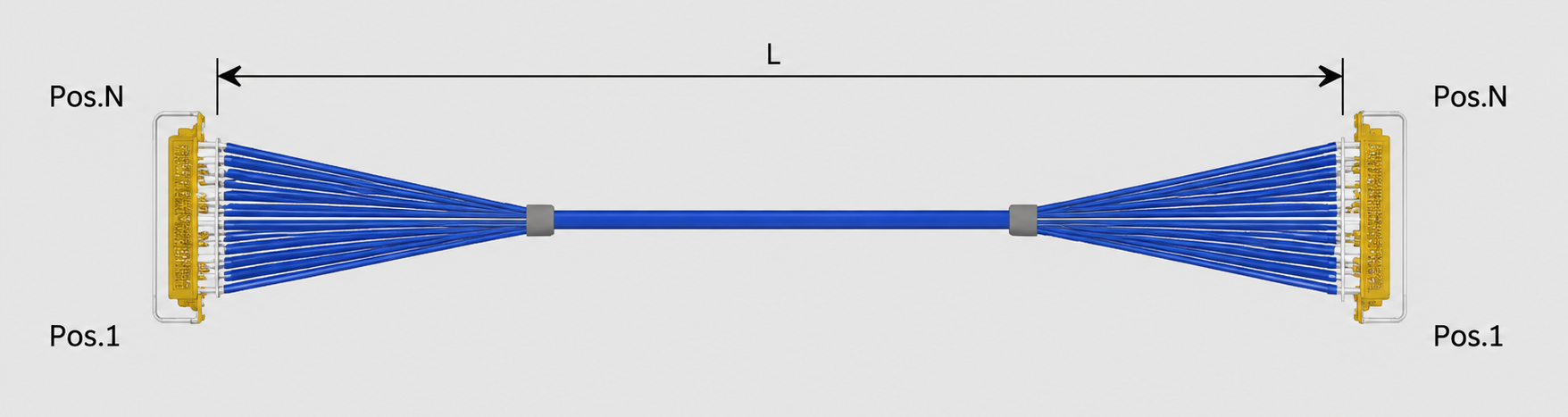
If the customer's existing equipment uses I-PEX 82866-100B-02-D, when considering domestic substitution or the development of a second supplier, it is recommended to prioritize selection based on the思路 of "complete harness structure compatibility + high-speed signal performance verification." On the mechanical level, it is necessary to confirm the 60Pin, 0.4mm Pitch connector system, 300mm length, cable exit direction, end size, and installation space; on the electrical level, it is necessary to focus on verifying the impedance consistency of the 40AWG Micro-Coaxial Cable, the quality of the connector termination, and the actual link parameters such as insertion loss, return loss, and crosstalk; in terms of wire sequence, the 1-N definition must be maintained. The official I-PEX CABLINE-CA platform offers 10, 12, 20, 30, 40, 50, and 60Pin specifications, supports AWG36, 38, 40, 42, and 44 Micro-Coaxial Cable, and officially provides the 60Pin 82866-100B-02-D evaluation harness model. Our company can provide: I-PEX 82866-100B-02-D compatible replacement harness solutions, which can match the customer's original harness specifications, including extremely thin coaxial cable, connector termination, 300mm length, 1-N wire position definition, and structural dimensions, and cooperate with sample verification to help customers advance domestic substitution, supply chain optimization, and bulk procurement.
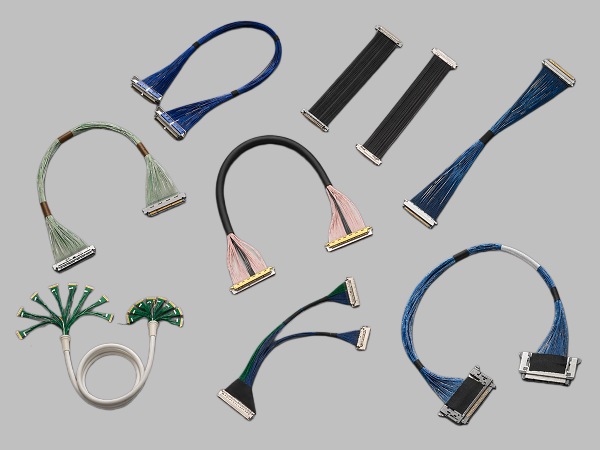
High-frequency signal reflection control ultimately tests the manufacturing capability of an entire bundle of extremely thin coaxial cables.
Extremely thin coaxial cables can help high-speed systems reduce the risk of signal reflection. The core is not that "the thinner the wire diameter, the better," but rather, by utilizing controlled coaxial structures, stable material dimensions, and reliable termination processes, to establish a more continuous and stable transmission path for high-speed signals. For products like the I-PEX 82866-100B-02-D, which are 60Pin, 40AWG, 300mm, and 1-N ultra-thin coaxial cable assemblies, engineers truly need to focus on the complete high-speed chain from the wire material to the termination, connector, and PCB. Purchasers, on the other hand, need to pay attention to specification consistency, compatibility verification, and mass production stability. We continue to focus on the research and development of domestic alternatives for ultra-thin coaxial cable assemblies and the development of market application solutions. If you are looking for a compatible alternative to the I-PEX 82866-100B-02-D or have procurement needs for ultra-thin coaxial cable assemblies with 60Pin, 40AWG, 1-N, etc., I am【3W Electronic Components Network】We specialize in providing custom and compatible replacement services for high-speed ultra-thin coaxial cables such as eDP, MIPI, USB3.X/4, LVDS, etc. If you need technical support, please contact us:Manager Zhang
18913228573 (WeChat same number)The I-PEX CABLINE®-CA uses a 0.4mm pitch and a horizontal insert structure, and provides a mechanical lock; its official materials also list the 60Pin 82866-100B-02-D as a 300mm 1-N evaluation cable model. Therefore, in high-speed display, camera, machine vision, AI vision, and other high-density electronic device internal connections, impedance continuity and signal integrity have become crucial core indicators that cannot be ignored in the selection of ultra-thin coaxial cable assemblies.
“Without the consent or authorization of this site, no one shall reproduce, reprint, distribute, cite, change, broadcast or publish the content in whole or in part in any form, nor shall there be any other violation of the copyright of this site.