


Categorization:Harness Component
As PCIe Gen5, USB4, Thunderbolt 5, DisplayPort UHBR20, and other high-speed interfaces continue to boost transmission speeds, the internal interconnection of electronic devices is no longer just about "transmitting the signal," but also requires solving engineering problems such as impedance control, crosstalk, EMI, electromagnetic compatibility, space occupancy, and connection reliability. The I-PEX CABLINE®-VS II series adopts a 0.5mm pitch, horizontal insertion and removal, and ZenShield® full shielding structure, taking PCIe Gen5 32 GT/s/lane as the high-speed transmission reference. The official materials also list high-speed applications such as USB4 Gen4, Thunderbolt 5, and DisplayPort UHBR20. For engineers, this means that the value of extremely thin coaxial cables is not diminished by the increase in transmission speed, but rather becomes more prominent in high-density, high-speed, and low space margin internal interconnection of devices; for purchasers, choosing a supplier of extremely thin coaxial cable bundles that can stably achieve high-speed signal integrity and batch consistency is also becoming a more important procurement indicator than simply comparing unit prices.
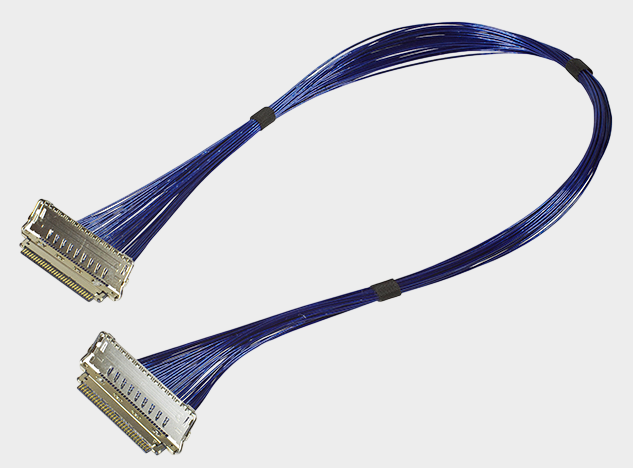
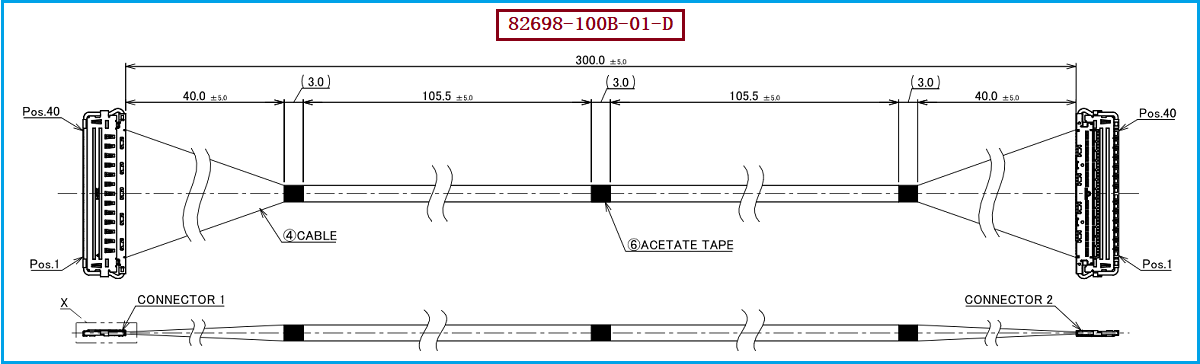
This recommended alternative product corresponds to I-PEX 82698-100B-01-D, belonging to the CABLINE®-VS II 40P, Micro-Coaxial 40AWG, 1-1 structure 300mm cable assembly solution. According to the aforementioned engineering drawings, this model uses 40 AWG #40, 50Ω ultra-fine coaxial cables, with a 1:1 matching method at both ends; the connector used with the cable ends is 20847-040T-01. From the product structure, the 40P signal channels are concentrated in a high-density connector with a 0.5mm pitch, which is conducive to compressing the internal space of the equipment and suitable for high-speed signal wiring. It needs to be specially pointed out that the official I-PEX CABLINE®-VS II high-speed test data uses AWG #40, 45Ω, 100mm cables, and provides a reference test result of 32 GT/s/lane NRZ; this belongs to the official test conditions and cannot be directly equivalent to the 50Ω cable parameters explicitly marked in the 82698-100B-01-D engineering drawings. Therefore, when conducting alternative design, sampling, and procurement, the final determination should be based on the specific project requirements for impedance, cable length, Pin Mapping, and the whole machine SI verification results.
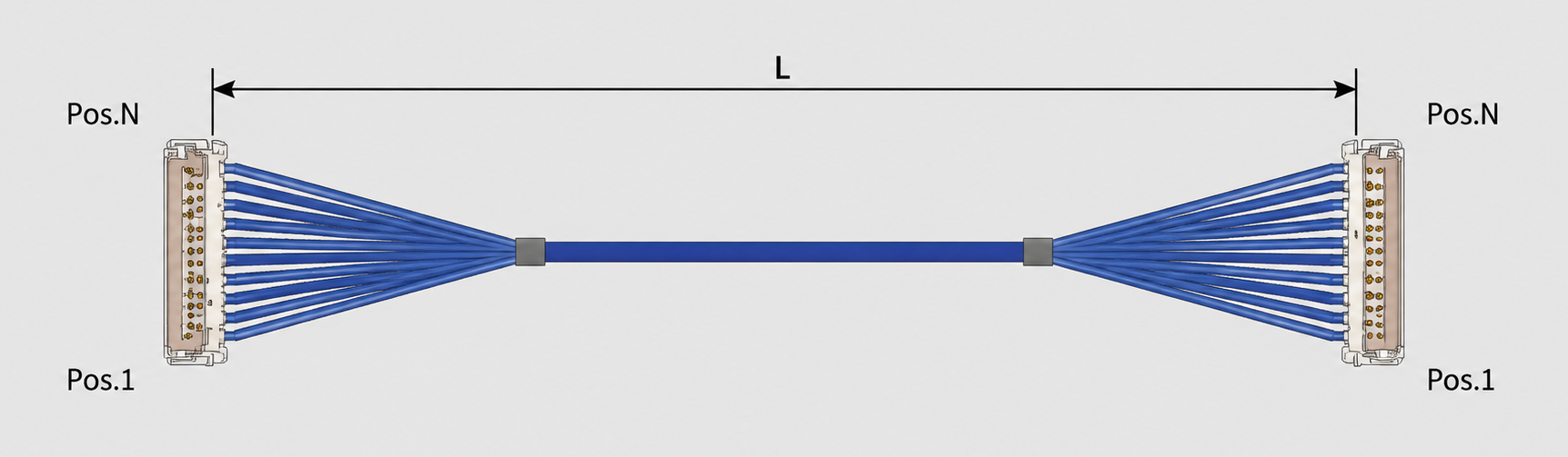
From the perspective of market technical trends, it is more appropriate to say that ultra-fine coaxial cables will continue to maintain significant competitiveness in the field of high-density, high-speed, and short-distance internal interconnections for devices, rather than simply judging whether they will dominate all high-speed transmission markets. The reason is that with the increase in data rates, signal integrity issues are increasingly difficult to solve simply through ordinary multi-core wires, and the ultra-fine coaxial structure can provide clearer electromagnetic transmission boundaries around single-channel signals. At the same time, connectors must also address EMI and mechanical reliability issues. The ZenShield® full shielding, multi-point grounding, and mechanical locking design of CABLINE®-VS II is an overall connection solution formed in response to such needs. Of course, in the future, high-speed interconnections will not be limited to only one technological route; board-to-board connectors, FPC, Twinax, optical interconnects, and other high-speed cable solutions will compete under different conditions of distance, speed, and cost. Therefore, for engineers, the true advantage of ultra-fine coaxial cables is not "to replace all solutions forever," but to achieve a better overall balance between high bandwidth, fine diameter, high density, and EMI control in notebook computers, display devices, high-performance computing equipment, camera modules, and other space-limited devices.
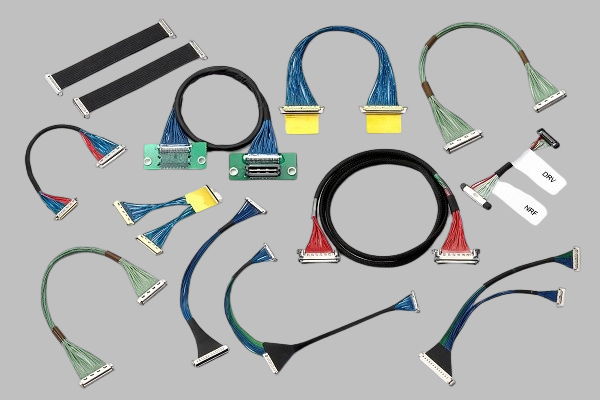
If the project's original design refers to the I-PEX CABLINE®-VS II 40P scheme, it is recommended that engineers and purchasing personnel first verify the 40P connector system, AWG #40 wire, cable length, 50Ω impedance, 1:1 Pin Mapping, termination structure, and mechanical dimensions, and then conduct sample verification, rather than simply judging compatibility based on "40Pin+300mm". I-PEX official data indicates that CABLINE®-VS II provides 20P, 30P, and 40P versions, supports AWG36~AWG44 Micro-Coaxial Cable, and uses a 0.5mm Pitch horizontal insertion and removal structure; among them, the connector current capacity for AWG #40 is 0.3A/contact. For purchasing personnel, if they wish to reduce dependence on a single original manufacturer's part number, they can use I-PEX 82698-100B-01-D as a specification benchmark and compare it item by item with alternative suppliers in terms of connector matching, wire specifications, impedance, termination quality, dimensional tolerance, electrical testing, and high-speed SI performance. Our company can provide: I-PEX 82698-100B-01-D compatible alternative cable assembly solutions, which can produce extremely fine coaxial cables according to the actual equipment structure, cable length, Pin count, wire specifications, and connector requirements, providing engineers with alternative choices for sample development, specification confirmation, and mass production.
“Without the consent or authorization of this site, no one shall reproduce, reprint, distribute, cite, change, broadcast or publish the content in whole or in part in any form, nor shall there be any other violation of the copyright of this site.