


Categorization:Harness Component
With the development of 8K displays, ultra-high-definition cameras, professional visual equipment, and high-performance computing platforms, image transmission has gradually shifted from "whether it can be transmitted" to "whether it can be transmitted stably, quickly, and with low loss." 8K images contain more pixels and larger data volumes than traditional high-definition images, thus placing higher requirements on the high-speed performance of connectors, cables, PCB routing, and the entire signal chain. In the case of increasingly compact internal spaces, extremely thin coaxial cables can utilize the coaxial transmission structure to integrate signal conductors, insulating media, and shielding structures into very small cables. While meeting high-density wiring requirements, they provide a relatively stable transmission channel for high-speed signals. Taking the I-PEX 82697-100B-01-D introduced this time as an example, this product belongs to the CABLINE®-VS II series 40P extremely thin coaxial cable assembly, using 40AWG Micro-Coaxial Cable, 200mm in length, and a 1-1 structure. The connector model used at the cable end is 20847-040T-01, which is compatible with AWG #40 wire. For engineers, the core value of such solutions is not simply to pursue "the thinner the wire diameter, the better," but to achieve a balance between miniaturization, high density, and high-speed signal transmission.
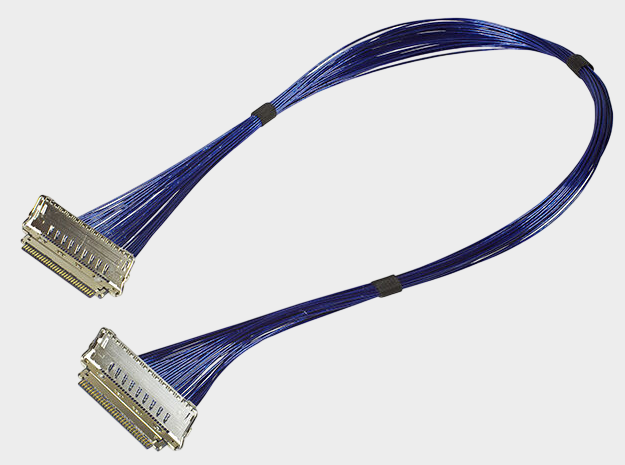
So-called ultra-thin coaxial cables support 8K image transmission, but it does not mean that "40AWG wire naturally equals 8K high-speed wire". Instead, it requires the joint implementation of wire structure, impedance control, shielding design, connector performance, and the overall system's signal integrity design. The central conductor of the ultra-thin coaxial cable is responsible for transmitting high-speed electrical signals, the outer insulation layer provides electrical isolation, and the shielding structure helps to reduce external electromagnetic interference and crosstalk between adjacent high-speed channels; when multiple ultra-thin coaxial cables are arranged closely together, this independent signal transmission structure is of great importance for maintaining the stability of the high-speed link. For the 40AWG solution adopted by I-PEX 82697-100B-01-D, its配套's 20847-040T-01 connector belongs to the CABLINE®-VS II 40P platform, which adopts a 0.5mm Pitch high-density structure and is combined with ZenShield® full shielding design, providing a more suitable EMI/EMC environment for high-speed signal connections. It is particularly important to note that 8K is not solely determined by the cable model. Whether it can stably realize 8K image transmission actually requires verification by combining specific transmission protocols, data rates, cable length, impedance, connectors, PCB layout, as well as the SI design of the transmitting and receiving ends. Therefore, when engineers are selecting 8K applications, they should pay more attention to indicators such as Insertion Loss, Return Loss, Crosstalk, impedance continuity, and actual eye diagrams.
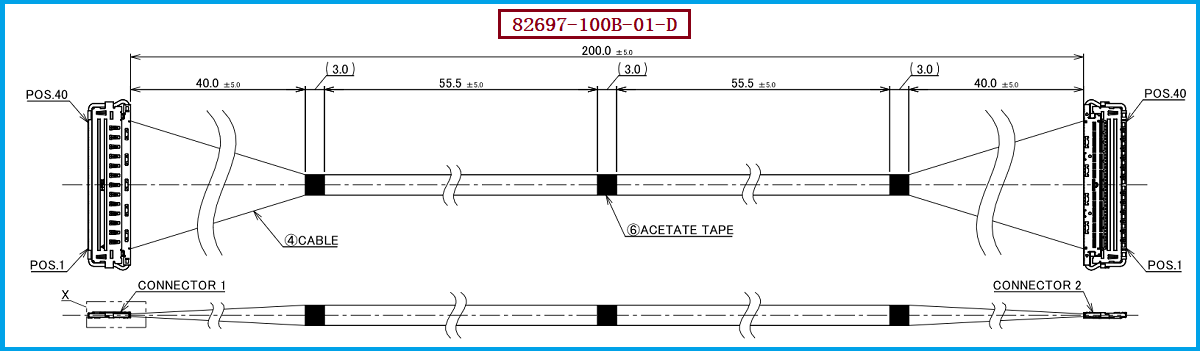
For engineers, when looking for a super-fine coaxial cable assembly that matches I-PEX 82697-100B-01-D, it is recommended to first confirm the basic conditions such as 40P, 40AWG, 200mm, 1-1 structure, and the 20847-040T-01 cable end connector, and then confirm the protocol, bandwidth, impedance, and high-speed SI specifications according to the actual 8K image transmission scheme; especially when the cable assembly needs to pass through bends, narrow space wiring, or be close to other high-speed signal lines, attention should also be paid to shielding continuity, crosstalk, and mechanical reliability. For purchasers, it is not enough to compare prices based on specifications such as "40P, 40AWG, 200mm", because the stability of high-speed cable assembly applications is truly affected by factors such as connector termination quality, wire material consistency, shielding treatment, impedance control, and mass production stability. Based on the production and manufacturing capabilities of super-fine coaxial cable assemblies, our company can provide: I-PEX 82697-100B-01-D compatible and alternative cable assembly solutions, which can be developed and produced around key specifications such as 40P, 40AWG, 200mm, 1-1 structure, and 20847-040T-01 connector, providing engineers with a high-speed signal cable assembly alternative solution, and at the same time helping purchasers to expand a stable supply channel for super-fine coaxial cable assemblies.
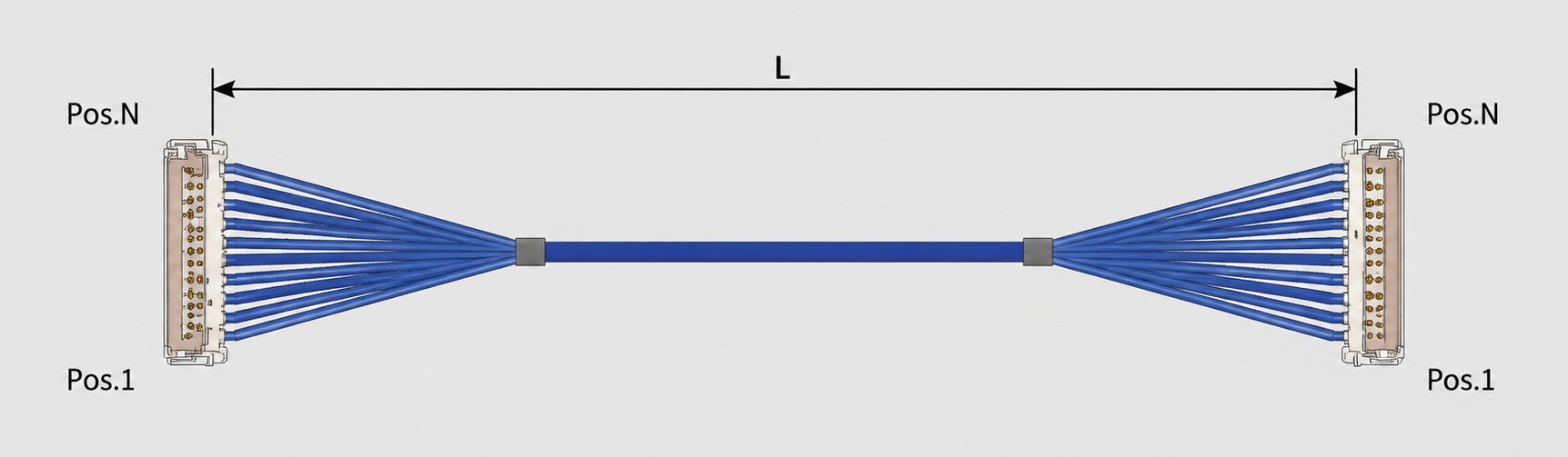
For the compatibility and alternative options of I-PEX 82697-100B-01-D, it is recommended to conduct a comprehensive verification based on the original product, focusing on aspects such as "mechanical compatibility, electrical compatibility, high-speed performance, reliability, and batch consistency." In terms of mechanics, it is necessary to confirm the mating relationship of the 40P connector, 0.5mm pitch, cable length, and wire exit structure; for cables, it is necessary to confirm the AWG #40 Micro-Coaxial Cable and shielding structure; and in terms of electricity, it is necessary to verify impedance, insertion loss, return loss, and crosstalk according to the specific protocol and rate used for 8K image transmission. For procurement personnel, if a domestic alternative solution is adopted, it is recommended to first conduct actual equipment testing with samples, then proceed to small batch verification and mass importation, rather than directly determining "complete compatibility" based solely on appearance, pin count, or whether the connector can be inserted. Our company can provide ultra-thin coaxial cable compatibility alternative manufacturing services for I-PEX 82697-100B-01-D and develop matching for wire length, wire sequence, structure, and related performance according to customer project requirements.
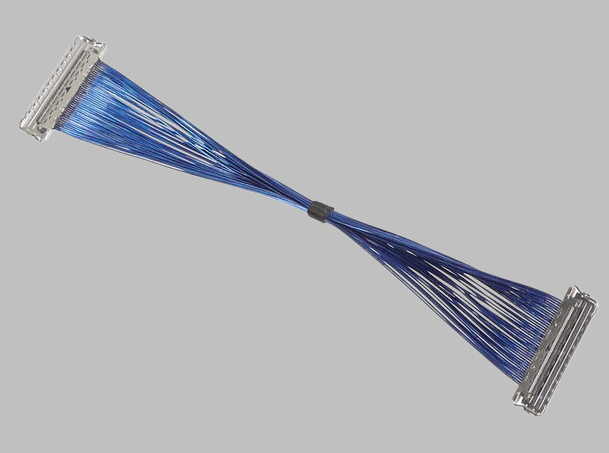
“Without the consent or authorization of this site, no one shall reproduce, reprint, distribute, cite, change, broadcast or publish the content in whole or in part in any form, nor shall there be any other violation of the copyright of this site.