


Categorization:Product Information
Today, with the continuous development of electronic products towards miniaturization, high integration, and high speed, the internal connection scheme is becoming increasingly important. Many products, in the initial design stage, often prioritize connector models, cable costs, and installation space, but easily ignore a question: Can the existing internal wiring connection methods really meet the future performance requirements of the product?
Especially in laptops, industrial cameras, machine vision equipment, medical electronics, intelligent terminals, and various high-speed electronic devices, the internal high-speed signal transmission puts higher requirements on the connection components. Although traditional connection methods can meet some basic applications, it is necessary to re-examine the original cable design solutions when devices face challenges such as space compression, signal rate improvement, and electromagnetic interference control.
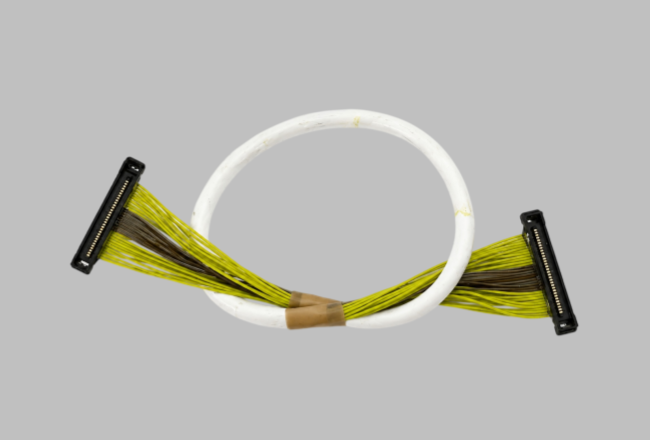
One, the internal connection scheme cannot only be considered in terms of whether it can be connected.
A suitable internal harness scheme not only needs to achieve electrical connections but also needs to comprehensively consider signal integrity, transmission stability, structural space, bending paths, and long-term reliability.
With the extensive application of high-speed cameras, display modules, image processing units, and high-speed data interfaces in electronic devices, internal signal transmission has gradually shifted from ordinary connections to high-speed differential signal transmission. At this point, if the cable structure, impedance control, shielding design, or connector matching is not reasonable enough, it may lead to problems such as signal attenuation, crosstalk, EMI interference, and decreased transmission stability.
Therefore, when determining whether a wiring harness connection scheme is suitable, it cannot be solely based on whether it can operate normally at present, but also on whether it can meet the performance requirements after the product upgrade.
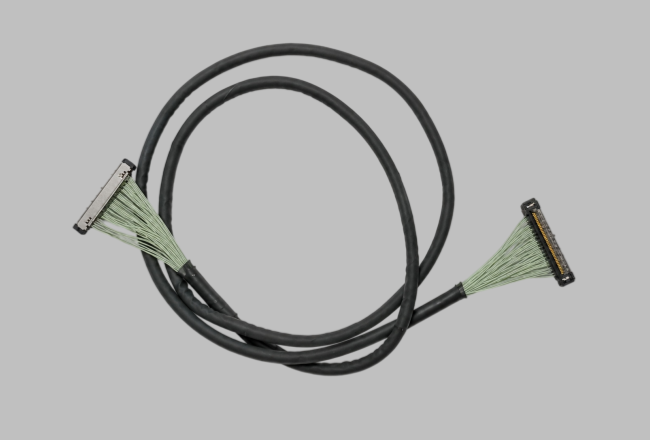
Why are more and more products starting to pay attention to ultra-fine coaxial cables?
A very fine coaxial cable assembly is a precision cable component designed for high-speed signal transmission within electronic devices. It is usually composed of multiple micro coaxial cables combined with precision connectors, enabling multi-channel signal connections within a limited space.
Compared with ordinary wire harnesses or some traditional cable schemes, ultra-thin coaxial cable assemblies have better high-frequency transmission characteristics, independent shielding ability, and wiring flexibility. Under reasonable cable, connector, and structural design, they can help products achieve a more compact internal layout while meeting the design requirements for high-speed signal transmission and electromagnetic compatibility.
For industrial cameras and machine vision equipment, extremely thin coaxial cables can be used to connect image sensors to the main control board; in laptops and display devices, they can be used for internal high-speed signal connections such as cameras and display modules; in medical electronics and precision instruments, they can also provide connection solutions for high-speed data transmission in space-limited environments.
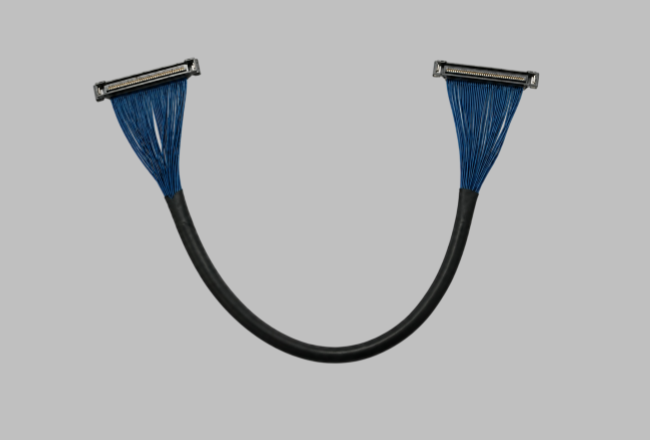
Three, when re-evaluating the harness scheme, what aspects should be focused on?
If you hope to find a more suitable internal connection scheme, you can evaluate from the following aspects:
● Signal transmission capability: According to the actual signal rate, transmission distance, and impedance requirements, choose a suitable cable structure, and pay attention to insertion loss, return loss, and crosstalk performance.
●Space Adaptability: Combine the internal structure of the device, connector spacing, cable diameter, and routing path to determine if a more compact layout can be achieved.
●EMI shielding capability: According to the product's working environment and signal characteristics, evaluate the cable shielding, grounding, and connector shielding structure to reduce the risk of electromagnetic interference.
● Mechanical reliability: Consider factors such as harness bending radius, movable area, insertion and extraction times, fixing methods, and assembly processes to avoid issues such as unstable connections during long-term use.
●Cost and Supply Chain: In addition to the initial procurement price, factors such as processing difficulty, product yield, delivery cycle, follow-up maintenance, and alternative supply capability should also be considered.
These factors are interrelated and cannot be pursued individually for any single indicator. A truly appropriate solution should achieve a reasonable balance between electrical performance, mechanical structure, production process, and overall cost.
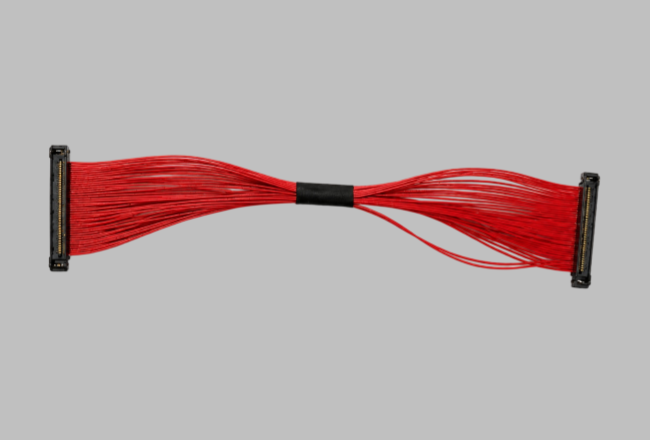
Four, rethink the overall solution from connectors to harness components
Sometimes, poor internal connection of a product may not necessarily be due to the cable itself, but may also be related to the selection of connectors, termination technology, wire sequence definition, shielding treatment, or overall structural design.
Therefore, when optimizing the scheme, it is recommended to evaluate the connector and the extremely thin coaxial cable bundle as a complete connection system, rather than simply replacing a single cable or a specific connector model.
For products that have already entered the mass production stage, it does not necessarily mean that the original design must be overthrown. By analyzing the existing wire harness models, connector specifications, wire sequence definitions, wire length, wire diameter, and actual usage environment, it is possible to find alternatives that are compatible, structural optimizations, or customized development. On the basis of maintaining the original interfaces and installation methods as much as possible, more options can be provided for the product. The best internal wire harness connection solution is not the cheapest or the one with the highest specifications, but the one that truly meets the product's performance, spatial layout, reliability, and cost requirements.
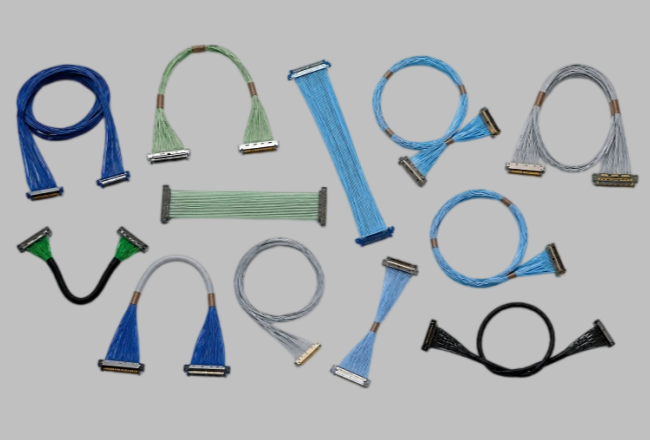
With the development of electronic devices towards high speed, lightweight, and high-density, ultra-fine coaxial cable bundles are increasingly becoming an important choice for high-speed internal connection design. Early evaluation of the connection scheme not only helps to improve the quality of product design but also creates more room for subsequent product upgrades and supply chain optimization.
In high-speed internal connection applications, product development, compatibility replacement, customization processing, and application scheme support are mainly focused on ultra-fine coaxial cable assemblies and their配套 connectors. In conjunction with the existing product structure, signal transmission requirements, and assembly conditions of customers, we assist in evaluating the feasibility of cable selection and connection schemes, providing corresponding engineering support for product design optimization, domestic replacement, and stable mass production.
“Without the consent or authorization of this site, no one shall reproduce, reprint, distribute, cite, change, broadcast or publish the content in whole or in part in any form, nor shall there be any other violation of the copyright of this site.