


Categorization:Harness Component
In display equipment, industrial cameras, machine vision, and high-speed data transmission equipment, engineers often encounter the concepts of "ultra-fine coaxial cable束" and "LVDS line." In fact, the two are not simply an either/or relationship: LVDS primarily describes a low-voltage differential signal transmission technology, while ultra-fine coaxial cable束 mainly describes a cable and cable束 structure. LVDS signals can be fully connected through ultra-fine coaxial cables that are suitable for high-speed differential transmission, so it cannot be simply understood that "ultra-fine coaxial cable" and "LVDS line" are two mutually exclusive products. Taking the I-PEX 82882-100B-02-D corresponding to this article as an example, it belongs to the CABLINE®-SS 14Pin ultra-fine coaxial cable束, using 14Pin, 0.4mm Pitch, AWG#40 Micro-Coaxial Cable, 300±5mm, 1-N wire sequence, and the wire material connector model is 20373-R14T-06. I-PEX official data shows that CABLINE®-SS supports AWG36, AWG38, AWG40, and AWG42 Micro-Coaxial Cable specifications, and 20373-R14T-06 belongs to the 14Pin Plug Housing and supports AWG40 Micro-Coaxial Cable.
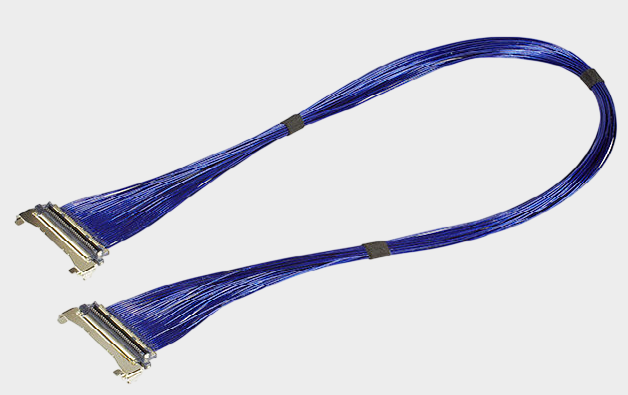
LVDS relies essentially on differential signal transmission, which transmits information through the voltage difference between two signal lines, and therefore LVDS systems themselves have good common-mode noise suppression capability. However, in actual equipment, the signal lines are still subject to electromagnetic interference generated by power supply, DC-DC, motors, wireless modules, and other high-speed digital lines. Very fine coaxial cables increase shielding at the physical cable structure level, with each coaxial cable typically consisting of a central conductor, insulation layer, and outer shielding layer, making the signal transmission path more clear and helping to reduce the coupling of external electromagnetic fields to the signal lines. Therefore, in devices with limited space and dense high-speed signals, engineers often choose Micro-Coaxial Cable based on system requirements for EMI, impedance, crosstalk, and mechanical layout rather than simply determining the material based on the word "LVDS". CABLINE®-SS itself adopts a 0.4mm ultra-fine spacing, vertical right-angle insertion and extraction, and horizontal outgoing line structure, and improves contact reliability through W-Point dual-contact design; I-PEX also showcased high-speed transmission test conditions for this series, such as the application verification of 16Gbps/Lane for a 40Pin, AWG#40, 45Ω, 100mm Micro-Coaxial Cable.
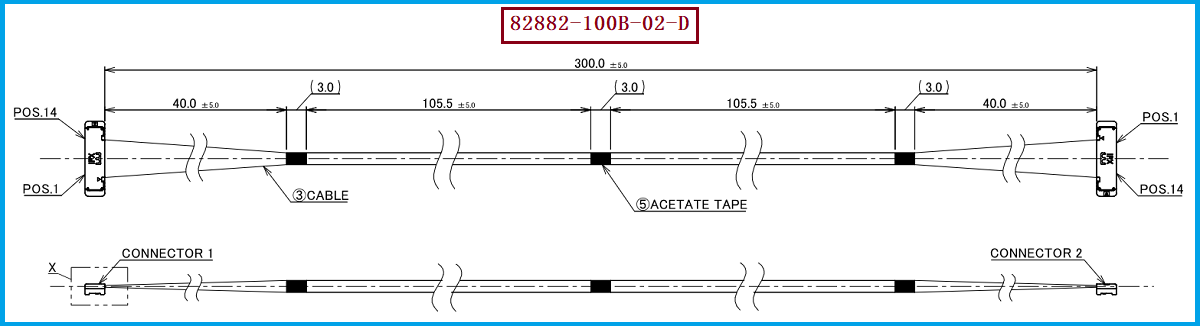
For engineers, what truly needs to be judged is whether "signal type + transmission rate + impedance + line length + space + EMI requirements" match, rather than simply determining "which type of wire LVDS should use." For example, in display modules or industrial vision equipment, if differential signals need to be transmitted over a longer distance and there are many interference sources inside the equipment, the characteristic impedance control of the wire material, internal crosstalk, external radiation, and shielding grounding will all affect the final signal integrity. Extremely thin coaxial cables can provide a relatively clear transmission environment for each signal through an independent shielding structure, making them particularly suitable for high-density, high-speed, and space-limited internal connections. For I-PEX 82882-100B-02-D, the PDF drawing explicitly specifies it as a 14-core AWG#40, 50Ω Micro-Coaxial Cable, with a length of 300±5mm, using a 1-N wire sequence. Therefore, when carrying out alternative development, it should be prioritized to confirm the 50Ω specification according to the original drawing, rather than directly applying the 45Ω parameters from a specific high-speed test condition of CABLINE®-SS. The I-PEX official page also clearly lists the 82882 as 14Pin, 300mm, 1-N, distinguishing it from the 14Pin, 300mm, 1-1 of 83012.
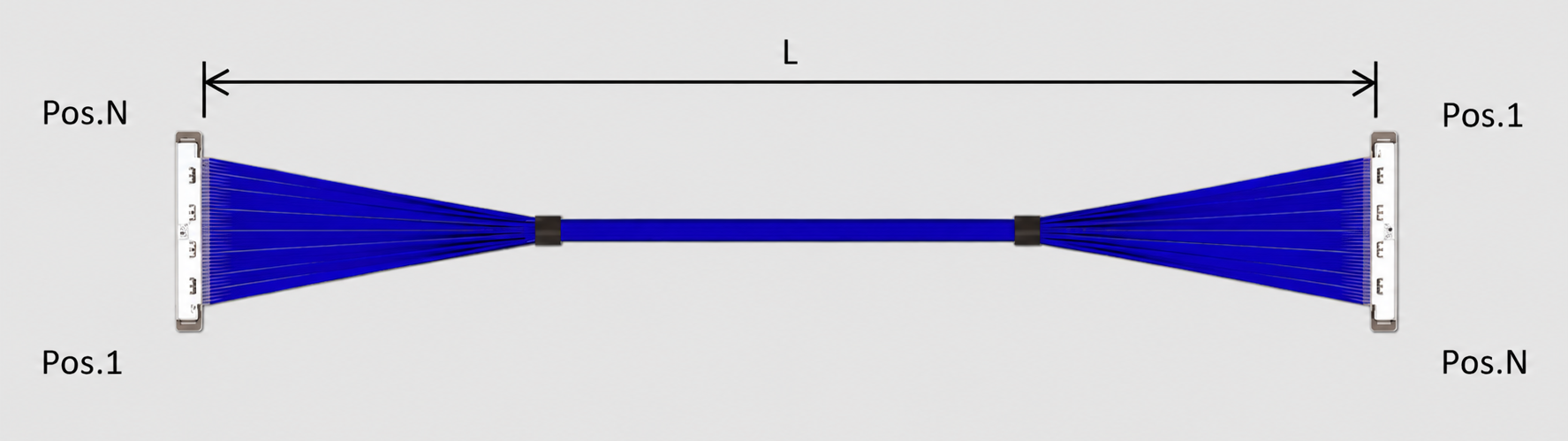
For purchasing personnel, when looking for compatible alternative cables for existing equipment using I-PEX 82882-100B-02-D, it is not recommended to simply purchase according to "LVDS line" or "14Pin line". Instead, the connector, cable, impedance, length, and wire sequence should be confirmed as a complete specification. The product corresponds to a cable end connector of 20373-R14T-06, with compatible Micro-Coaxial Cable including AWG#40; specifically, the 82882-100B-02-D uses AWG#40, 50Ω, 300±5mm, and 1-N wire sequence. For alternative products, it is also necessary to confirm the actual fitting size of the connector, 0.4mm pitch, cable exit direction, and internal assembly space of the equipment, especially to avoid mistakenly considering models with the same 14Pin and 300mm but using 1-1 wire sequence as direct substitutes. The I-PEX official data indicates that the 14Pin 1-N series includes 82881 (100mm), 82441 (200mm), and 82882 (300mm), while 83010, 83011, and 83012 are the 1-1 series for 100mm, 200mm, and 300mm respectively. Our company can provide I-PEX 82882-100B-02-D compatible alternative cable solutions, which can be developed and produced according to customers' original cable drawings and actual application requirements, for 14Pin, 0.4mm pitch, AWG#40, impedance, length, wire sequence, and connector assembly requirements, suitable for engineering prototyping, product verification, and bulk procurement.
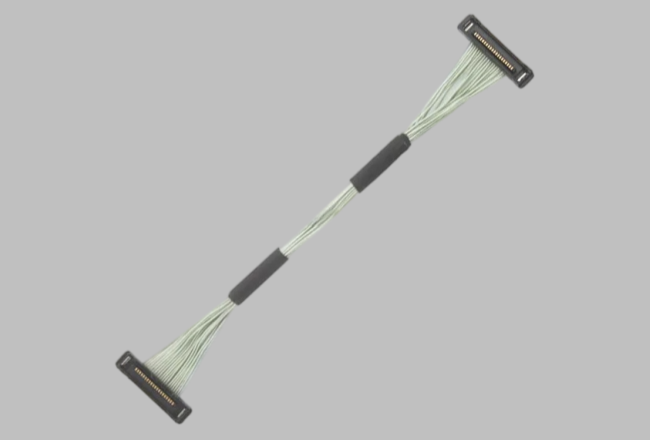
LVDS is a signal technology, and extremely thin coaxial cable is the transmission medium
The biggest difference between "micro coaxial cable bundle" and "LVDS line" is that they define different objects: LVDS mainly belongs to differential signal transmission technology, while Micro-Coaxial is a specific cable transmission structure. In fact, they can be used together. For engineers, whether high-speed LVDS or other differential signals are suitable for using a micro coaxial cable bundle should be comprehensively considered, including impedance matching, signal rate, cable length, EMI, crosstalk, connectors, and equipment space; for purchasing personnel, it is necessary to focus on verifying whether the product part number and key specifications are truly consistent. I am【3W Electronic Components Network】, Deeply engaged in the production and development of ultra-fine coaxial cable束 and precision connectors, we can provide stable and reliable alternative solutions. For more details, please contact:Manager Zhang 18913228573 (WeChat number same)I-PEX 82882-100B-02-D as a CABLINE®-SS 14Pin 0.4mm Pitch AWG#40 50Ω 300mm 1-N fine coaxial cable assembly should be based on complete engineering specifications when searching for compatible replacement products rather than judging replaceability solely by the name "LVDS cable"
“Without the consent or authorization of this site, no one shall reproduce, reprint, distribute, cite, change, broadcast or publish the content in whole or in part in any form, nor shall there be any other violation of the copyright of this site.