


Categorization:Harness Component
In high-speed signal transmission, impedance is one of the key parameters that engineers need to confirm when choosing extremely thin coaxial cables. The characteristic impedance of common extremely thin coaxial cables mainly focuses on 45Ω, 50Ω, and other specifications determined according to system design. It cannot be determined solely based on the name "extremely thin coaxial cable," but needs to be comprehensively determined by combining factors such as core wire size, dielectric material, insulation structure, shielding structure, and connectors. For high-speed digital signals, if the cable impedance differs significantly from that of the transmitter, receiver, and PCB transmission lines, it may cause reflections, increased insertion loss, and reduced signal integrity. Therefore, when engineers design high-speed display, camera, data acquisition, and other equipment, they usually need to match the cable impedance, connector, PCB routing, and working frequency as a whole. In the official high-speed performance test conditions of I-PEX CABLINE®-SS, AWG#40, 45Ω, 100mm Micro-Coaxial Cable is used, and its 16Gbps/Lane transmission capability is verified under specific test conditions.
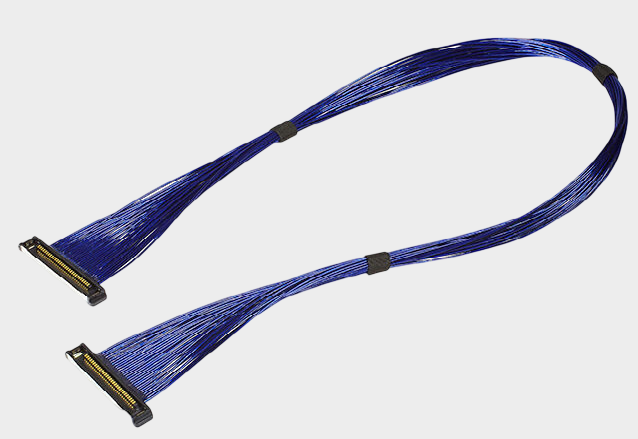
From practical application perspective, both 45Ω and 50Ω are common impedance specifications in very thin coaxial cables, but they are not interchangeable "universal specifications". For example, in the high-speed testing conditions on the product page of I-PEX CABLINE®-SS, it is explicitly mentioned that AWG#40, 45Ω, and 100mm very thin coaxial cable are used; while the I-PEX 82441-100B-02-D engineering drawing analyzed this time explicitly corresponds to 14PIN, AWG#40, 50Ω, 200mm, and 1-N cable assembly. This indicates that under the same connector series, different specific Harness part numbers may correspond to different cable impedance and structural requirements. For engineers, if the original design uses 50Ω cable, the alternative solution cannot be simply replaced with 45Ω just because they are both AWG40; the reverse is also true. Purchasers are also advised to write product part number, AWG, impedance, length, PIN count, and wire sequence into the procurement specifications when inquiring for quotes to avoid suppliers quoting based on connector models only, leading to inconsistent actual cable specifications.
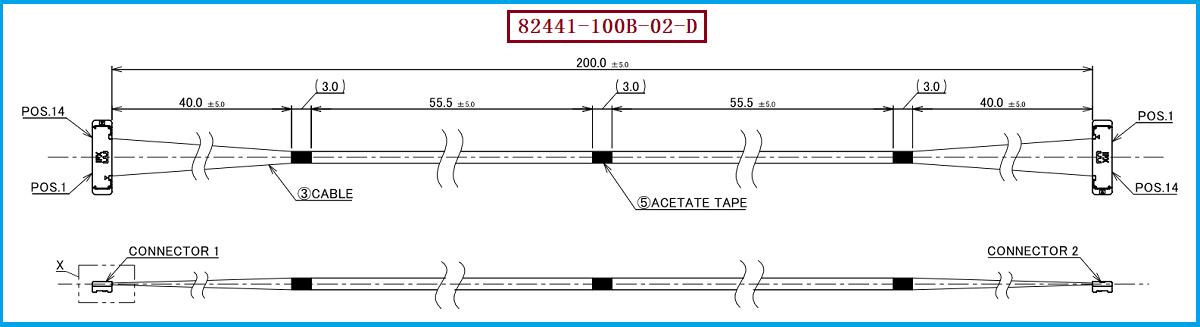
This I-PEX 82441-100B-02-D is a CABLINE®-SS series 14PIN ultra-thin coaxial cable assembly. The engineering drawing corresponds to wire material of 14 AWG#40, 50Ω Micro-Coaxial Cable, with a total length of 200.0±5.0mm, and wire sequence of 1-N. The connector model used at the cable end is 20373-R14T-06, corresponding to 14PIN, 0.4MM Pitch. The I-PEX official page also explicitly lists 82441 as a 14PIN, 200mm, 1-N Micro-Coaxial Harness, and also provides 100mm 82881 and 300mm 82882 for convenient selection to meet different equipment length requirements. For engineering development, the key to identifying this product is not just to look at the "50Ω", but to confirm the complete combination of 82441-100B-02-D + AWG40 + 50Ω + 200mm + 14PIN + 0.4MM + 1-N; especially, I-PEX also provides 14PIN, 200mm, 1-1 83011-100B-01-D, so the wire sequence is also a parameter that cannot be ignored during alternative development.
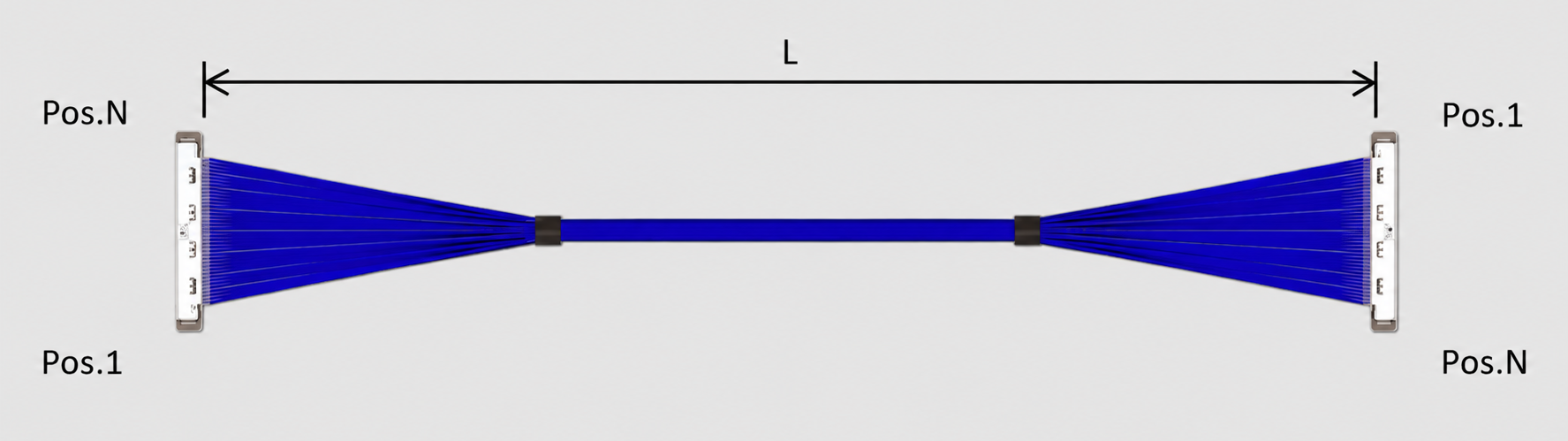
For high-speed devices using CABLINE®-SS connectors, when looking for compatible alternative cables, it is recommended that the engineering team first confirm the original cable's impedance system, followed by confirming the AWG, length, PIN count, Pitch, wire sequence, and connector model. For the I-PEX 82441-100B-02-D, the alternative development should focus on specifications matching AWG#40, 50Ω, 200mm, 14PIN, 0.4MM Pitch, 1-N, with the cable end connector being 20373-R14T-06. I-PEX official data indicates that CABLINE®-SS uses a 0.4mm Contact Pitch, Vertical Right Angle structure, and supports 10, 14, 20, 30, 32, 35, 40, 50PIN; this series also supports AWG36, 38, 40, 42 Micro-Coaxial Cable, but the official has a special note on the AWG42 for impedance mismatch issues. Therefore, in the development of alternative cables, it is not sufficient to simply choose "thinner wire diameter is better" as a selection criterion, but should be matched based on actual high-speed signal rate, impedance requirements, wiring space, and electrical performance. Our company can provide: I-PEX 82441-100B-02-D compatible alternative cable solutions, which can be developed according to the original cable, engineering drawings, or specification requirements provided by the customer, and can match the key parameters such as 14PIN, 0.4MM Pitch, AWG40, 50Ω, 200mm, 1-N, and match the impedance consistency and cable processing dimensions.
“Without the consent or authorization of this site, no one shall reproduce, reprint, distribute, cite, change, broadcast or publish the content in whole or in part in any form, nor shall there be any other violation of the copyright of this site.