


Categorization:Harness Component
For engineers and purchasing personnel, the difference between ultra-fine coaxial cables and ordinary wires cannot be simply understood as "one is thinner and the other is thicker." In high-speed, high-density, and miniaturized equipment, ultra-fine coaxial cables typically undertake multiple tasks simultaneously, such as signal transmission, impedance control, and shielding against interference. Although ordinary wires have a cost advantage in low-speed power supply or general signal connections, when faced with high-speed differential signals, factors such as the wire structure, impedance consistency, shielding ability, and crosstalk control will directly affect signal integrity. The I-PEX CABLINE®-UX II adopts a 0.25mm Contact Pitch, Vertical Right Angle structure, supports AWG44/AWG46 Micro-Coaxial Cable, and uses 5Gbps/lane NRZ as the reference transmission speed, reflecting the design direction of "miniaturization + high density + high-speed transmission."
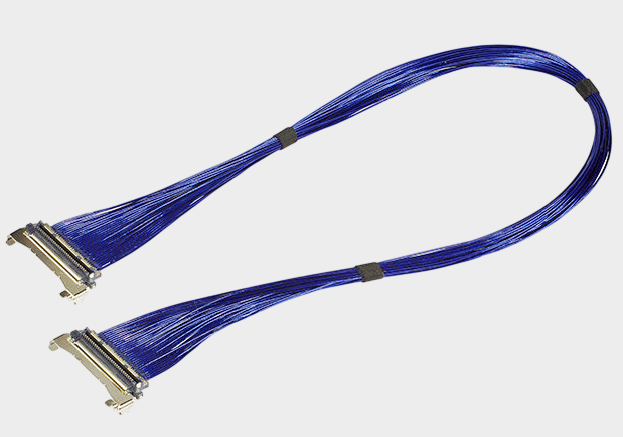
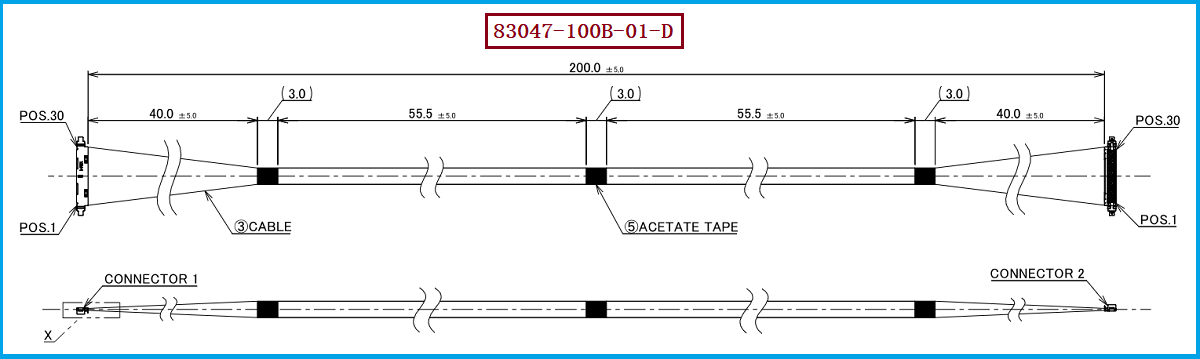
This introduction is about the I-PEX 83047-100B-01-D, which is a 30Pin ultra-thin coaxial cable assembly in the CABLINE®-UX II series. It corresponds to the 30Pin, Micro-Coaxial 46AWG, L=200mm, 1-1 specification in I-PEX's official sample cable assembly. The connector model used at the cable end is 20532-030T-02, and the wire position is defined as 1-1, meaning that the connections between the ends are made by the same pin positions. According to the 2D drawings of this model, the cable assembly uses 30 46AWG, 50Ω Micro-Coaxial Cables, with a length of 200±5.0mm, and is accompanied by Housing Assembly, Metal Cover, and other structural components. For actual replacement and development, in addition to the pin count and length, attention must also be paid to details such as wire diameter, impedance, shielding treatment, end dimensions, and assembly method.
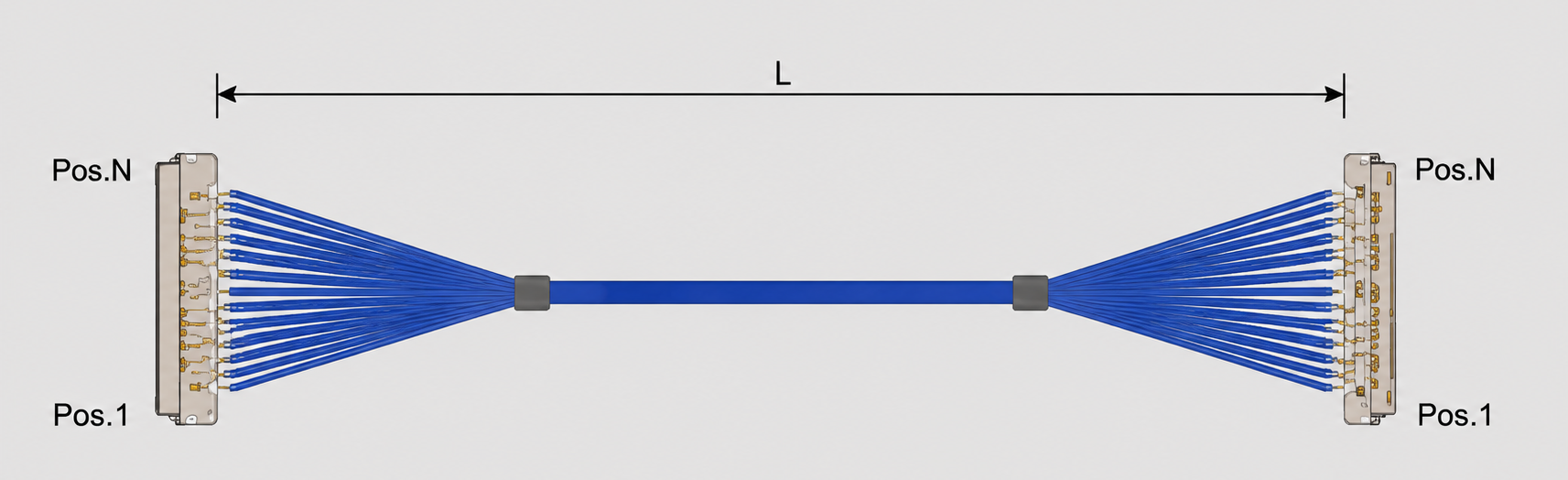
From the perspective of engineering applications, the value of extremely fine coaxial cables is mainly reflected in two aspects: signal integrity and space utilization. Ordinary wires may be sufficient for low-speed applications, but when equipment needs to transmit high-speed display, camera, or data communication signals, impedance changes, external electromagnetic interference, and crosstalk between adjacent lines become more sensitive. CABLINE®-UX II adopts a multi-point grounding design, forming a continuous grounding path between Wire Shield, Ground Bar, Plug Shell, Receptacle Shell, and PCB. At the same time, the connector uses a 0.25mm ultra-narrow spacing, which, combined with extremely fine wire materials, can achieve high-density wiring within a limited space. I-PEX data also provides a reference example: a 40Pin cable assembly processed with coaxial cables with an outer diameter of about 0.24mm can pass through a Φ2.66mm shaft or small-diameter pipe, which is an advantage in space that ordinary wire materials are difficult to achieve.
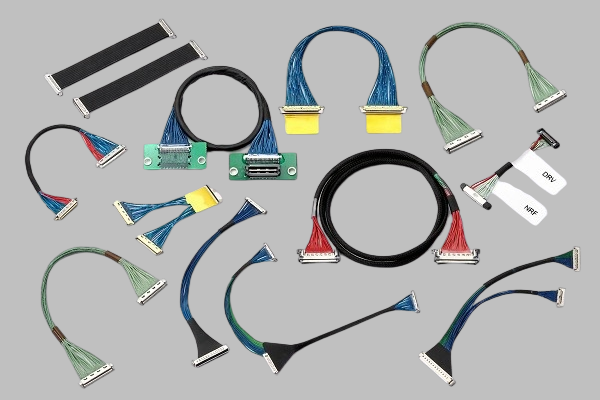
For procurement of alternative or domesticated projects, it is not recommended to simply replace with "30Pin+200mm", but rather to accurately confirm the connector, wire material, impedance, length, wire position definition, and terminal processing structure based on the original harness drawings. This solution corresponds to I-PEX 83047-100B-01-D, with key parameters of 30Pin, 46AWG Micro-Coaxial, 200mm, 1-1 wire position definition, and the wire end connector model is 20532-030T-02. At the same time, it should be noted that the current I-PEX official website lists 20532-030T-02 as an EOL model, with the corresponding alternative model being 20532-030T-02-1, with the difference marked as shape. Therefore, when selecting for new projects, it is necessary to confirm the actual matching structure of the equipment end. For engineers, it is recommended to prioritize the verification of connector mating dimensions, Pin count, wire position definition, wire material outer diameter, and impedance; for purchasers, it is important to confirm whether the alternative harness can be delivered in bulk with stable quality according to the original product's length, tolerance, terminal structure, and testing requirements. Our company can provide: I-PEX 83047-100B-01-D compatible alternative harness solution, which can match fine coaxial wire, connector, length, and wire position definition according to the actual equipment requirements of customers.
“Without the consent or authorization of this site, no one shall reproduce, reprint, distribute, cite, change, broadcast or publish the content in whole or in part in any form, nor shall there be any other violation of the copyright of this site.