


Categorization:Harness Component
For engineers, the most intuitive difference between ordinary coaxial cables and ultra-thin coaxial cables is the wire diameter and flexibility. Traditional coaxial cables typically have a relatively larger outer diameter and more obvious structural occupation, while ultra-thin coaxial cables further miniaturize the structures of conductors, insulating layers, shielding layers, etc., while maintaining the coaxial transmission structure. Therefore, they are particularly suitable for devices with highly limited internal space, such as laptops, tablets, display modules, VR/AR, etc. The I-PEX CABLINE®-UX II uses a 0.25mm contact pitch and Vertical (Right Angle) plug-and-play structure, with a mating height of about 1.04mm and a depth of 2.4mm, and the connector itself is also designed for miniaturized applications. Official materials also provide a simulation reference case where a 40Pin cable harness with an outer diameter of about 0.24mm coaxial cable can pass through an internal diameter space of about Φ2.66mm. It can be seen that the true value brought by ultra-thin coaxial cables is not just "thinner wires," but allows engineers to achieve higher density and more flexible signal wiring within limited space.
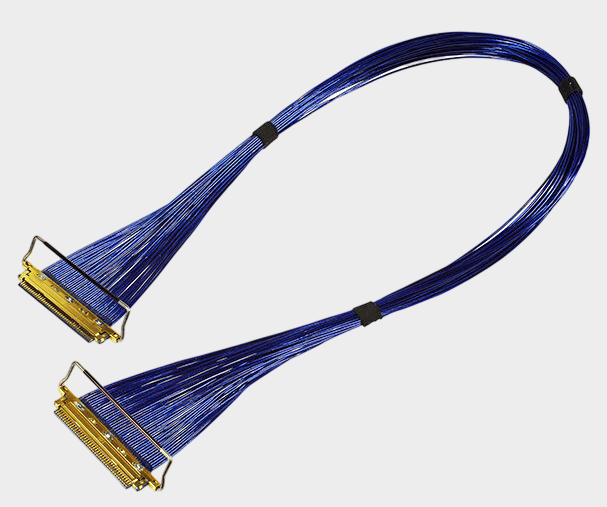
Many purchasing personnel are prone to a misconception: the finer the wire, the weaker the signal transmission capability? In fact, the advantage of extremely fine coaxial cables is not solely determined by "thickness", but is related to impedance, coaxial structure, shielding continuity, termination technology, and connector matching. The I-PEX 83046-100B-01-D introduced this time is a 30Pin Micro-Coaxial extremely fine coaxial cable assembly, using AWG#46, 50Ω, blue wire material, length 100MM, 1-1 wire sequence structure; its both ends use the corresponding CABLINE®-UX II terminal components. According to I-PEX official data, CABLINE®-UX II supports AWG44, AWG46 Micro-Coaxial Cable, with a reference transmission speed of up to 5Gbps/lane NRZ, and can be used for reference high-speed applications such as USB 3.1 Gen 1, V-By-One HS 1.4, HDMI 1.3, eDP, and MIPI. Therefore, extremely fine coaxial cables are not just to pursue "the thinner the better", but to achieve a balance between size, signal integrity, and mechanical flexibility within a limited space.
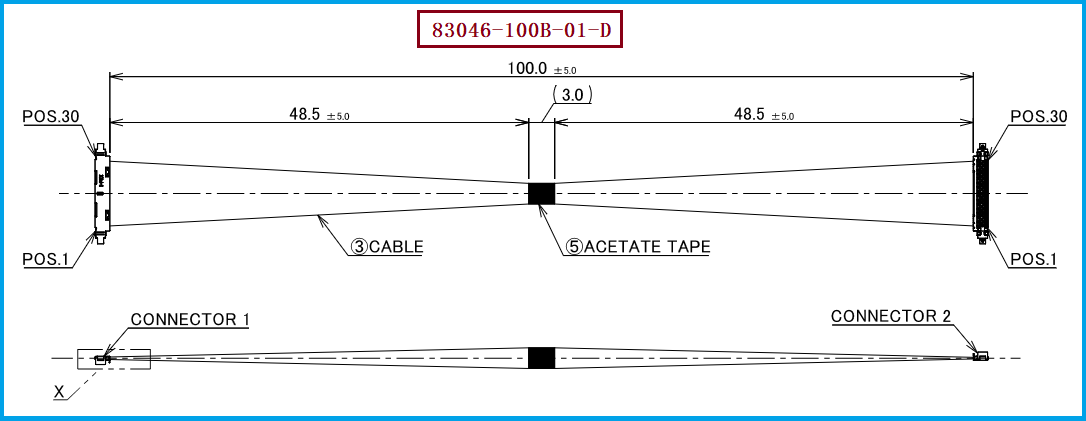
From the perspective of engineering selection, the key specifications of I-PEX 83046-100B-01-D need to be understood as a whole, rather than just looking at "30Pin" or "100MM". This model corresponds to CABLINE®-UX II 30Pin Micro-Coaxial 46AWG, L=100mm, 1-1 structure, and the PDF engineering diagram clearly labels the wire as AWG#46, 50Ω, BLUE, with both ends using corresponding connection components and connected in a Pin-to-Pin manner in the 1-1 configuration; the user-specified wire end connector model is 20532-030T-02. For engineers, it is necessary to check the Pin count, wire gauge, impedance, length, wire sequence, end dimensions, and shielding structure when substituting; for purchasing personnel, it should be avoided to find substitutes based solely on "30Pin+100MM", as there are also 1-N structures and different versions such as 200MM, 300MM in the same series. The current I-PEX official website also explicitly lists 83046-100B-01-D as a 30Pin, 46AWG, 100mm, 1-1 Harness, and distinguishes it from models such as 83047, 83048.
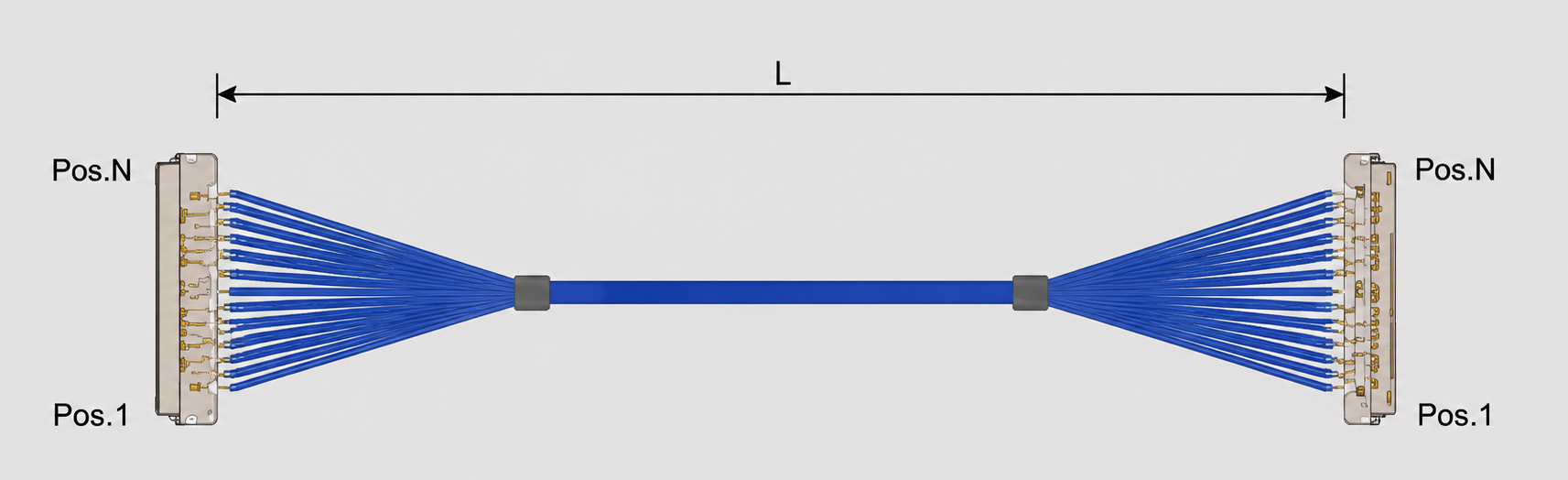
If the device previously used I-PEX 83046-100B-01-D, it is recommended to base the domestic substitution, second supplier introduction, or bulk procurement on the original cable sample and engineering drawings. The focus should be on confirming the CABLINE®-UX II series, 30Pin, AWG#46, 50Ω, 100MM, 1-1 wiring sequence, and the structure of the 20532-030T-02 end connector. At the same time, check the height, wiring direction, shielding continuity, and internal wiring space of the device after actual assembly. It should be noted that the current I-PEX official website lists the old version 20532-030T-02 as an old model that can correspond to 20532-030T-02-1, with the difference marked as Shape. Therefore, when engineering substitution is performed, it should be confirmed according to the actual version and assembly status of the connector used by the customer. For customers with needs for domestic substitution, sample verification, or bulk supply, our company can provide: I-PEX 83046-100B-01-D compatible cable replacement solution, which can produce and manufacture extremely fine coaxial cables according to the customer's cable length, pin count, AWG, impedance, wiring sequence, and connector assembly requirements, helping engineering teams reduce the cost of re-development and providing procurement personnel with a stable alternative supply channel.
“Without the consent or authorization of this site, no one shall reproduce, reprint, distribute, cite, change, broadcast or publish the content in whole or in part in any form, nor shall there be any other violation of the copyright of this site.