


Categorization:Harness Component
In high-speed signal transmission systems, the extremely thin coaxial cable is not simply "making the wire thinner." Its internal structure typically requires the combination of a central conductor, insulating layer, shielding layer, and external protective structure to form a stable transmission channel. The so-called shielding weave density generally refers to the extent to which the metal wires in the shielding weave layer cover and interlace to form a shielding area. It is closely related to the shielding layer's coverage effect, the ability to resist external electromagnetic interference, and the control ability of signal radiation. For engineers, shielding weave density should not be understood in isolation as "the higher the better," but needs to be considered comprehensively in terms of wire diameter, flexibility, bending radius, shielding material, structural size, and the signal integrity requirements under the target frequency. Especially within industrial cameras, AI vision, high-speed display, and high-speed computing equipment, cables are often closely arranged with high-speed digital circuits, power lines, and other communication channels. Therefore, reasonable shielding design is of great significance in reducing EMI, controlling crosstalk, and maintaining high-speed signal quality.
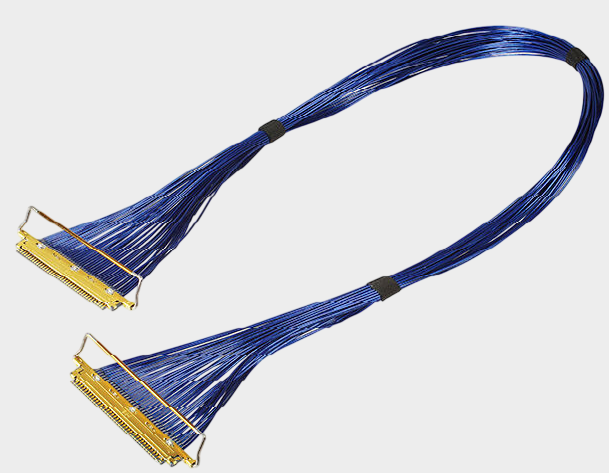
This product corresponds to the extremely fine coaxial cable assembly part number/model I-PEX 83062-100B-01-D, which belongs to the CABLINE®-VS 20P HARNESS. According to the official engineering drawings, this product uses 20 extremely fine coaxial cables, AWG#40 specification, with a cable length of 200.0±5.0mm, and the characteristic impedance is marked as 50Ω. The wire position is defined as 1-1, meaning that pin 1 corresponds to pin 1, pin 2 corresponds to pin 2, and so on until pin 20; the connector used at the cable end is the main model 20454-220T, and it is also matched with the CABLINE-VS Plug P/N 20453-220T-03 and other structural components. For engineers, this means that when evaluating "screening weave density," it is not only the shielding layer itself that should be considered, but the entire high-speed channel should be judged as a system, including the extremely fine coaxial cable itself, the connector, termination process, grounding path, PCB routing, and the coupling between adjacent high-speed channels. The platform-level data provided by I-PEX for the CABLINE-VS series shows that this series uses a 0.5mm contact spacing, a horizontal insertion structure, supports 20/30/40/50Pin, and supports AWG36~AWG44 extremely fine coaxial cables; the official also provides a reference transmission capability of 32Gbps/lane and related high-speed interface reference applications.
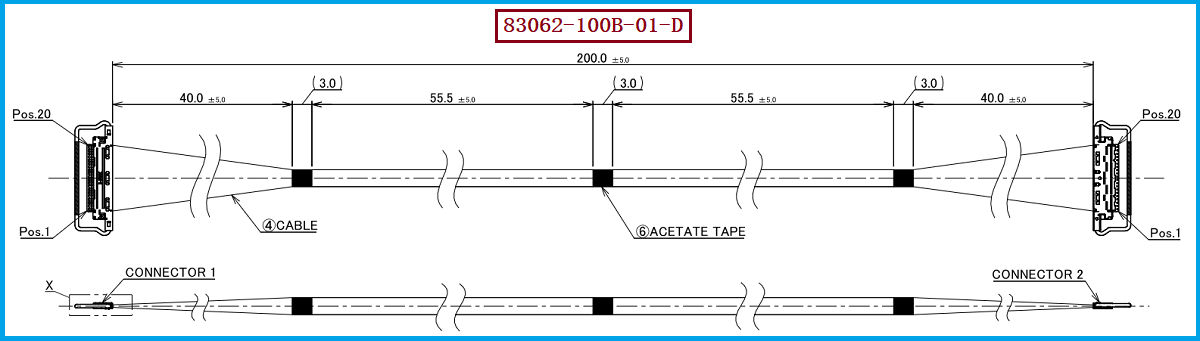
For purchasers and engineers, the saying "the higher the shielding weave density, the better" is actually a statement that is prone to misunderstanding. A higher shielding coverage usually contributes to a more continuous shielding path, but it may also affect the flexibility, bending performance, outer diameter, weight, and processing cost of the cable harness. For extremely thin coaxial cables, the space dimensions are inherently very limited, so a balance needs to be struck between high-speed performance, EMI suppression, mechanical flexibility, and manufacturing consistency. More importantly, the official engineering drawing of 83062-100B-01-D clearly specifies a 50Ω characteristic impedance, but does not list "shielding weave density" as a separate public specification indicator for the product. Therefore, when considering domestic substitution or supplier evaluation, it is not recommended to judge the cable harness solely based on the weave density parameter. Instead, a comprehensive verification should be conducted by combining impedance, insertion loss, return loss, crosstalk, voltage resistance, insulation resistance, termination consistency, and actual system SI test results. The official engineering drawing also provides electrical requirements such as the cable harness's 30V rated voltage, AC250V voltage resistance, and 50MΩ or more insulation resistance under DC100V conditions, so these indicators should also be included in the specification confirmation during procurement selection.
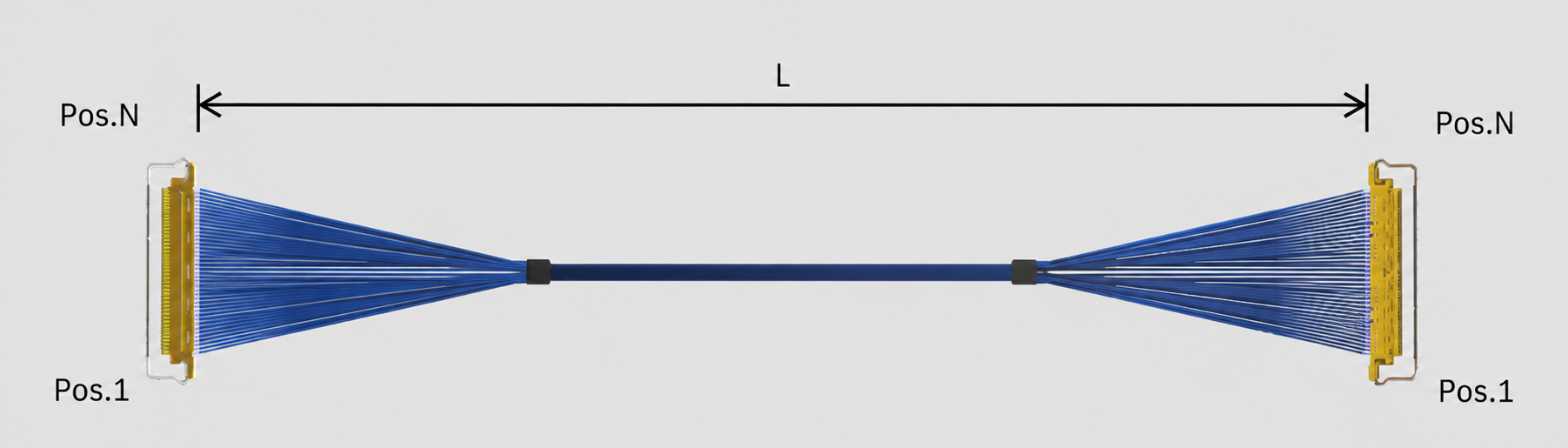
If the company is engaged in the domestic substitution of I-PEX 83062-100B-01-D, the introduction of a second supplier, or bulk procurement, it is recommended to first confirm whether the product can fully match the key conditions such as 20Pin, AWG#40, 200mm, 1-1 line position definition, and 50Ω characteristic impedance. At the same time, confirm the matching relationship of the wire end connector 20454-220T, the terminal crimp/welding process, and the shielding layer treatment method. The official I-PEX CABLINE-VS page lists 20454-220T as a 20Pin Plug Housing, and 83062-100B-01-D as a 20Pin, 40AWG, 200mm, 1-1 evaluation cable model. For purchasers, what is truly worth paying attention to is not whether the appearance is the same, but whether the substitute cable can meet the original design requirements in terms of connector matching, line position definition, impedance consistency, length tolerance, shielding structure, terminal reliability, and high-speed signal integrity. Our company can provide: I-PEX 83062-100B-01-D compatible substitute cable solutions, which can develop extremely fine coaxial cable solutions around the actual pin count, wire length, wire diameter, line position definition, connector, and application environment of the customer's equipment, providing a domestic substitution option for engineering verification, sample making, and bulk procurement.
“Without the consent or authorization of this site, no one shall reproduce, reprint, distribute, cite, change, broadcast or publish the content in whole or in part in any form, nor shall there be any other violation of the copyright of this site.