


Categorization:Harness Component
In high-speed display, industrial cameras, AI vision equipment, and internal connections of precision electronic products, engineers often encounter the concepts of "extremely thin coaxial cable bundles" and "LVDS lines." In fact, the two are not completely in the same category: extremely thin coaxial cable bundles mainly describe the physical structure and bundle form of the cables, while LVDS mainly describes a low-voltage differential signal transmission technology. LVDS transmits high-speed signals through differential methods, which can effectively reduce common-mode noise and improve the stability of signal transmission; while Micro-Coaxial extremely thin coaxial cables add shielding structures to each signal line, making the signal channel have a relatively independent electromagnetic environment. Therefore, a set of extremely thin coaxial cable bundles can be used to transmit LVDS-type differential signals, but it cannot be simply understood that "extremely thin coaxial cable" and "LVDS line" are two mutually exclusive products. For engineers, it is more important to determine the cable scheme according to the actual interface protocol, impedance requirements, transmission rate, cable length, EMI environment, and connector structure; for purchasing personnel, it is necessary to confirm the specific cable structure and connector model, and not just judge whether it can be replaced based on the name "LVDS line."
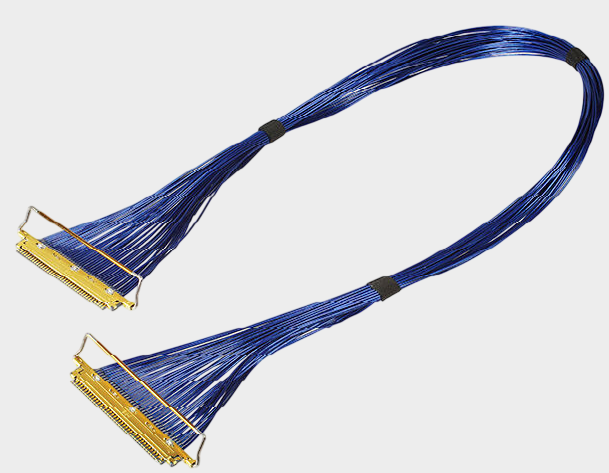
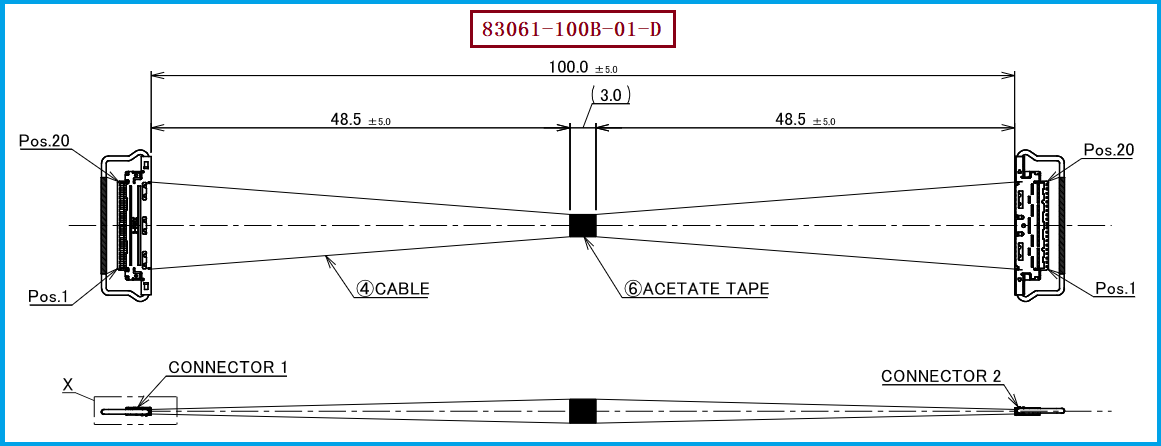
This introduced ultra-fine coaxial cable assembly product part number/model is I-PEX 83061-100B-01-D, corresponding to the CABLINE®-VS 20P HARNESS engineering drawing. This product uses 20 Micro-Coaxial Cables ultra-fine coaxial cables, wire specification AWG#40, characteristic impedance 50Ω, length 100.0±5.0MM, Pin Assignment of 1-1. The connector model used at the wire end is 20454-220T, and it is combined with related Shell, Pull Bar, and terminal fixing processes to form a complete cable assembly. From the perspective of high-speed connection design, 50Ω impedance and independent coaxial structure are very important parameters, directly related to the impedance continuity of high-speed signals during the connection process and the ability to resist external interference. For 100MM internal short-distance connections in equipment, ultra-fine coaxial cable assemblies can achieve 20-way high-density signal connections in a smaller space while meeting flexible wiring requirements. Therefore, when engineers carry out high-speed cable assembly design within AI vision, industrial cameras, high-speed displays, and other compact electronic devices, they usually need to consider "signal protocol + wire structure + connector + impedance + length" simultaneously and not just focus on the LVDS signal name.
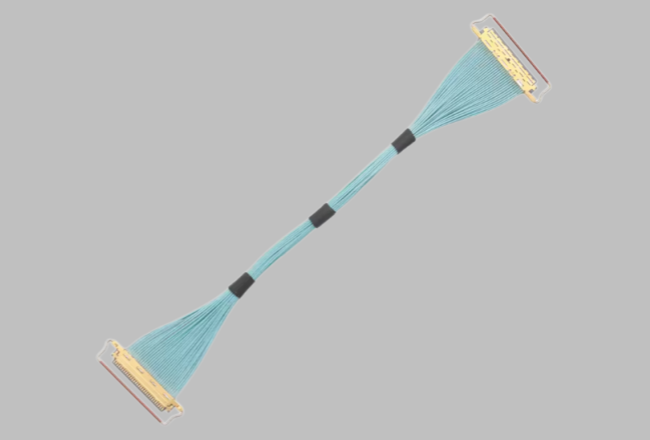
The core advantage of LVDS lies in differential transmission, which transmits data through the voltage difference between a pair of differential signals, thus having high requirements for line impedance, differential pair consistency, and external noise environment. When LVDS signals further enter the internal high-density, miniaturized devices, extremely thin coaxial cables can provide an independent shielding structure for each high-speed signal channel, which helps to reduce external electromagnetic interference and coupling between adjacent channels. In other words, LVDS solves the issue of "how to transmit signals," while extremely thin coaxial cables solve the issue of "the physical cable structure through which signals are transmitted." Both can be used in combination. For multi-channel high-speed devices, if ordinary ribbon cables or materials not optimized for high-speed signals are used, issues such as crosstalk, impedance discontinuity, or signal quality degradation may be more likely to occur in high-speed and complex EMI environments; using structurally reasonable Micro-Coaxial cable assemblies can provide clearer transmission channels for high-speed differential signals. Of course, the final performance still depends on the overall design of the cable material, connectors, PCB routing, grounding, and the entire high-speed link, and cannot be simply determined to meet a certain LVDS application just by the "coaxial structure."
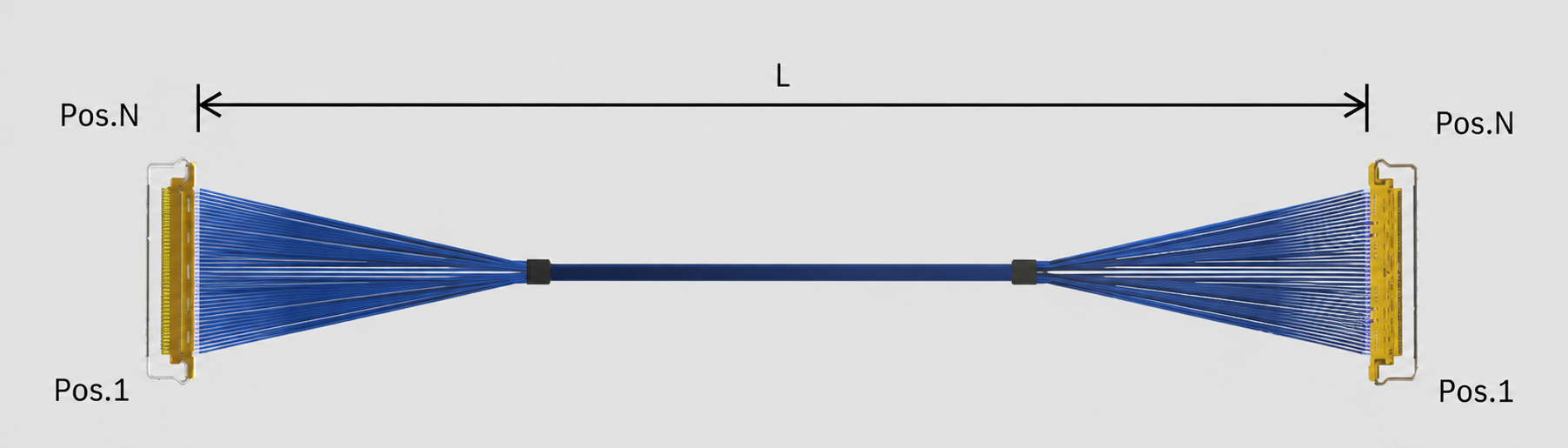
If the engineering project is looking for a domestic compatible alternative solution for I-PEX 83061-100B-01-D, engineers and purchasers are advised to first establish a complete specification benchmark based on the original product, including 20PIN, Micro-Coaxial Cable, AWG#40, 50Ω, 100.0±5.0MM, 1-1 wire sequence, and 20454-220T connector solution. Among them, the wire sequence is particularly worth noting, 1-1 means that Connector 1's Pin 1 corresponds to Connector 2's Pin 1, and so on, rather than all 20PIN ultra-thin coaxial cables can be directly replaced. At the same time, it is also necessary to verify the connector end size, wiring method, cable forming, installation space, and actual high-speed signal performance. Our company can provide: I-PEX 83061-100B-01-D compatible alternative cable assembly solution, which can produce and develop ultra-thin coaxial cables around customer equipment requirements for 20454-220T connector, AWG#40 ultra-thin coaxial wire, 50Ω impedance, 100MM length, 20PIN and 1-1 wire sequence. For customers who need to purchase in bulk, it is recommended to complete sample installation, high-speed signal testing, and reliability verification before mass production to ensure that the domestic alternative cable assembly not only can be mechanically connected but also meet the electrical performance requirements of the actual system.
“Without the consent or authorization of this site, no one shall reproduce, reprint, distribute, cite, change, broadcast or publish the content in whole or in part in any form, nor shall there be any other violation of the copyright of this site.