


Categorization:Harness Component
Within high-speed electronic devices, the increasing speed of signal transmission imposes higher requirements for impedance control of the connecting cable harness, signal integrity, and anti-interference capability. The core reason why extremely thin coaxial cable harnesses (Micro-Coaxial Cable Harness) can be used for high-speed signal transmission lies in their coaxial structure: the central conductor is responsible for transmitting the signal, the outer insulation layer provides electrical isolation, and the outer shielding layer forms a relatively stable electromagnetic environment, thus helping to control impedance and electromagnetic coupling during the transmission process. Compared to ordinary multi-core wires, the independent coaxial structure can reduce the mutual interference between adjacent signals, making it more suitable for high-density, multi-channel, and high-speed signal connections. Taking I-PEX 82983-100B-01-D as an example, this product belongs to CABLINE®-CA 50P HARNESS, using 50 AWG#40, 50Ω Micro-Coaxial extremely thin coaxial cables, with a finished length of 100MM, and achieving multi-channel high-speed signal connections through a high-density structure in a limited device space.
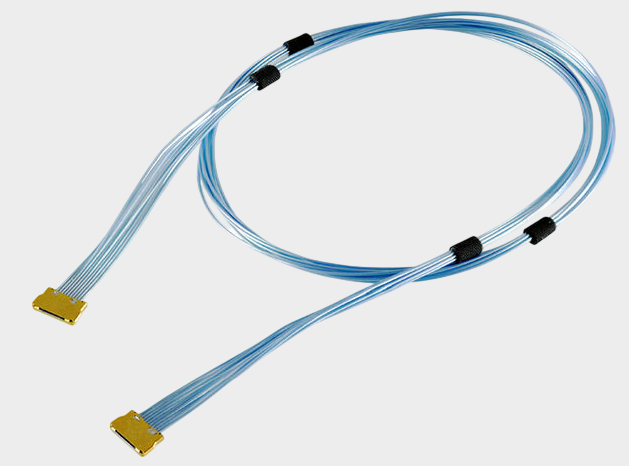
For engineers, determining whether a very thin coaxial cable can be used in a high-speed signal system cannot be simply based on the wire diameter and connector, but requires attention to the impedance continuity, insertion loss, return loss, crosstalk, signal attenuation, and delay consistency of the entire signal path. The very thin coaxial cable forms a controlled transmission path through relatively stable conductor, dielectric, and shielding structures, enabling high-speed signals to remain as stable as possible during the process from PCB, connector, to cable, and then to another PCB. At the same time, CABLINE®-CA uses a 0.4mm Pitch horizontal insertion structure, with a mating height of about 1.0±0.1mm, and is equipped with mechanical locking tabs, shielding, and multi-point grounding design. This not only meets the requirements for high-density installation but also helps to enhance the reliability of high-speed signal connections. The official specifications indicate that the high-speed application capability of the CABLINE®-CA platform can reach up to 32Gbps/Lane PAM4, making this type of connector particularly suitable for high-speed display, industrial vision, camera modules, and data connections within high-performance electronic equipment.
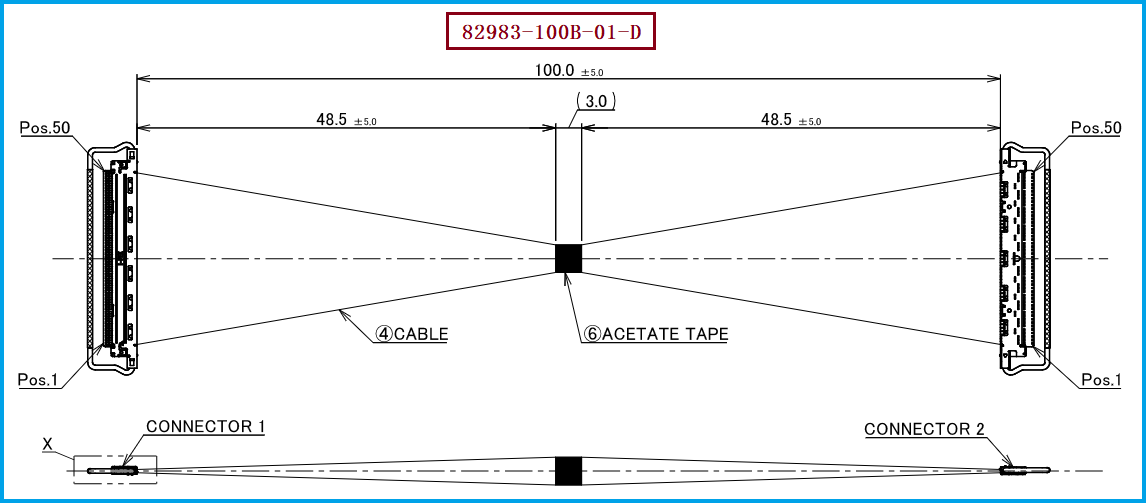
A typical feature of I-PEX 82983-100B-01-D is that it integrates 50 ultra-fine coaxial signal channels in a small connection area. This cable assembly uses 50 AWG#40, 50Ω ultra-fine coaxial cables, with both ends equipped with the 20634-150T-02 connector body. The overall length is 100.0±5.0mm, and the Pin Assignment uses a 1-1 method, that is, Pin 1 on one end corresponds to Pin 1 on the other end, and Pin 50 on one end corresponds to Pin 50 on the other end. For engineers, this configuration is suitable for集中 connection of multi-channel high-speed signals inside the device, while also reducing the space occupation of traditional thicker cables. For purchasers, it is particularly important to note that "50P, 100MM" is not enough to define the complete substitute product, and it is necessary to confirm the AWG specification, 50Ω impedance, connector model, Pin Assignment, and terminal structure simultaneously. If any of these key parameters change, it may affect equipment assembly or high-speed signal performance.
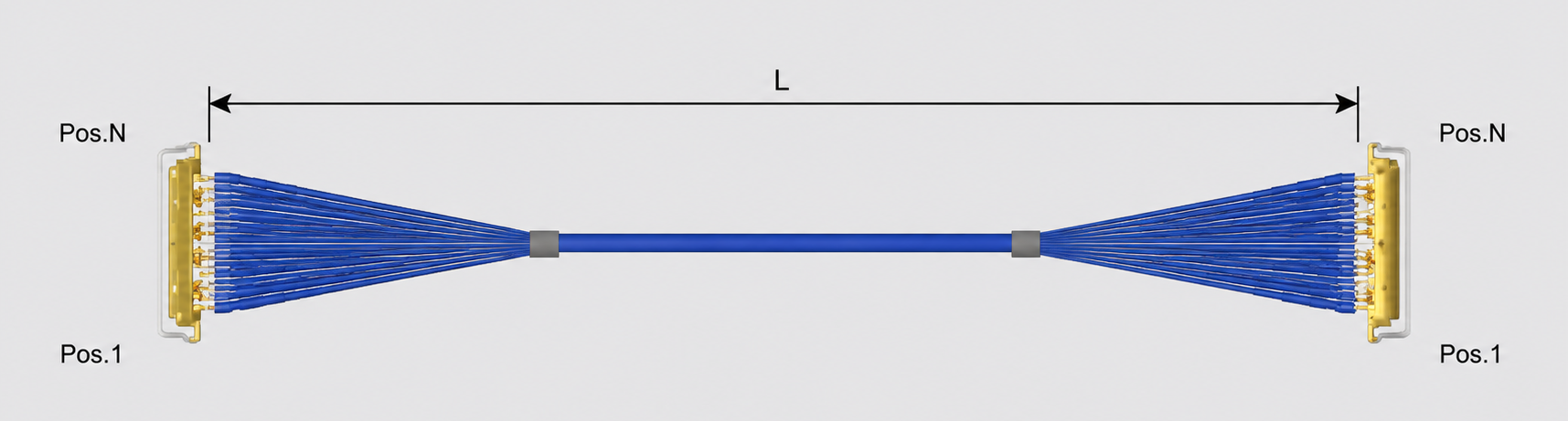
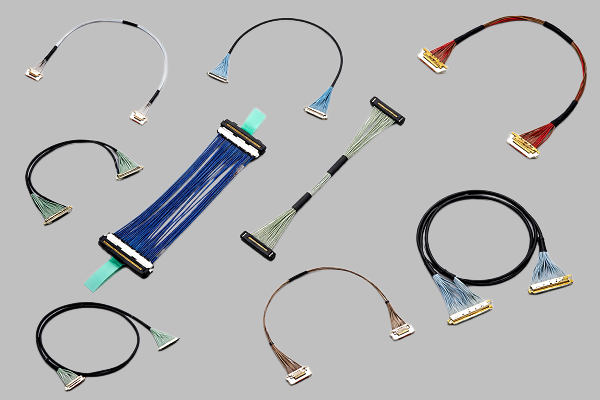
When performing compatibility replacement for I-PEX 82983-100B-01-D, it is recommended that engineers first lock in the basic conditions such as the 20634-150T-02 connector, 50Pin, AWG#40, 50Ω, 100MM length, and 1-1 wire sequence, and then perform signal integrity verification based on the actual data rate of the terminal device. Especially, attention should be paid to the fact that although the I-PEX CABLINE®-CA series supports various pin counts, cable specifications, and high-speed applications, whether a specific cable assembly meets the requirements of USB4, eDP, DisplayPort, MIPI, or other high-speed interfaces still needs to be verified in combination with the actual system design; it cannot be directly judged that the entire cable assembly has passed a certain protocol certification solely based on the maximum transmission capability of the connector. For procurement personnel, if the goal is to reduce supply chain costs, find a second supplier, or carry out domestic substitution, it is recommended to prioritize cable assembly manufacturers that can complete connector matching, wire sequence copying, impedance control, end processing, and finished product testing according to the original specifications. Our company can provide: I-PEX 82983-100B-01-D compatibility replacement cable assembly solutions, which can match specifications for extremely thin coaxial cable assemblies, develop samples, and carry out mass production according to the actual equipment requirements of customers, providing domestic compatibility replacement options for high-speed electronic equipment.
“Without the consent or authorization of this site, no one shall reproduce, reprint, distribute, cite, change, broadcast or publish the content in whole or in part in any form, nor shall there be any other violation of the copyright of this site.