


Categorization:Harness Component
A super-fine coaxial cable assembly is a cable product designed for high-density, high-speed signal connections. Its basic working structure is similar to that of a common coaxial cable, both using the coaxial structure of "center conductor—insulation layer—shielding layer—external protective layer" to transmit electrical signals. Taking I-PEX 82864-100B-02-D as an example, this product belongs to the CABLINE®-CA 50P HARNESS, adopting 50 AWG#40, 50Ω Micro-Coaxial Cable (super-fine coaxial cable), with an overall cable length of 300.0±5.0mm. Both ends are equipped with high-density connector structures, where the connector model used at the wire end is 20634-150T-02, which is compatible with AWG#40 specifications. Compared to ordinary multi-core cables, each super-fine coaxial cable has a relatively independent signal transmission and shielding structure, making it particularly suitable for high-speed camera, display, MIPI, eDP, and other high-frequency, high-speed electronic devices internal signal connections.
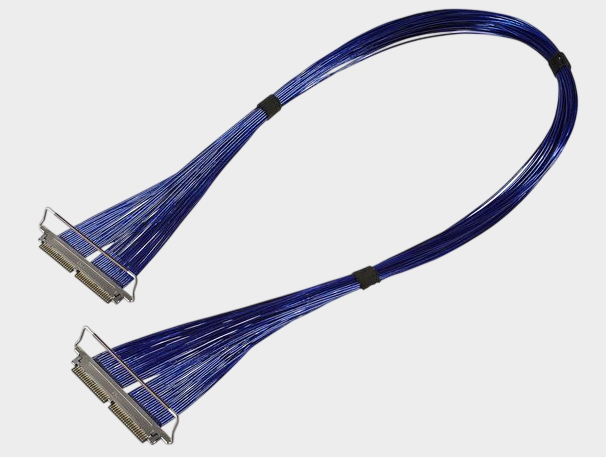
From the perspective of working principle, the extremely fine coaxial cable bundle is first responsible for high-speed electrical signal transmission by the central conductor, the outer insulating layer is used to maintain electrical isolation between the central conductor and the shielding layer, and the external shielding structure undertakes the important functions of electromagnetic shielding and signal loop. When high-speed differential signals enter the extremely fine coaxial cable, the electromagnetic field is mainly confined within the coaxial structure, thereby reducing external electromagnetic interference and crosstalk between adjacent channels, and helping to maintain a relatively stable transmission impedance. The 82864-100B-02-D uses a 50Ω extremely fine coaxial cable, and for high-speed signals, stable impedance characteristics help reduce reflections and waveform distortion during transmission. At the same time, 50 independent extremely fine coaxial cables are terminated in high-density connections through connectors to form a complete high-speed signal channel. Therefore, the extremely fine coaxial cable bundle is not simply "tying many thin wires together", but achieves stable signal transmission through factors such as wire material structure, shielding, impedance, connector termination, and wire sequence.
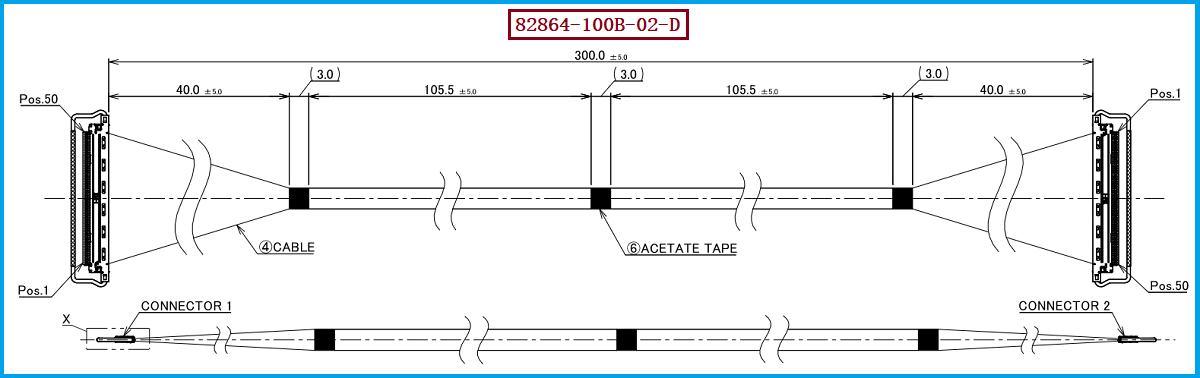
For engineers, when judging the performance of extremely fine coaxial cables, it is not enough to simply perform a simple continuity test. Taking 82864-100B-02-D as an example, its 50 AWG#40 extremely fine coaxial cable uses a 50Ω specification and is terminated with a high-density 20634-150T-02 connector. This model also uses a 1-N reverse Pin Assignment, meaning that one end's Pin 1 corresponds to the other end's Pin 50, and one end's Pin 50 corresponds to the other end's Pin 1. Therefore, when used in high-speed interfaces such as MIPI, it is necessary to pay attention to Pin definitions, differential signal correspondences, impedance continuity, insertion loss, return loss, crosstalk, and timing consistency between different channels. Especially in high-speed camera, display, and AI vision equipment, the cable is actually part of the complete high-speed link. Any significant mismatch between the connector, cable, PCB routing, and chip interface may cause eye diagram degradation, increased error rates, and even communication anomalies. Therefore, the true value of extremely fine coaxial cables lies in the ability to achieve high-density wiring, stable high-speed transmission, signal isolation, and flexible connection within limited space.
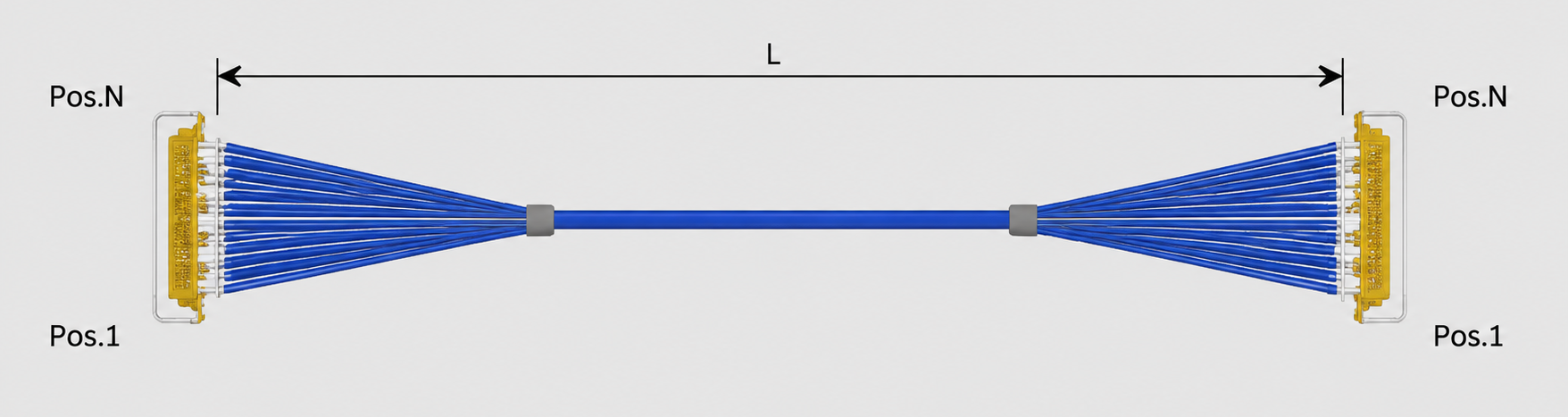
For engineers and procurement personnel engaged in the domestic substitution of I-PEX X-ray beam, it is recommended to use the key parameters of the original product as the basis for alternative development. The core specifications of I-PEX 82864-100B-02-D include 50Pin, AWG#40, 50Ω Micro-Coaxial Cable, 300.0±5.0mm, 1-N reverse Pin Assignment, and 20634-150T-02 connector structure. Among them, the AWG#40 wire specification and connector termination size need to be matched with emphasis, as the outer diameter of the wire, the stripping size, the termination position, and the connector structure will directly affect the final assembly effect; it should also be confirmed whether the Pin Assignment at both ends is completely consistent with the original equipment. For high-speed applications such as MIPI D-PHY, eDP, it is recommended to further conduct high-speed signal integrity tests during the sample verification stage, rather than simply judge compatibility through appearance and conduction tests. Our company can provide: I-PEX 82864-100B-02-D compatible alternative cable solution, which can develop compatible 50Pin AWG#40 ultra-fine coaxial cable according to customer equipment interface, Pin definition, cable length, and application requirements, and provide corresponding cable solutions for engineering research and development, sample verification, domestic substitution, and bulk procurement.
“Without the consent or authorization of this site, no one shall reproduce, reprint, distribute, cite, change, broadcast or publish the content in whole or in part in any form, nor shall there be any other violation of the copyright of this site.