


Categorization:Harness Component
Why are ultra-fine coaxial cables suitable for high-definition image and high-speed data transmission?
For engineers, "high-definition signal" is not just about resolution; it is more important that the high-speed digital signal behind the image data can be transmitted stably. For example, high-resolution displays, industrial cameras, and machine vision systems generate a large amount of high-speed differential data. If the cable impedance control is unstable, or if it is affected by external EMI and crosstalk from adjacent high-speed channels, there may be problems such as eye diagram degradation, increased bit error rate, and even abnormal images. The CABLINE®-CA connector itself uses a 0.4mm pitch, horizontal insertion structure, and has shielding and multi-point grounding design. Its product platform is aimed at high-speed signal transmission applications, and the official data shows that it can support high-speed transmission scenarios such as up to 32 Gbps/Lane PAM4. Therefore, in actual cable design, the extremely thin coaxial cable is not simply "the thinner, the better." It is necessary to achieve a balance between wire diameter, impedance, attenuation, shielding, length, and connector termination quality. For devices that need to complete high-definition images, high-speed displays, or other high-speed data transmission in narrow spaces, a reasonably designed extremely thin coaxial cable can become an internal connection solution that takes into account both space utilization and the integrity of high-speed signals.
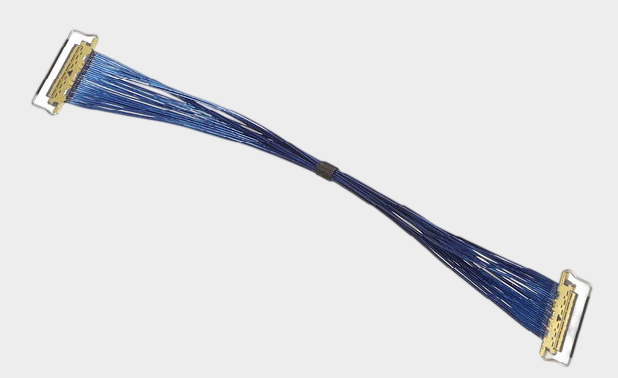
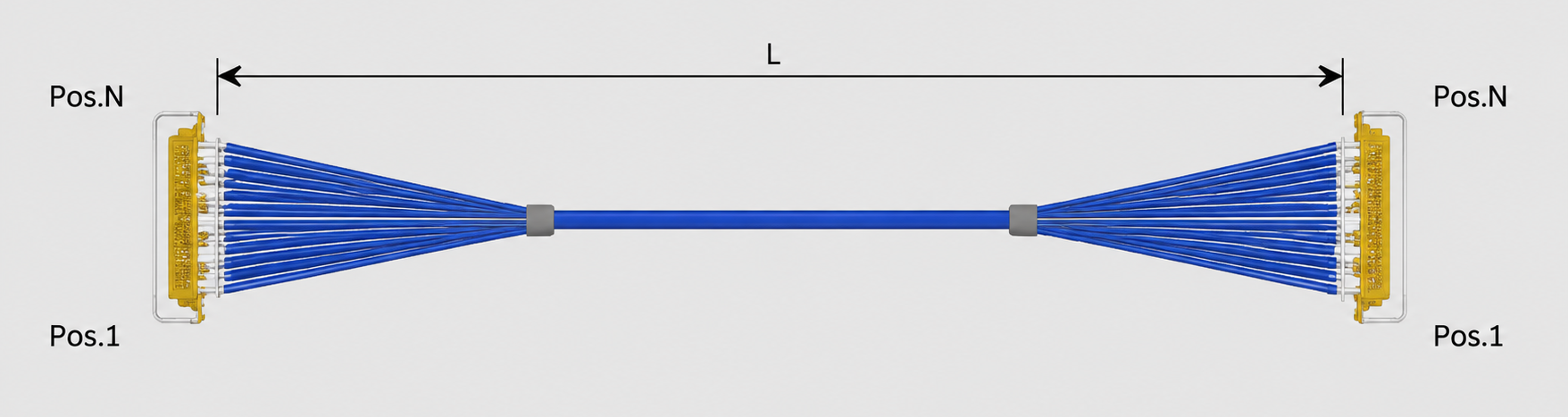
From the perspective of engineering applications, when selecting extremely fine coaxial cable assemblies, it is necessary to confirm the product part number/model, Pin count, wire diameter, wire length, connector model, and wire position definition simultaneously. The I-PEX 82650-100B-02-D referenced in this case is an extremely fine coaxial cable assembly with 30 Pins, 40AWG, 100mm, and a 1-N wire position definition. The connector model used at the wire material end is 20634-130T-02. "1-N" can be understood as a definition method where the wire positions at both ends of the cable assembly correspond to one end being Pin 1 and the other end being N. Engineers should particularly confirm the actual Pin Assignment when designing PCB connector layout, schematic definition, and cable assembly drawings to avoid abnormal correspondence of signal channels due to incorrect understanding of wire position orientation. For purchasers, it is also not recommended to simply inquire for "30Pin extremely fine coaxial cable" but rather to confirm key parameters such as I-PEX 82650-100B-02-D, 20634-130T-02, 40AWG, 100mm, and 1-N together. This is more conducive to ensuring that the purchased alternative products are consistent with the original design in terms of mechanical interfaces, electrical connections, and wire position definitions.
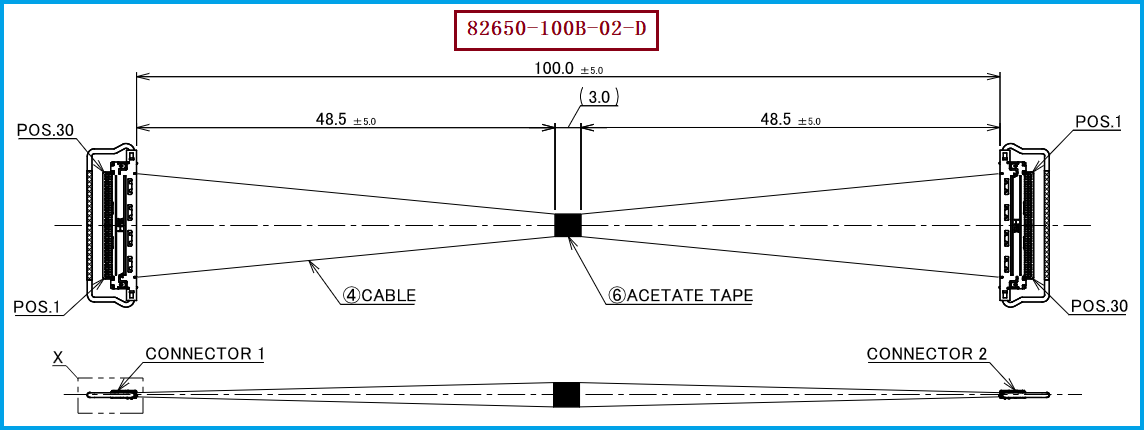
If the project requires domestic substitution or second-source development for I-PEX 82650-100B-02-D, it is recommended that engineers and purchasing personnel prioritize the confirmation of the mechanical dimensions at the connector end, pin count and arrangement, wire specification, cable length, wire position definition, and high-speed signal performance, followed by further verification of insertion and extraction reliability, impedance consistency, attenuation, crosstalk, and EMI performance. For this model, the key reference information is: 30 pins, 40AWG, 100mm, 1-N wire position definition, and the connector model at the wire end is 20634-130T-02. In the process of substitution and development, it is not only necessary to connect the wire and connector together, but also to pay attention to the quality of coaxial end termination, shielding layer continuity, and consistency in mass production. If necessary, high-speed performance should be verified through methods such as TDR, network analyzer, and eye diagram. Our company can provide I-PEX 82650-100B-02-D compatible substitution cable solutions and can match and develop according to the actual equipment structure and application requirements of customers, including ultra-thin coaxial cable specifications, cable length, wire position definition, and connector termination scheme, providing engineers with domestic substitution selection and customized ultra-thin coaxial cable束 solutions. At the same time, we can also cooperate with purchasing personnel for sample verification and batch import.
Is it possible to transmit high-definition signals through extremely thin coaxial cable bundles? The key is signal integrity.
In notebook computers, industrial cameras, machine vision, high-definition displays, AI vision equipment, and other high-density electronic devices, as image resolution and data transmission rates continue to increase, internal connection lines must not only "transmit quickly" but also minimize signal loss, crosstalk, and electromagnetic interference as much as possible. Therefore, many engineers focus on a practical issue: **Is it possible to transmit high-definition signals with extremely thin coaxial cables?** The answer is yes, but it requires a reasonable match of cable structure, characteristic impedance, shielding capability, connectors, and termination processes. Taking I-PEX 82650-100B-02-D as a reference, this model belongs to the CABLINE®-CA series 30Pin Micro-Coaxial Harness, using 40AWG extremely thin coaxial wire, 100mm in length, and 1-N wire position definition. The cable end is matched with a connector model of 20634-130T-02. The extremely thin coaxial cable uses a coaxial structure, forming a relatively stable electromagnetic transmission environment between the signal conductor and the shielding layer, which can meet the needs of miniaturization, flexible wiring, and high-speed signal transmission in the limited space of high-speed electronic devices.
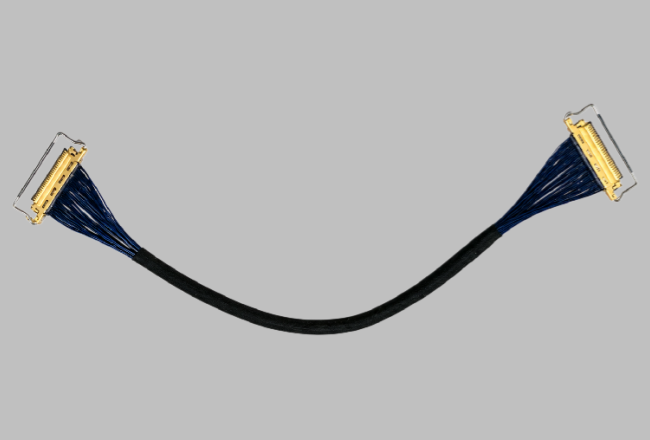
The core of high-definition signal transmission is not that "the thinner the wire is, the better," but rather overall matching.
High-definition signal transmission via ultra-thin coaxial cables is feasible, but high-speed high-definition applications require much more from the cables than do ordinary low-speed connection lines. The true determinant of transmission performance is the overall performance of factors such as cable structure, characteristic impedance, shielding performance, connector matching, termination technology, cable length, and line position definition. The I-PEX 82650-100B-02-D, corresponding to a 30-pin, 40AWG, 100mm, 1-N configuration, along with the 20634-130T-02 connector, provides a clear reference foundation for engineers to select and develop similar high-speed ultra-thin coaxial cable types. I am【3W Electronic Components Network】If you need to select, purchase, develop, or find alternative solutions for ultra-fine coaxial cable assemblies, please feel free to contact us at any time.Manager Zhang: 18913228573 (WeChat number same)For enterprises looking for compatible alternatives to I-PEX CABLINE®-CA series products, they can carry out sample verification and parameter matching based on actual application requirements, realizing domestic production of wire harnesses, supply chain optimization, and cost control of procurement while ensuring high-speed signal integrity.
“Without the consent or authorization of this site, no one shall reproduce, reprint, distribute, cite, change, broadcast or publish the content in whole or in part in any form, nor shall there be any other violation of the copyright of this site.