


Categorization:Harness Component
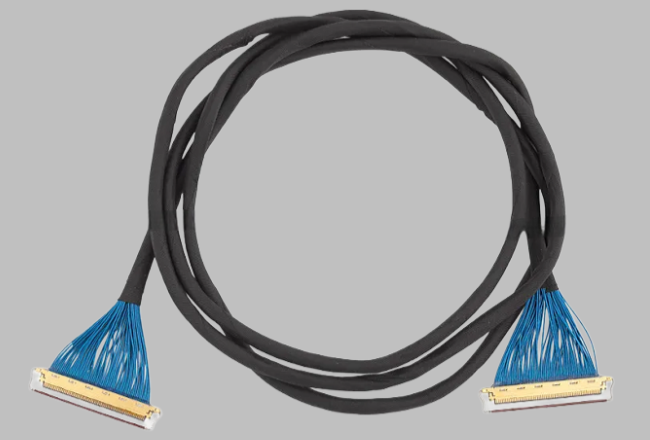
In notebook computers, display devices, industrial vision, camera modules, and other high-density electronic devices, internal high-speed signal connections not only need to meet transmission performance requirements but also need to consider space size, wiring flexibility, and long-term reliability. For such application needs, the I-PEX 82980-100B-01-D is a high-speed cable assembly product using a very thin coaxial structure, suitable for internal connections of devices with high requirements for cable size and signal transmission performance. This product adopts a 20PIN connection scheme, and the connector model at the cable end is 20634-120T-02. The connector is designed with a 20PIN, 0.4MM pitch, which can achieve high-density signal connections. For engineers, when selecting such very thin coaxial cable assemblies, in addition to confirming the PIN number, connector model, and cable length, they should also pay close attention to parameters such as cable specifications, termination method, characteristic impedance, signal integrity, and mechanical reliability; for purchasers, it is necessary to further confirm product part numbers, connector matching relationships, and consistency of alternative products to avoid situations where "models are similar but cannot be directly replaced."

The extremely fine coaxial cable bundle, due to its small wire diameter and precise structure, usually experiences assembly bending, routing corner turns, equipment opening and closing, and long-term dynamic motion inside actual equipment. Therefore, the bending resistance is an important indicator for evaluating the reliability of the cable bundle. During engineering testing, it is generally necessary to determine the bending radius, bending angle, reciprocation times, bending speed, and test environment according to the actual usage status of the product, and then repeatedly bend through a dedicated bending test device. During the testing process, it is not only necessary to observe the appearance of the cable bundle, but also to combine the forward and reverse comparisons of conductive resistance, contact resistance, insulation performance, and high-speed signal transmission performance. For high-speed extremely fine coaxial cable bundles, it is more important to pay attention to whether there are problems such as impedance change, increased transmission loss, degraded crosstalk, or reduced shielding performance after bending. In the actual development process, targeted bending resistance test plans can be formulated according to the bending path and motion conditions of the customer's equipment, such as simulating the repeated opening and closing of the screen, the movement of the camera module, or the dynamic routing inside the equipment, to verify the reliability of the cable bundle under long-term use conditions. Therefore, for I-PEX 82980-100B-01-D and other 20PIN high-speed extremely fine coaxial cable bundles, when carrying out domestic substitution development, the bending resistance performance should also be taken as an important verification item, and it cannot be solely judged by "the same size and able to be inserted into the connector" as the basis for the success of substitution.

For engineers, the first step in selection should be to confirm the original product's I-PEX material number/model: 82980-100B-01-D, then verify if the wire harness connector is 20634-120T-02, and ensure that the connector is 20PIN with a 0.4MM pitch. Additionally, further check the wire harness length, wire sequence, termination structure, wire specification, and installation space inside the device. If the application involves high-speed signal transmission, a complete SI verification is required, with a focus on evaluating insertion loss, return loss, crosstalk, and impedance consistency, among other indicators. For purchasing personnel, it is recommended not to only purchase according to "20PIN ultra-thin coaxial cable" but to use product material number/model + connector model + PIN number + Pitch + wire specification + length + termination method as the basic conditions for supplier inquiry and alternative assessment. Our company has been focusing on the production and manufacturing of ultra-thin coaxial cable assemblies and compatible alternatives for a long time and can develop wire, termination, and size matching according to the original factory samples, drawings, or product material numbers provided by the customer. Our company can provide: I-PEX 82980-100B-01-D compatible alternative wire harness solutions to help customers customize based on the installation size and connector matching requirements, further focusing on wire harness length, bending path, high-speed signal performance, and bulk production needs.

For projects that need to replace I-PEX 82980-100B-01-D, it is recommended that engineers and procurement personnel adopt a comprehensive evaluation approach of "connector matching + cable matching + structural matching + electrical performance verification + reliability verification". Firstly, confirm the connector model 20634-120T-02 at the cable end and its 20PIN, 0.4MM pitch features, ensuring that the replacement cable can reliably match the connector at the device end; secondly, check the cable length, wire direction, wire sequence, and termination size to avoid interference during installation; thirdly, confirm the electrical parameters of the extremely thin coaxial cable and its high-speed signal performance, especially for high-speed display, camera, and data transmission applications, where signal integrity testing on actual equipment should be conducted. In terms of reliability, it is recommended to increase tests such as bending, tensile strength, insertion and extraction, temperature, and environmental durability, with the bending resistance test simulating the actual operating conditions of the customer's equipment as much as possible. For bulk procurement projects, attention should also be paid to the consistency of the replacement cables, termination yield, delivery capacity, and long-term stable supply capability. By adopting the above methods, it can avoid judging compatibility solely based on appearance and size, thereby improving the first verification success rate of domestic replacement projects.
“Without the consent or authorization of this site, no one shall reproduce, reprint, distribute, cite, change, broadcast or publish the content in whole or in part in any form, nor shall there be any other violation of the copyright of this site.