


Categorization:Harness Component
The finer the coaxial cable bundle, the more precise it is, and the more attention should be paid to the impact of bending on high-speed signals.
Within laptops, display devices, industrial cameras, AI vision equipment, robots, and other high-density electronic devices, extremely fine coaxial cables play a crucial role in high-speed differential signal transmission. Compared to ordinary cables, extremely fine coaxial cables have advantages such as small diameter, light weight, flexible wiring, and low space occupancy. However, at the same time, their internal conductors, insulating layers, shielding layers, and overall structure are also more precise, so the bending method, bending radius, and bending position will directly affect the signal transmission performance. Taking the I-PEX 82975-100B-01-D coaxial cable of the CABLINE®-CA series as an example, its配套 line material connector model is 20634-210T-02, and the wire material specification compatible with the connector is AWG#40. The AWG#40 extremely fine coaxial cable itself is already a very fine high-speed wire material. When the cable is repeatedly bent, excessively bent, or locally compressed inside the device, it cannot be simply regarded as a common wire that "as long as it doesn't break, there is no problem." For high-speed signals, even if the cable has no obvious damage on the surface, minor changes in the internal electrical structure may cause changes in impedance, insertion loss, return loss, and crosstalk, ultimately resulting in a decrease in signal quality.
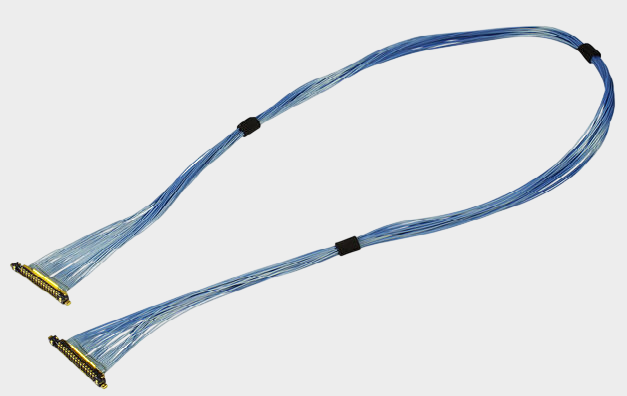
Why does the bending of ultra-fine coaxial cable bundles affect signal transmission?
One of the core advantages of extremely fine coaxial cable bundles is their stable transmission of high-speed signals through their internal structure. Under normal conditions, the center conductor, insulating layer, and shielding layer maintain a relatively stable geometric relationship, forming a relatively stable characteristic impedance. When the bending radius of the cable bundle is too small or it is subjected to unreasonable mechanical stress, the first possible occurrence is a slight displacement of the internal conductor, while the insulating material is compressed or stretched, causing a change in the distance between the conductor and the shielding layer. For low-speed, low-frequency signals, this change may not be significant; however, for high-speed differential signals, even a local structural change may cause impedance discontinuity, causing some of the signals to reflect, increasing return loss, and further affecting eye diagrams, jitter, and signal margin. Moreover, bending may also change the relative positions of the two differential signals, altering the balanced state of the differential pair, thus increasing the risk of mode conversion and crosstalk. It is especially important to note that extremely fine coaxial cable bundles are usually bent, looped, and routed during equipment assembly. If the bending area is too close to the connector end, mechanical stress may concentrate on the crimping or termination area, leading to a decrease in contact reliability after long-term use. Therefore, "the cable bundle is not broken" does not mean "high-speed signals are not affected." Reasonably controlling the bending radius, avoiding sharp bends and repeated bending, is an important part of the design and production verification of high-speed extremely fine coaxial cable bundles.
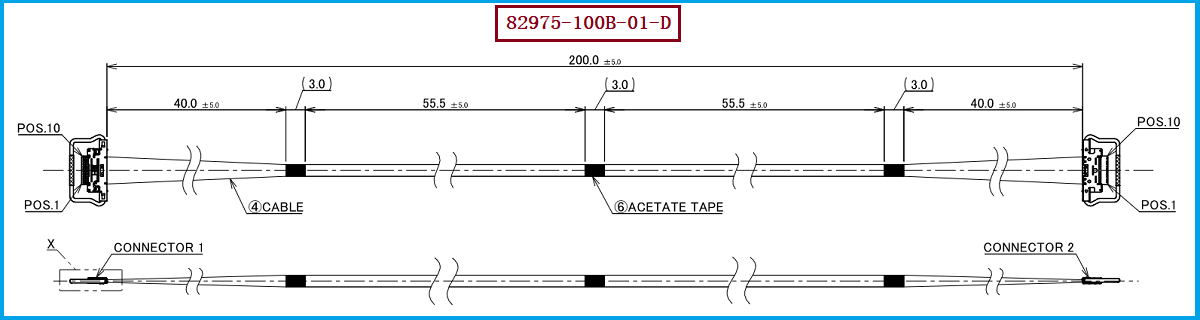
From the perspective of engineers and purchasing, what should be paid attention to when considering the compatibility and substitution of 82975-100B-01-D?
For engineers, when selecting or replacing the I-PEX 82975-100B-01-D, it is not enough to simply check the cable length and connector shape; it is more important to pay attention to the connector model, Pin definition, cable specification, impedance control, shielding structure, termination process, and signal integrity after bending. The wire end connector used by this product is 20634-210T-02, and the corresponding cable specification is AWG#40. Therefore, when designing for compatibility and replacement, it should be ensured that the replacement cable meets the original application requirements in terms of connector fit, cable specification, and electrical performance, and that the routing and bending method is reasonable based on the actual internal space of the equipment. For purchasing personnel, a truly valuable replacement solution is not just "the connector can be plugged in," but also requires further confirmation of sample verification, batch production consistency, delivery time, cost, and long-term supply capacity. Especially in high-speed equipment, if the cable experiences signal attenuation or impedance change after bending, even if the mechanical dimensions are completely compatible, it may lead to failure of the whole machine verification. Therefore, it is recommended to use "mechanical compatibility + electrical compatibility + process compatibility + production reliability" as an overall evaluation standard when making purchasing and selection decisions, rather than relying solely on the connector part number as the only basis for judgment.
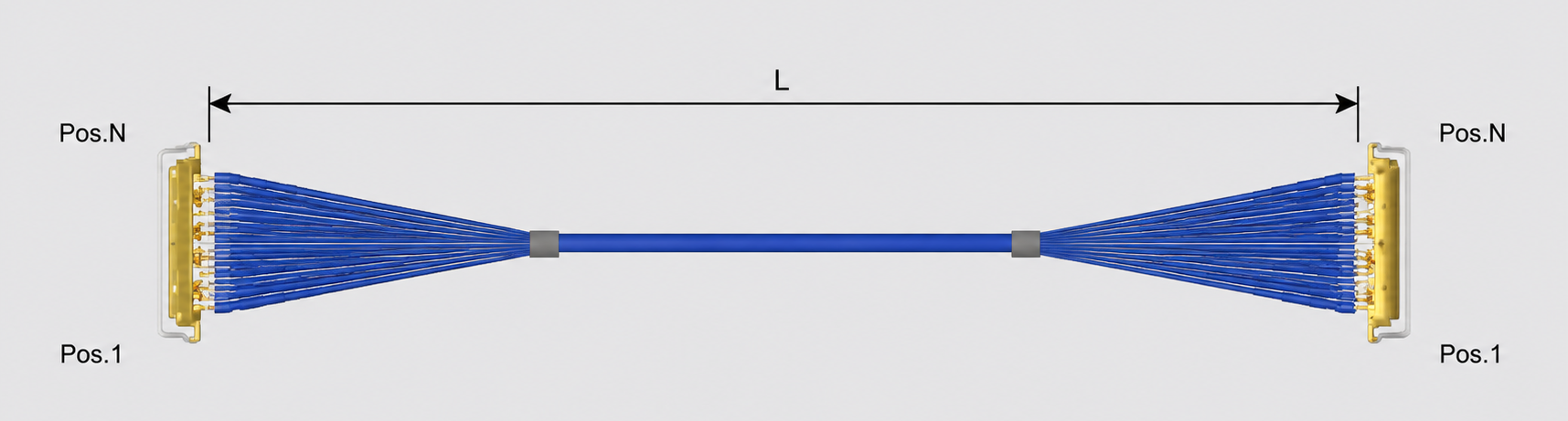
Selection and compatibility with reference and suggestions for alternative solutions
For the domestic alternative of I-PEX 82975-100B-01-D, engineers are recommended to first confirm the connector interface, Pin quantity, and Pin Assignment of the original cable harness, then confirm the use of extremely thin AWG#40 coaxial cable, and verify impedance, attenuation, and crosstalk based on the actual high-speed signal type and transmission distance. In terms of structural design, it is important to confirm the cable harness exit direction, the length of the termination area, the minimum bending radius, and the actual stress after equipment assembly to avoid sharp bends near the connector. For devices that require frequent movement, opening and closing, or vibration, it is also recommended to focus on evaluating the dynamic bending life and long-term signal stability. For purchasing personnel, it is suggested to require sample recognition at the supplier introduction stage, and to comprehensively verify the alternative cable harness through tests such as size, conductivity, voltage resistance, insulation, terminal retention force, and high-speed signal related tests. Based on the matching relationship of 20634-210T-02 + AWG#40, our company can provide: I-PEX 82975-100B-01-D alternative cable harness solution, which can match specifications, customize lengths, process terminations, and mass produce extremely thin coaxial cable harnesses according to customers' actual application needs, providing domesticated and compatible cable harness supply options for equipment using I-PEX CABLINE®-CA series connector solutions.
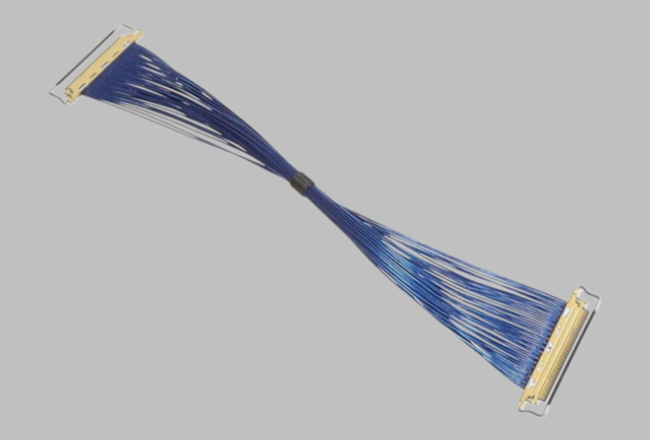
High-speed ultra-fine coaxial cable束,it is not just about "whether it can be connected," but also about whether it can still be stable in transmission after bending.
For high-speed cable assembly products like I-PEX 82975-100B-01-D that use extremely thin AWG#40 coaxial cable material and are matched with 20634-210T-02 connectors, the mechanical structure and electrical performance of the cable assembly are interrelated. Reasonable bending does not become a significant短板 for high-speed signal transmission, but overly small bending radii, localized compression, repeated bending, and improper forces near the termination area can cause internal structural changes, which in turn may affect impedance continuity and signal integrity. Therefore, during the selection, development, replacement, and procurement processes of extremely thin coaxial cable assemblies, attention should be given to connector matching, AWG wire diameter, cable assembly structure, bending technology, and high-speed electrical performance. I am【3W Electronic Components Network】We specialize in providing customized and compatible alternative services for high-speed ultra-thin coaxial cable assemblies such as eDP, MIPI, USB3.X/4, LVDS, etc. If you need technical support, please contact us:Manager Zhang 18913228573 (WeChat same number)Our company specializes in the production and manufacturing of ultra-fine coaxial cable assemblies and compatible alternative solutions. We can provide corresponding cable assembly processing and domestic substitution support based on customers' product structures and actual application needs, helping customers reduce supply chain costs and substitution risk.
“Without the consent or authorization of this site, no one shall reproduce, reprint, distribute, cite, change, broadcast or publish the content in whole or in part in any form, nor shall there be any other violation of the copyright of this site.