


Categorization:Harness Component
In notebook computers, high-resolution display devices, industrial cameras, machine vision, AI vision equipment, and other high-speed electronic devices, with the continuous increase of signal rate, the internal wiring harness not only needs to meet the structural requirements of "miniaturization and light weighting", but also needs to have good impedance control, signal integrity, and EMI interference resistance. The I-PEX CABLINE®-CA series is an extremely fine coaxial cable connection solution designed for such high-speed, high-density internal connection scenarios. According to the provided product information, I-PEX 82857-100B-02-D belongs to the CABLINE®-CA series evaluation use of extremely fine coaxial cable assembly, using 10Pin, Micro-Coaxial extremely fine coaxial cable, AWG#40, 100mm length, and 1-N Pin Assignment configuration. The connector model used at the cable end is 20634-210T-02, and the extremely fine coaxial cable specification corresponding to this connector is compatible with AWG#40. For engineers, the value of this type of cable assembly is not only to complete electrical connections but more importantly, to balance high-speed signal transmission, mechanical reliability, and electromagnetic compatibility within a limited space. For purchasers, it is necessary to further pay attention to the manufacturer model correlation, wire diameter, number of pins, length, termination method, and manufacturing consistency of alternative suppliers.
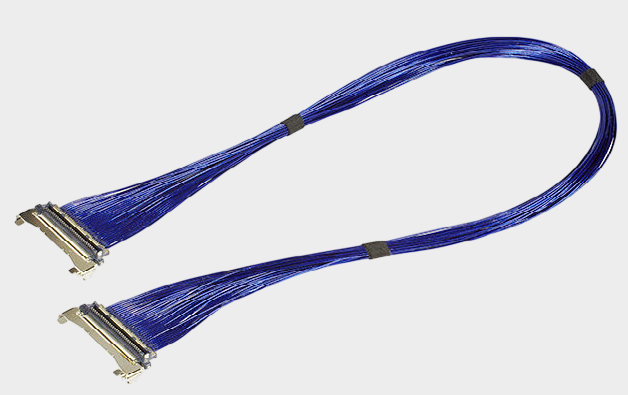
When high-speed signals pass through extremely thin coaxial cables, the common failure modes are initially from signal attenuation, impedance discontinuity, increased return loss, crosstalk, and EMI interference. Especially as the frequency of high-speed digital signals continues to increase, the cable itself, the connector termination area, and the transition position between PCB and cable束 may form impedance mutations. If the structural dimensions, dielectric material, conductor size, or shielding structure of the extremely thin coaxial cable are not controlled stably, it may cause increased insertion loss, resulting in a decrease in the amplitude of the received signal; when the impedance matching between the connector termination and the cable is poor, reflections are likely to occur, leading to a decrease in eye diagram margin and an increase in jitter, ultimately resulting in sporadic errors in high-speed communication, abnormal images, unstable data transmission, or even the inability to establish a normal link. In addition, factors such as small bending radii of the cable束, inconsistent剥线 sizes at the ends, fluctuations in crimping or welding processes, and poor shielding layer treatment may also become potential failure points in high-speed links. Therefore, during the manufacturing process of I-PEX 82857-100B-02-D AWG#40 extremely thin coaxial cable束, it is necessary to focus on controlling the consistency of the conductor, insulation layer, shielding layer, outer sheath, and connector termination to ensure that the entire signal path maintains as continuous and stable electrical characteristics as possible.
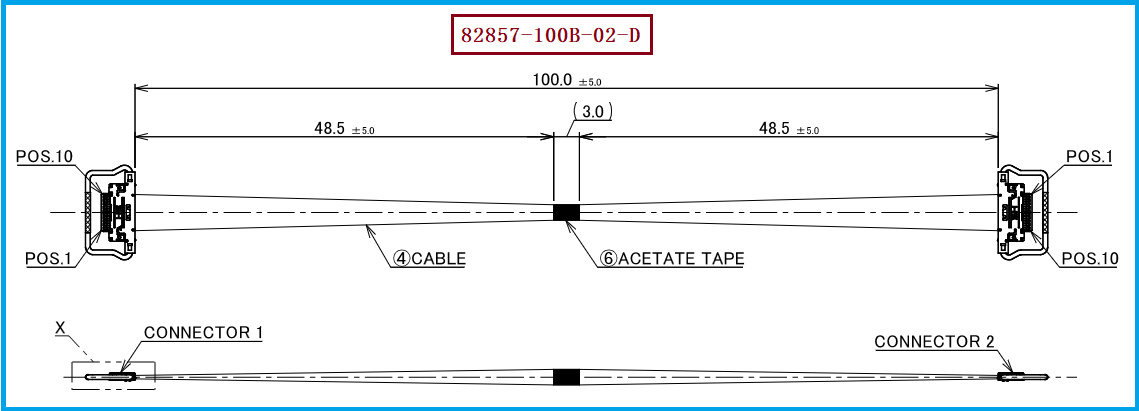
For the common failure modes in the high-speed transmission of extremely fine coaxial cable bundles, relying solely on the connector itself cannot completely solve the problem. The true impact on the final performance is the overall match of "cable + termination + shielding + manufacturing process." Extremely fine coaxial cables usually transmit high-speed signals through the central conductor, and utilize insulating media and peripheral shielding structures to form a relatively stable transmission environment; the dielectric properties of the insulating material directly affect the characteristic impedance and high-frequency loss, while the shielding layer is responsible for suppressing external EMI and reducing signal crosstalk. Taking AWG#40 as an example, its wire diameter is very fine, which, while providing the advantage of high-density wiring, also imposes higher requirements on stripping, cutting, maintaining the coaxial structure, terminal connection, and tension control. Therefore, engineers should not only look at the "AWG#40" parameter when selecting high-speed cable bundles, but should also make a comprehensive evaluation based on signal rate, transmission length, impedance requirements, bending space, and connector termination structure; purchasers should also pay special attention to confirming that the wire diameter, Pin position, length, connector type, wire sequence, and termination process are consistent with the original design when selecting alternative suppliers. For I-PEX 82857-100B-02-D, its matching connector model is 20634-210T-02, corresponding to AWG#40 extremely fine coaxial cable, so when considering compatibility and alternative, priority should be given to one-to-one matching around these key specifications, and not just based on appearance dimensions to determine whether it can be replaced.
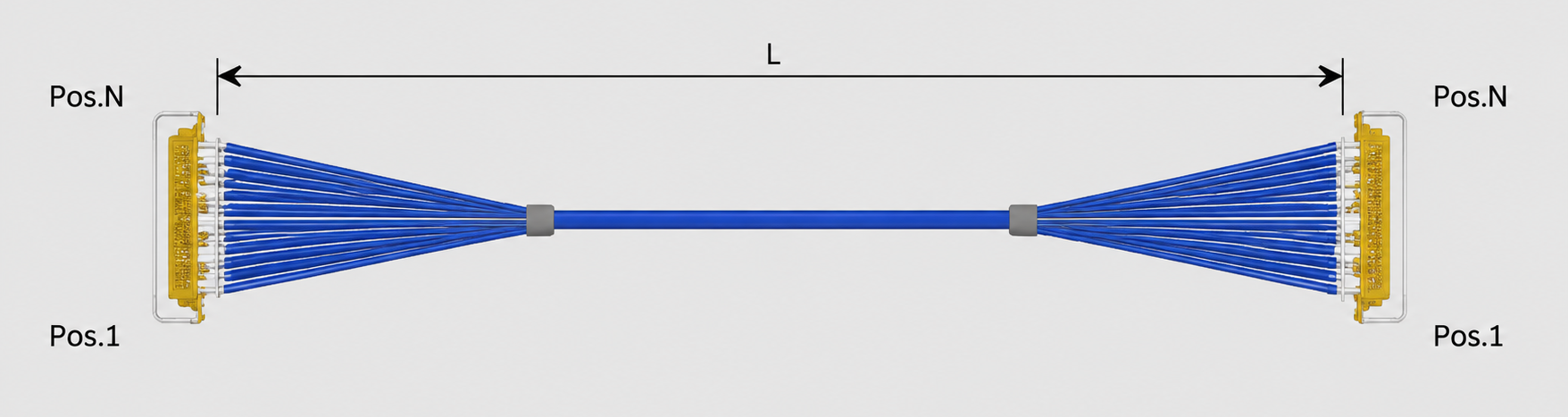
For projects that need to import I-PEX CABLINE®-CA series cables, engineers are advised to first confirm the PCB connector system and the actual number of pins used, and then confirm the cable length, wire sequence, AWG specification, and high-speed signal type. If the original design uses I-PEX 82857-100B-02-D, its core reference configuration can be understood as 10Pin + Micro-Coaxial + AWG#40 + 100mm + 1-N, and the connector model at the cable end is 20634-210T-02. During the compatibility replacement process, it is necessary to focus on checking the mating dimensions of the connectors, the termination structure, the wire sequence definition, the length tolerance of the cables, and the high-speed signal transmission performance, and to carry out sample verification through projects such as impedance, insertion loss, return loss, crosstalk, and EMI. For the purchasing department, if there are pressures related to delivery time, cost, MOQ, or supply stability in the original supply chain, suppliers with independent manufacturing capabilities of extremely fine coaxial cables can be found for localization or the introduction of a second supplier; however, replacement is not just a simple change of a "same specification cable," but it should ensure that the connectors match, the AWG specification is consistent, the Pin definition is consistent, the length is consistent, and it passes high-speed signal integrity verification. Our company can provide I-PEX 82857-100B-02-D compatible replacement cable solutions, and can produce samples and custom-made extremely fine coaxial cables according to the actual equipment structure, connector configuration, cable specification, and length requirements of the customers, providing compatibility design support for engineers, as well as a stable second supply chain choice for purchasers.
“Without the consent or authorization of this site, no one shall reproduce, reprint, distribute, cite, change, broadcast or publish the content in whole or in part in any form, nor shall there be any other violation of the copyright of this site.