


Categorization:Harness Component
In laptops, AI terminals, high-speed displays, industrial vision, and high-speed computing equipment, with the continuous increase in signal rates, internal wiring harnesses not only need to meet miniaturization requirements but also need to consider high-frequency signal integrity, impedance control, and EMI suppression capabilities. The I-PEX 82452-100B-02-D introduced in this article belongs to the CABLINE®-UM series 40Pin ultra-thin coaxial cable evaluation sample, corresponding to 40Pin, AWG#40 Micro-Coaxial, length 300mm, and 1-N Pin Assignment application solutions. The connector model used at the cable end is 20878-040T-01, which is compatible with AWG#40 ultra-thin coaxial cables. The CABLINE®-UM connector uses a 0.4mm Contact Pitch, vertical right-angle structure, and is paired with a height of approximately 2.2±0.15mm. It also adopts ZenShield® full shielding and mechanical locking design, making it suitable for internal connections in devices with limited space and high requirements for high-speed signal integrity.
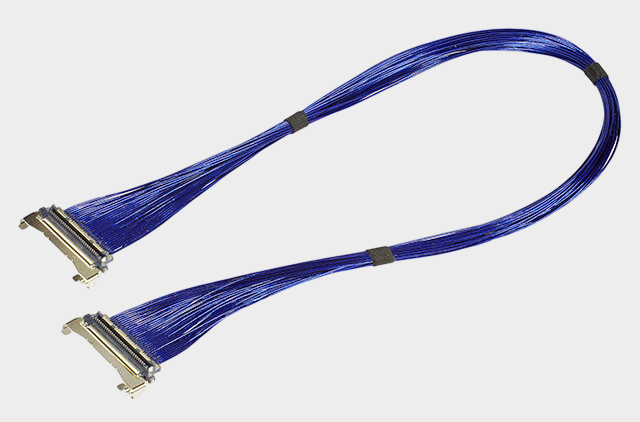
Engineers often ask when selecting components, "How much GHz of signal can a very thin coaxial cable transmit?" In fact, there is no fixed frequency range for very thin coaxial cables that is determined solely by the AWG wire diameter or connector type. The actual usable upper frequency limit needs to be judged comprehensively by considering the cable structure, characteristic impedance, cable length, attenuation, return loss, crosstalk, connector performance, and specific high-speed protocols. For AWG#40 very thin coaxial cable sets like the I-PEX 82452-100B-02-D, the accompanying CABLINE®-UM platform is designed for high-speed signal applications such as USB4, Thunderbolt 5, DisplayPort, eDP, HDMI, MIPI, etc., indicating that these cable sets are mainly used for multi-GHz high-speed signal transmission scenarios. It should be noted that Gbps is not the same as GHz: for example, high-speed digital signals are expressed in Gbps for data rate, but their actual frequency spectrum covers from low frequencies to multiple GHz and even higher frequency bands; for engineers, it is more important to pay attention to indicators such as Nyquist frequency, insertion loss (Insertion Loss), return loss (Return Loss), crosstalk, and eye diagrams under the target protocol, rather than simply judging the performance of the cable set based on "supporting how many GHz." Therefore, the value of very thin coaxial cables is not simply pursuing the highest frequency, but rather achieving controllable impedance, lower loss, low crosstalk, and stable high-speed transmission within limited space.
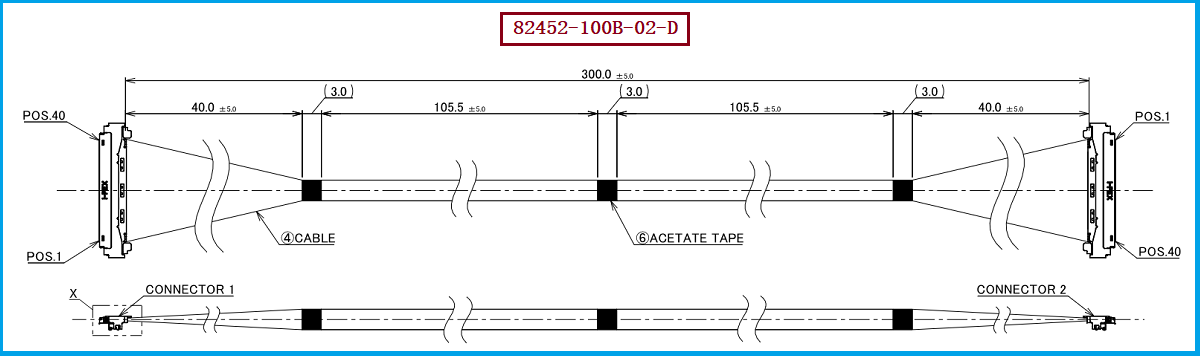
For engineers, when choosing the I-PEX 82452-100B-02-D or equivalent cable harness, it is recommended to first confirm the high-speed protocol used by the equipment and the actual data rate, and then conduct a signal integrity assessment in conjunction with the cable length. This model is 40Pin, AWG#40, and 300mm in length, with connectors using 20878-040T-01. Therefore, when designing high-speed display, high-speed computing modules, or other internal high-speed interconnections, it is essential to check the connector Pin definition, signal and GND arrangement, cable length, characteristic impedance, and insertion loss within the target frequency range. Especially for high-speed signals, the longer the cable, the more obvious the transmission loss, so it cannot be simply assumed that "the same AWG#40, any length has the same performance." During the supplier evaluation stage, it is also recommended for purchasers to request test data that matches the actual cable length, connectors, and termination processes, thereby avoiding the comparison of only unit price or cable diameter while ignoring high-speed performance. Our company can provide I-PEX 82452-100B-02-D compatible alternative cable harness solutions, which can be designed and manufactured around AWG#40 wire materials, 40Pin connector schemes, and the actual cable length, Pin definition, and installation space of the equipment.
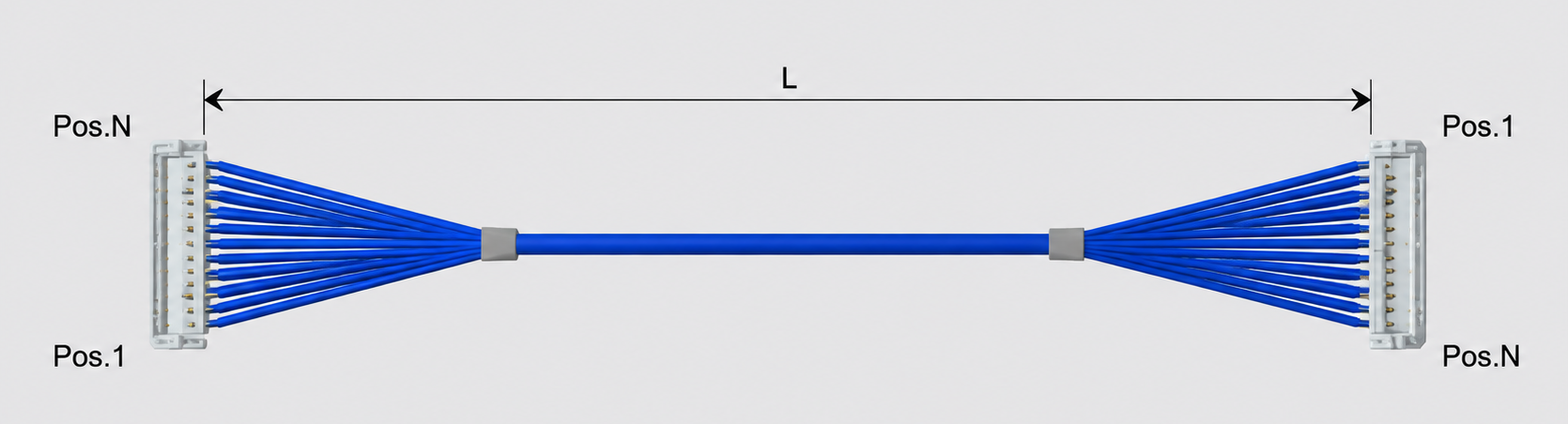
For projects requiring replacement of I-PEX 82452-100B-02-D, engineers and purchasers advise against a simple replacement based solely on "40Pin+AWG#40". Instead, they should also confirm the connector model 20878-040T-01, CABLINE®-UM series配套 structure, Pin Assignment, cable length, and high-speed signal requirements. If the original design uses a 300mm cable length, the replacement product should preferably maintain the same or similar mechanical dimensions and electrical structure, and verify impedance, insertion loss, and return loss within the target frequency range; if the device space or wiring method changes, cable length, cable exit direction, and termination scheme design can also be redesigned according to actual needs. For purchasers, it is recommended to clearly state "I-PEX 82452-100B-02-D compatible replacement" as well as key conditions such as 20878-040T-01, AWG#40, 40Pin, 300mm, and 1-N Pin Assignment during the quotation stage to reduce supplier misunderstandings. For engineering introduction, it is recommended to carry out sample testing, size matching, continuity testing, high-frequency performance testing, and actual system verification before mass introduction.
“Without the consent or authorization of this site, no one shall reproduce, reprint, distribute, cite, change, broadcast or publish the content in whole or in part in any form, nor shall there be any other violation of the copyright of this site.