


Categorization:Harness Component
Why are increasingly more high-speed devices adopting ultra-fine coaxial cables from the perspective of engineering applications?
With the continuous development of high-resolution displays, industrial vision, high-speed cameras, AI terminals, and smart devices towards high-speed and miniaturization, there are higher requirements for signal connections within the equipment for cables. Traditional connection schemes not only need to consider transmission speed but also need to take into account signal integrity, impedance matching, crosstalk control, EMI anti-interference, space occupation, and connection reliability. The I-PEX 82187-100B-02-D introduced in this article is a 30Pin ultra-fine coaxial cable solution from the CABLINE®-UM series. It adopts 40AWG ultra-fine coaxial wire, with a cable length of 100mm, and the wire end is matched with the connector model 20878-030T-01. The matched CABLINE®-UM connector uses a 0.4mm contact spacing and has ZenShield® full shielding and mechanical lock design features, which has good space adaptability in high-density high-speed internal connection applications. For engineers, such products are suitable for evaluation from the perspective of "high-speed signal connection + miniaturization + EMC control"; for procurement personnel, it can focus on whether the product can achieve stable compatibility with the original cable, mass supply, and long-term consistency.
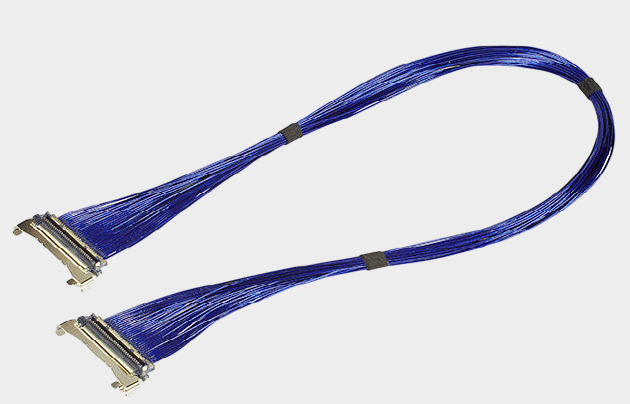
The main differences between ultra-fine coaxial cable束 and LVDS (Low Voltage Differential Signaling) are:
1. Signal Transmission Method: Ultra-fine coaxial cable束 typically transmits signals using differential signaling, while LVDS uses low-voltage differential signaling. This difference affects the signal integrity, noise immunity, and transmission distance.
2. Signal Level: LVDS has a lower signal level compared to ultra-fine coaxial cable束, which can reduce power consumption and electromagnetic interference (EMI). The lower voltage also helps to improve signal integrity over longer distances.
3. Bandwidth: Ultra-fine coaxial cable束 generally has a wider bandwidth than LVDS, allowing it to support higher frequency signals. LVDS, on the other hand, is optimized for lower frequency signals.
4. Application Scenarios: Ultra-fine coaxial cable束 is commonly used in high-speed data transmission, such as in medical imaging equipment and industrial automation systems. LVDS is often used in computer peripheral devices, consumer electronics, and high-speed communication systems.
5. Cost: LVDS may have a lower cost than ultra-fine coaxial cable束, depending on the specific product and quantity required. This is due to the simpler circuitry and lower power requirements of LVDS.
In summary, while both ultra-fine coaxial cable束 and LVDS are used for high-speed data transmission, they have different characteristics and are not simply the same product.
In actual projects, ultra-fine coaxial cables and LVDS lines often appear simultaneously in high-speed display, camera, and data transmission applications, but they are essentially not completely the same concepts. LVDS mainly describes a low-voltage differential signal transmission method, while ultra-fine coaxial cables describe the physical structure of the cable. Therefore, engineers cannot simply say "ultra-fine coaxial cables are LVDS lines" or "LVDS lines are definitely worse than ultra-fine coaxial cables." What truly needs to be compared is the specific system's requirements for transmission speed, impedance, crosstalk, EMI, cable size, and wiring density. Ultra-fine coaxial cables adopt a relatively independent coaxial transmission structure, with each signal channel having good electromagnetic isolation capabilities, which is conducive to reducing crosstalk between adjacent channels during multi-channel high-speed parallel transmission. On the other hand, LVDS commonly uses differential pair schemes to achieve good common-mode interference rejection capability through the cancellation of positive and negative signals and differential transmission. Therefore, in high-speed, high-density, and small-space applications, ultra-fine coaxial cable bundles are often more conducive to balancing high-speed signal transmission and cable miniaturization. However, the specific scheme to be adopted still needs to be comprehensively judged based on device interfaces, electrical specifications, and connector systems.
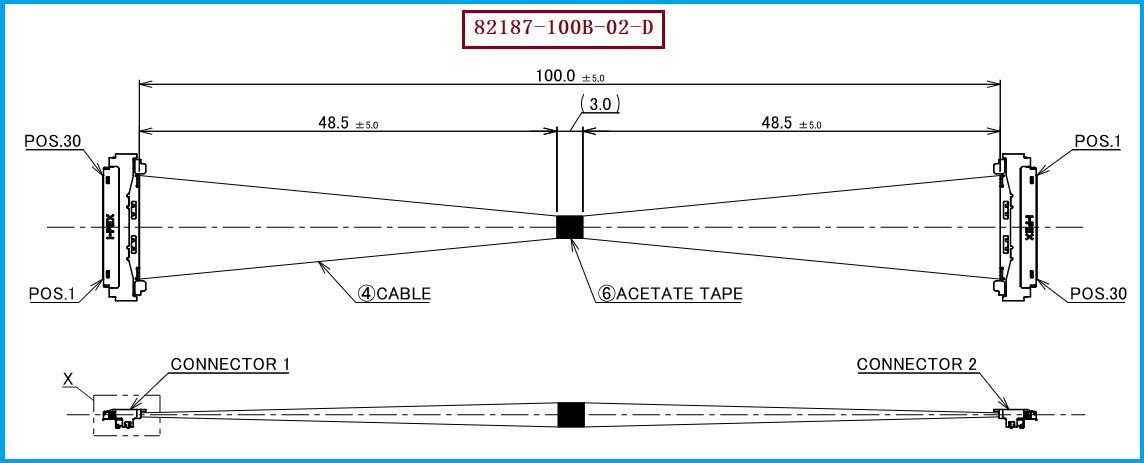
From the perspective of signal integrity: why is a very thin coaxial structure suitable for high-speed, multi-channel connections?
For engineers, the truly difficult problem with high-speed harnesses is not whether there is a signal, but whether the signal remains complete and stable after passing through the harness. As the signal rate increases, impedance discontinuity, signal reflection, insertion loss, crosstalk, and external electromagnetic interference may all affect system operation. The extremely thin coaxial cable forms a relatively independent transmission channel through the central conductor and the shielding structure, which helps control the electromagnetic environment around the signal and has certain anti-crosstalk advantages when arranged densely in multiple channels. At the same time, the CABLINE®-UM series connectors use a 0.4mm ultra-fine pitch, support 30Pin, 40Pin, 50Pin, 60Pin specifications, and adopt the ZenShield® full EMI shielding design, which helps maintain a continuous shielding effect in the area where the connector is combined with the harness. For equipment such as industrial vision, high-speed cameras, display modules, and so on, this design is particularly suitable for scenarios where a large number of high-speed signal channels need to be arranged in a limited internal space. The I-PEX 82187-100B-02-D uses a 40AWG ultra-thin coaxial cable, 100mm in length, and a 30Pin connection scheme, providing a good harness structural foundation for high-speed signal connections while meeting the miniaturization requirements.
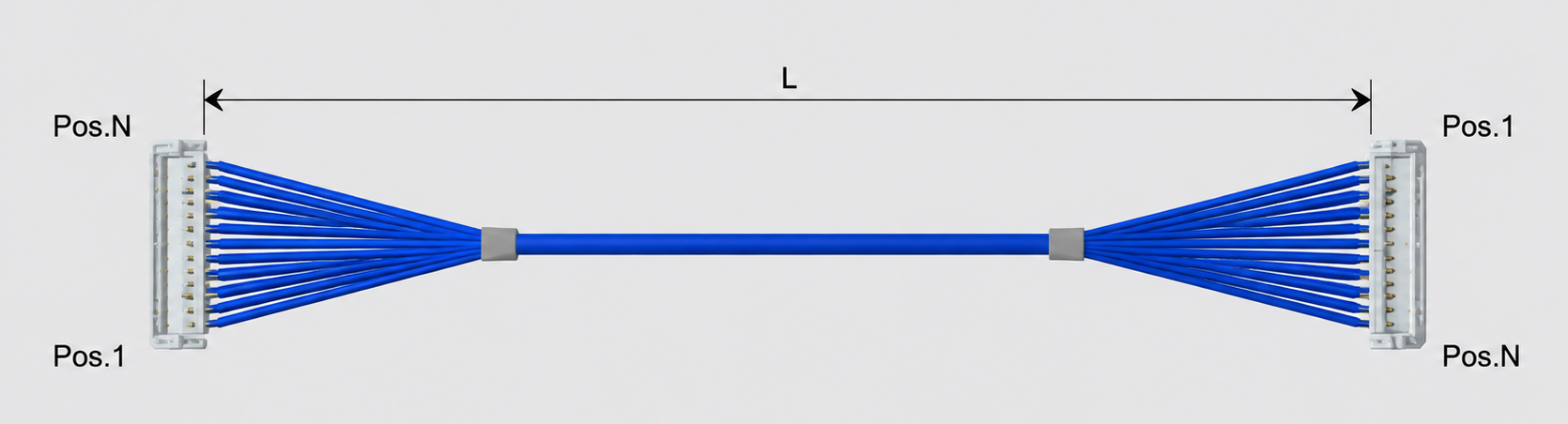
Selection, compatibility, and alternative solutions reference and recommendations: what should engineers and procurement personnel focus on separately?
If the company plans to replace the I-PEX 82187-100B-02-D, it is recommended that the engineering department first confirm the original cable's 30Pin configuration, 40AWG wire, 100mm length, 20878-030T-01 connector, and the actual Pin Assignment and assembly direction. Subsequently, the impedance, shielding, crosstalk, and high-speed transmission performance should be confirmed according to the actual signal requirements of the equipment. It should be particularly noted that compatibility replacement is not just about "the connector can be inserted", but also ensures that the mechanical dimensions, terminal contact, wire sequence, wiring method, and matching relationship with the PCB connector are consistent. For purchasing personnel, it is recommended to conduct a comprehensive evaluation from the supplier's ultra-fine coaxial cable processing capability, connector precision assembly capability, product consistency, sample verification capability, and batch delivery capability. Our company focuses on the research and development and production of ultra-fine coaxial cable assemblies and can carry out compatibility development according to the customer's original samples, drawings, connector models, and actual application requirements. We can also provide I-PEX 82187-100B-02-D compatibility replacement cable assembly solutions, corresponding production for key conditions such as 100mm length, 30Pin, 40AWG, and 20878-030T-01 connector, and provide cable solutions for customers in need of domestic replacement, second supplier introduction, and supply chain optimization.
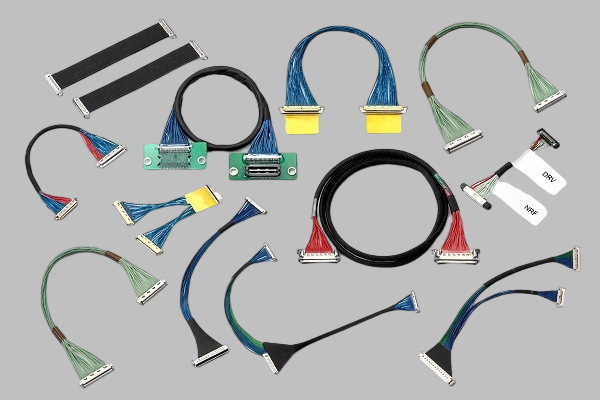
Extremely thin coaxial cables are not a simple substitute for LVDS, but rather another solution approach for high-speed interconnect needs.
The difference between extremely thin coaxial cable bundles and LVDS is not about simply comparing which one is "better," but rather lies in the different focuses of the two in solving problems. LVDS belongs to the signal transmission technology system, while extremely thin coaxial cables are a cable structure scheme adopted for high-speed signal connections. When devices enter the stage of high resolution, high speed, multi-channel, and high-density wiring, engineers need to make comprehensive selections from multiple dimensions such as signal integrity, impedance control, crosstalk, EMI, spatial layout, and connector matching. As the I-PEX 82187-100B-02-D is an extremely thin coaxial cable bundle solution with 30 pins, 40 AWG, and 100mm, paired with the 20878-030T-01 connector, it can serve as an important reference for internal connections and compatible alternative projects for related high-speed equipment. I am【3W Electronic Components Network】In the field of extremely fine coaxial cable bundles, we have mature production and engineering R&D experience, and can assist in model matching and structural substitution. For inquiries, please contact:Manager Zhang 18913228573 (WeChat same number)For enterprises seeking stable domestic alternatives or second suppliers, we can provide corresponding ultra-fine coaxial cable assembly customization and compatible alternative services based on the actual product structure and technical requirements of customers.
“Without the consent or authorization of this site, no one shall reproduce, reprint, distribute, cite, change, broadcast or publish the content in whole or in part in any form, nor shall there be any other violation of the copyright of this site.