


Categorization:Harness Component
It is not accurate to understand the ultra-fine coaxial cable束 from "how many GHz".
In high-speed digital signal applications, engineers often ask, "What is the maximum GHz of signal that this extremely thin coaxial cable bundle can transmit?" In fact, for high-speed digital interfaces such as USB4, Thunderbolt, DisplayPort, eDP, etc., it is not simple to define the highest transmission capability of the cable bundle with a fixed GHz value. More important indicators are transmission speed, signal integrity, and the insertion loss, return loss, crosstalk, and impedance control capability of the entire link within the target frequency range. I-PEX official data shows that CABLINE®-CA II is an extremely thin coaxial connector solution with a 0.4mm pitch, horizontal insertion and extraction, and full shielding structure. Its reference transmission capability reaches 32 Gbps/lane PAM4, and is compatible with high-speed applications such as USB4, Thunderbolt 5, DisplayPort UHBR20, HDMI 2.1, eDP, etc. It should be specially pointed out that 32 Gbps/lane is the high-speed transmission reference value of the connector/cable bundle solution and does not mean "the highest 32GHz"; the actual upper frequency limit that can be stably operated needs to be verified in combination with the specific thin coaxial cable material, length, impedance, connector, PCB routing, and whole machine system.
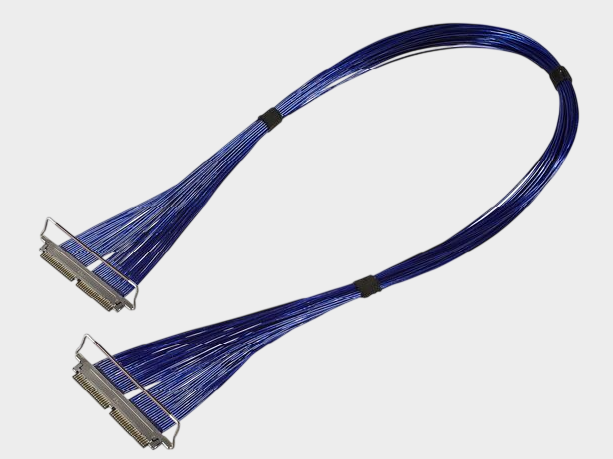
Why can extremely thin coaxial cables be used for high-frequency and high-speed signal transmission?
One of the major differences between extremely fine coaxial cable bundles and ordinary cables is that they establish a more controlled transmission structure for high-speed signals. The central conductor is responsible for signal transmission, surrounded by an insulating layer and shielding structure to form a relatively stable electromagnetic transmission environment, thereby reducing external interference and mutual influence between signals. For high-speed digital signals, what truly affects transmission quality is not simply "how thin the wire is," but rather characteristic impedance, attenuation, crosstalk, shielding effect, and the impedance continuity of the connector transition area. The CABLINE®-CA II uses a 0.4mm ultra-fine Pitch, improves EMI performance through ZenShield® full shielding and multi-point grounding structure, and adopts a mechanical locking structure to reduce the risk of connector disengagement or backtracking during use. In the officially published 32 Gbps/lane PAM4 test reference conditions, 40AWG, 45Ω, 100mm Micro-Coaxial Cable was used for testing, which also indicates that high-speed performance must be evaluated as a complete link that combines "connector + cable + length + signal definition," rather than just looking at the connector model.
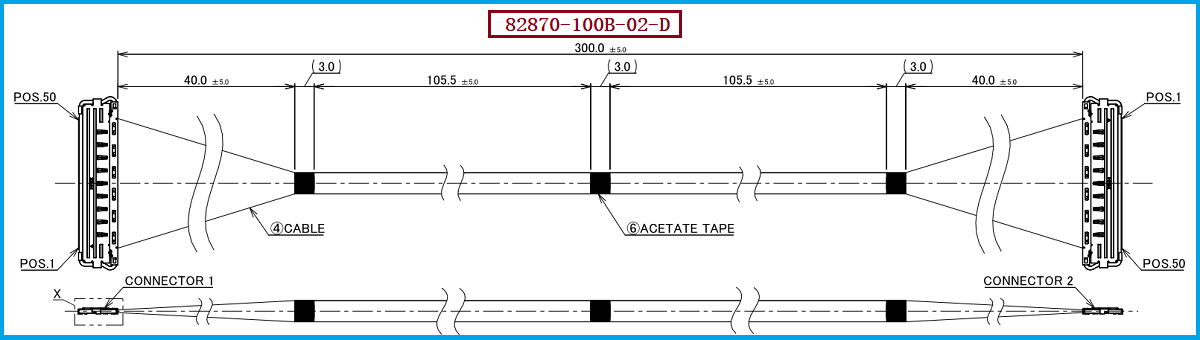
I-PEX 82870-100B-02-D: High-density ultra-fine coaxial cable assembly solution with 50Pin, 1-N structure
When designing high-speed display and high-speed data equipment for engineers, this time the key product model introduced is I-PEX 82870-100B-02-D, which belongs to the CABLINE®-CA II series 50Pin ultra-thin coaxial cable solution with a line position defined as 1-N. The cable set is paired with a cable end connector model of 20680-050T-01, corresponding to a 50Pin connection structure. The CABLINE®-CA II series supports 20, 30, 40, and 50Pin and uses a 0.4mm contact spacing; official documentation also provides a working temperature range of -40℃ to +105℃ as well as current capacity corresponding to different cable diameters. For engineers, the value of the 50Pin high-density structure is not only that "there are more pins" but more importantly, it can complete the concentrated connection of multiple high-speed signals within a limited device space; for purchasing personnel, after confirming key parameters such as 82870-100B-02-D, 20680-050T-01, 50Pin, and 1-N, it is necessary to further confirm cable specifications, length, Pin Assignment, impedance, and testing standards to avoid simple replacement based solely on part numbers.
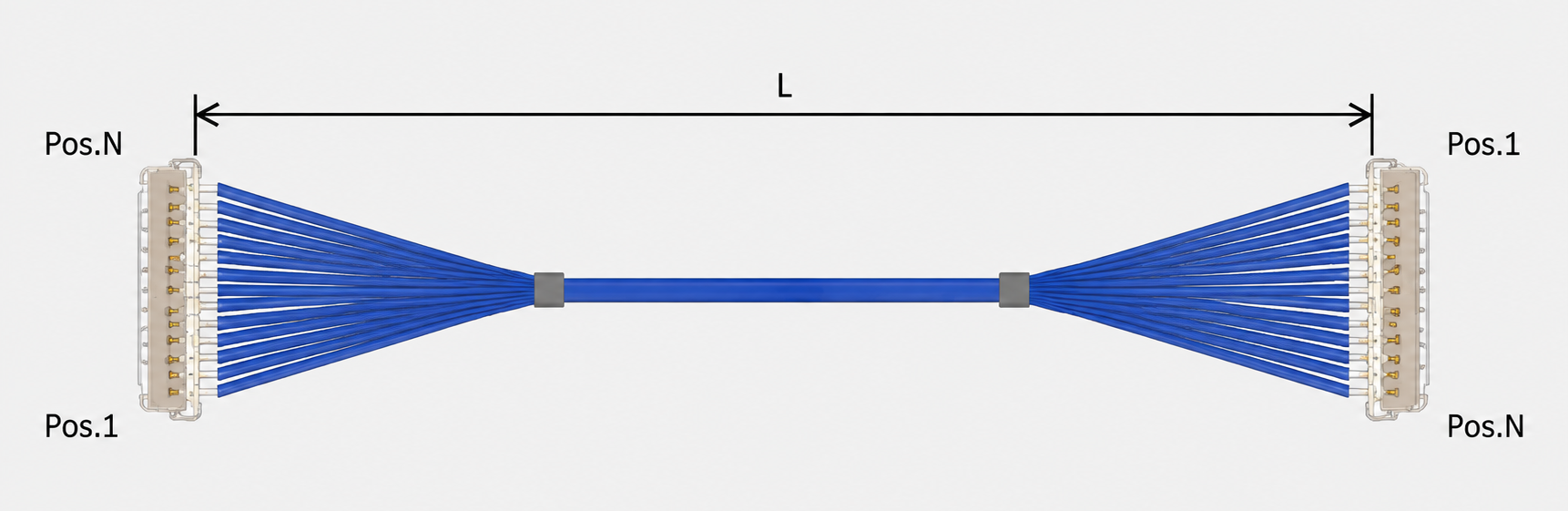
Selection, compatibility, and alternative solutions reference and suggestions
For projects that require domestic substitution, the introduction of a second supplier, or cost optimization, engineers are recommended to first use the original design connector series, pin count, wire position definition, wire material structure, characteristic impedance, wire length, and high-speed protocol requirements as the foundation, and then carry out compatibility evaluation. For this product, alternative cable harness development can be centered around the combination of I-PEX 82870-100B-02-D + 20680-050T-01 + 50Pin + 1-N; particularly for high-speed signal applications, it is not recommended to use only "identical physical dimensions" as the basis for alternative judgment. Instead, further verification should be performed on key indicators such as plug and play fit, contact reliability, impedance consistency, insertion loss, return loss, near-end/far-end crosstalk, and high-speed eye diagram. Our company can provide I-PEX 82870-100B-02-D compatible alternative cable harness solutions. We can match the specifications of extremely thin coaxial cables, perform termination processing, and develop solutions according to the customer's equipment structure and signal requirements. This provides engineers with options for domestic substitution and also provides a stable second supply source for procurement personnel.
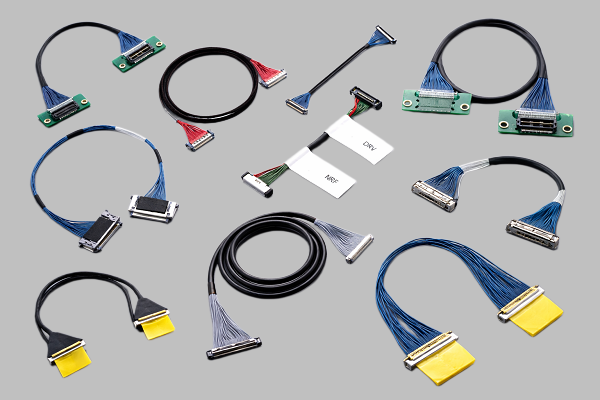
The key to determining the "highest frequency that can be achieved" by a very fine coaxial cable bundle is to examine the entire high-speed link.
The extremely thin coaxial cable assembly does not have a fixed "highest GHz" answer that is independent of specific structures, cable materials, and test conditions. For the I-PEX CABLINE®-CA II platform, the official high-speed transmission reference capability is 32 Gbps/lane PAM4, and it covers a variety of high-speed applications such as USB4, Thunderbolt, DisplayPort, HDMI, and eDP. For I-PEX 82870-100B-02-D and similar 50Pin, 1-N extremely thin coaxial cable assemblies, the true determinant of its high-speed transmission capability is the complete signal chain composed of the cable, impedance, length, connector, and the entire PCB assembly. I am【3W Electronic Components Network】We professionally provide customized and compatible replacement services for high-speed ultra-thin coaxial cable assemblies such as eDP, MIPI, USB3.X/4, LVDS, etc. If you need technical support, please contact us:Manager Zhang 18913228573 (WeChat same number)Therefore, in the process of domestic substitution and project selection, the evaluation of wire harness solutions should be upgraded from "whether it can connect" to "whether it can transmit signals stably, quickly, and reliably."
“Without the consent or authorization of this site, no one shall reproduce, reprint, distribute, cite, change, broadcast or publish the content in whole or in part in any form, nor shall there be any other violation of the copyright of this site.