


Categorization:Harness Component
Why can't the miniaturization of medical endoscopes do without extremely thin coaxial cables?
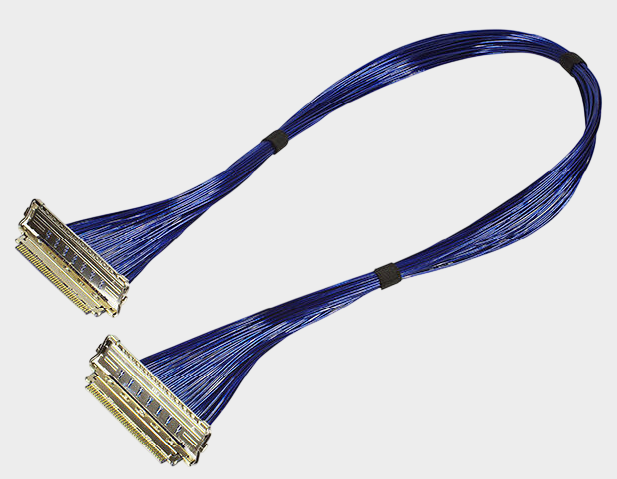
Medical endoscopes need to complete image acquisition, signal transmission, and device connection within extremely limited spaces, especially for devices like flexible endoscopes and ultra-fine endoscopes, which place higher requirements on the size, flexibility, and signal integrity of internal cables. Traditional cables with larger outer diameters and higher space requirements not only increase the difficulty of internal layout of the instruments but may also affect the miniaturization design of the probe tip. Therefore, ultra-thin coaxial cables can achieve multi-channel high-speed signal transmission within limited spaces, while also considering the cable volume and signal quality, making them an important solution for internal connections in precision medical imaging equipment. For medical equipment engineers, when choosing ultra-thin coaxial cables, they cannot only focus on whether the "wire diameter is thin enough," but also need to comprehensively consider impedance control, shielding performance, bending reliability, terminal crimp consistency, and long-term use stability.
Why do medical endoscopes have particularly high requirements for high-speed signal transmission?
The image data collected by the endoscopic camera system needs to be transmitted to the backend processing circuit through internal high-speed channels. With the development of high-definition, ultra-high-definition, and high-frame-rate imaging technology, the amount of data that needs to be transmitted within a unit of time continues to increase. The extremely thin coaxial cable bundle adopts a coaxial structure of central conductor-insulating layer-shielding layer-outer sheath, which can form a relatively stable transmission environment. This allows high-speed signals to maintain good signal integrity even under a small wire diameter. At the same time, the coaxial shielding structure can reduce the impact of external electromagnetic interference on weak image signals and also reduce the electromagnetic radiation generated by high-speed signals to the surrounding circuits. For engineers, this means that cable design cannot be simply understood as "putting many thin wires together". Instead, it requires systematic matching from aspects such as characteristic impedance, crosstalk, attenuation, shielding, connector termination, and overall signal integrity. This is also an important reason why extremely thin coaxial solutions are adopted in medical endoscopes.
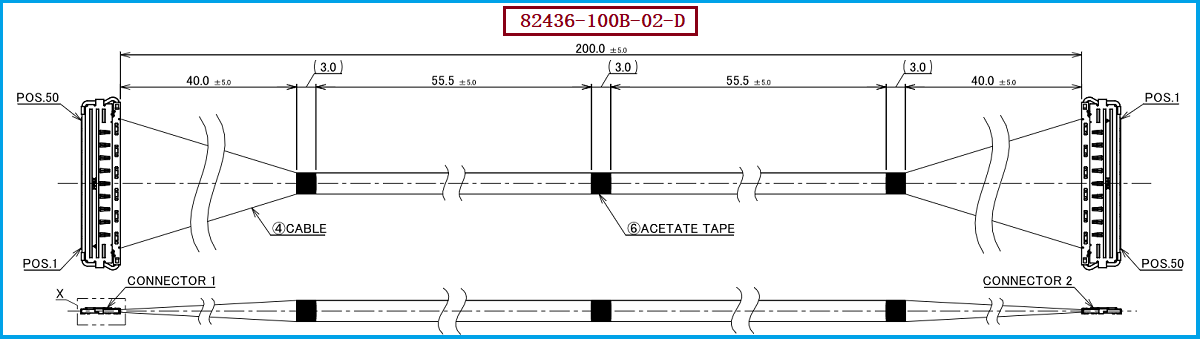
I-PEX 82436-100B-02-D: 50Pin, 200mm ultra-thin coaxial cable assembly solution
The I-PEX 82436-100B-02-D belongs to the 50Pin ultra-thin coaxial cable assembly reference model, corresponding to a length of 200mm, and is part of the 1-N (one-end connected) structural scheme, using Micro-Coaxial ultra-thin coaxial cables. The mating connector for this scheme is the model 20680-050T-01, corresponding to the CABLINE®-CA II 50Pin Plug Housing. The CABLINE®-CA II uses a high-density connection design with a 0.4mm pitch, combined with full shielding structure and mechanical lock design concepts, providing a foundation for high-density, high-speed signal connections. For medical imaging equipment engineers, this 50Pin, 200mm specification can provide high integration for multi-channel signal connections; for purchasers, 82436-100B-02-D, 20680-050T-01, and 200mm can be important information for specification verification and supplier technical confirmation. Our company can provide I-PEX 82436-100B-02-D compatible alternative cable assembly solutions, which can be manufactured and matched according to actual equipment structure, cable length, Pin count, termination method, and application requirements.
Selection, compatibility, and alternative solutions reference and suggestions
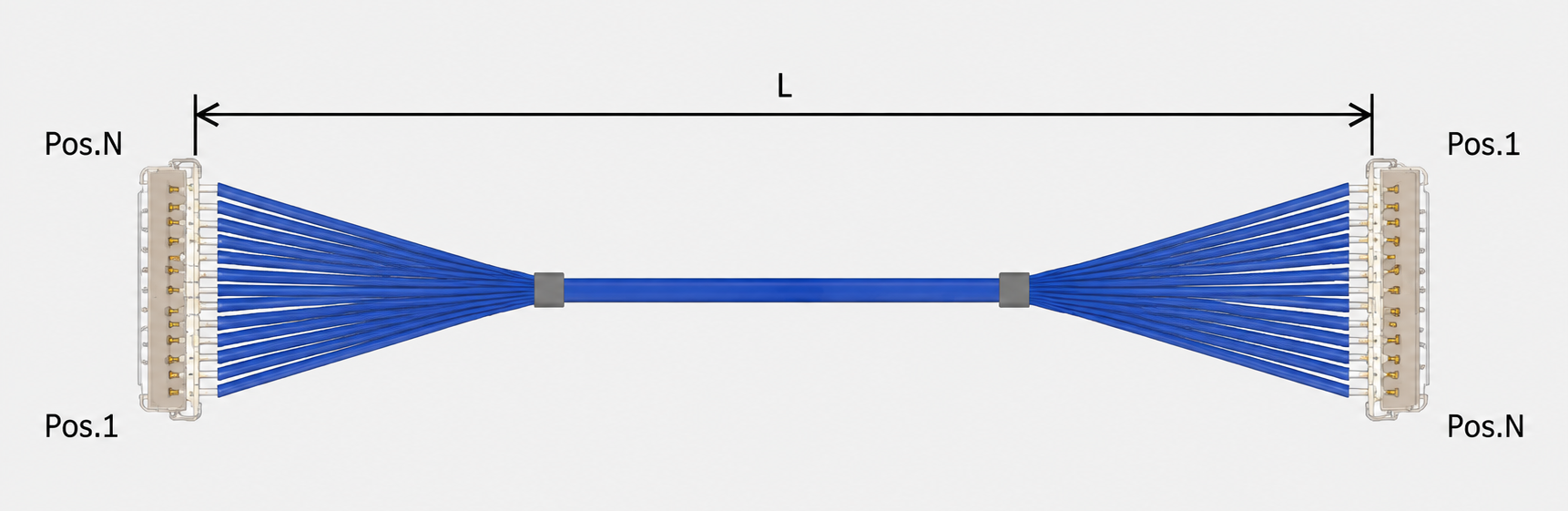
When selecting ultra-fine coaxial cable assemblies for medical endoscope projects, engineers and procurement personnel are advised not to replace connectors directly based on connector part numbers alone. Instead, they should also confirm the pin count, cable type, wire diameter/AWG, characteristic impedance, cable assembly length, connector model, termination structure, shielding requirements, and internal bending space of the equipment. For example, with this proposal, it is crucial to confirm whether the target product requires 50 pins and a 200mm length, as well as whether the cable ends use 20680-050T-01. If the original equipment uses the I-PEX CABLINE®-CA II series structure, the replacement cable assembly should also focus on verifying connector mating dimensions, terminal contact reliability, wire sequence, conductivity, and high-speed signal integrity. For procurement personnel, it is recommended to provide the original manufacturer's part number 82436-100B-02-D, the matching connector 20680-050T-01, and a length of 200mm during the quotation stage. It is also advisable to require suppliers to provide corresponding specification confirmation and sample verification to reduce compatibility risks caused by "connectors being the same but cables or processing technology being different."
Medical endoscopes require not just "thin," but also stable and reliable high-speed connections.
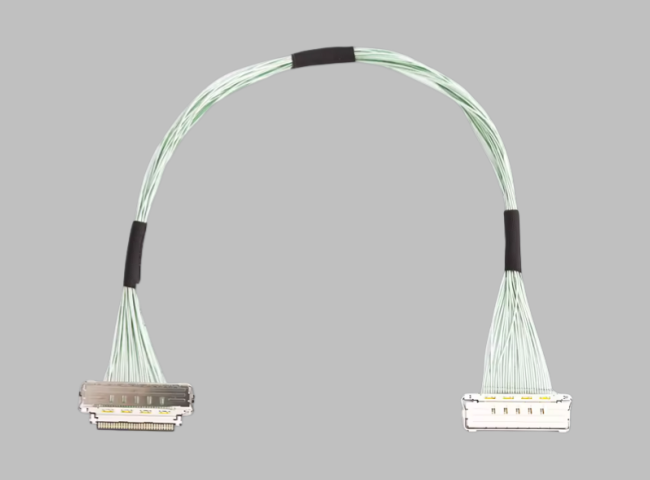
Medical endoscopes are developing towards smaller size, higher resolution, and higher integration, which simultaneously pose multiple challenges to internal cables, including limited space, high-speed transmission, multi-channel connections, anti-interference, and continuous bending. Ultra-thin coaxial cables, with their coaxial transmission structure, high-density wiring capability, and good shielding performance, provide a connection solution that balances miniaturization and high-speed signal transmission for precision medical imaging equipment. The I-PEX 82436-100B-02-D (50Pin, 200mm) + 20680-050T-01 can serve as an important reference model for specification matching and domestic alternative in related projects. I am[3W Electronic Components Network], can provide services and product solutions for structural optimization and signal consistency evaluation of high-speed ultra-fine coaxial cable assemblies. For more information, please contact:Manager Zhang 18913228573 (WeChat same number)For engineers and procurement personnel engaged in the development of medical endoscopes, precision camera modules, or other small high-speed equipment cable harnesses, choosing a fine coaxial cable manufacturer with stable termination technology and mass production capabilities helps to improve the reliability of product development and supply chain.
“Without the consent or authorization of this site, no one shall reproduce, reprint, distribute, cite, change, broadcast or publish the content in whole or in part in any form, nor shall there be any other violation of the copyright of this site.