Is it necessary to use a double shielded ultra-fine coaxial cable for high-speed signal lines?In high-speed display, camera, image capture, AI vision, and high-speed data transmission equipment, engineers often encounter a question: is it necessary to choose a "double shielded" ultra-fine coaxial cable for high-speed signal lines? In fact, not all high-speed signals must adopt a double shielded structure. The shielding scheme of high-speed signal lines needs to be judged comprehensively based on factors such as signal rate, transmission distance, working environment, impedance control, surrounding interference sources, and overall EMI requirements. The main function of the shielding layer is to reduce the external electromagnetic interference entering the signal channel and at the same time reduce the radiation of high-speed signals outward. However, "double shielding" does not mean that it will definitely bring a better overall system effect in any application.
For example, I-PEX CABLINE®-SS, as indicated in its official documentation, adopts a 0.4mm pitch, vertical right-angle structure, supports Micro-Coaxial Cable, and can cover specifications such as AWG36, AWG38, AWG40, AWG42, etc.; at the same time, the official clearly marks Full EMI Shielding (ZenShield®): No. Therefore, for specific harnesses using CABLINE®-SS, it cannot be simply judged by "whether it is double shielded" as the only criterion for high-speed performance, but attention should be paid to the cable's own shielding structure, connector termination, PCB grounding, and the overall EMI control of the high-speed link.
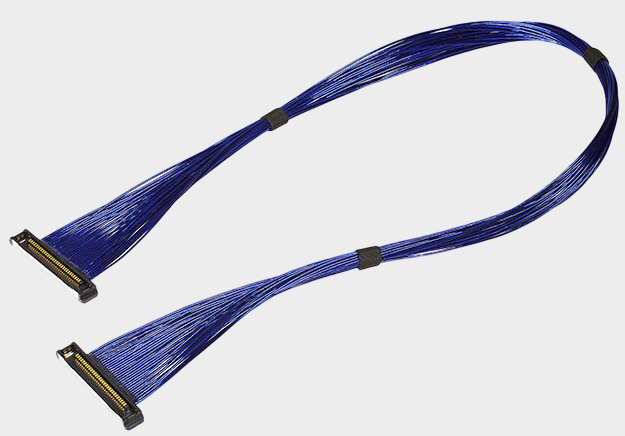
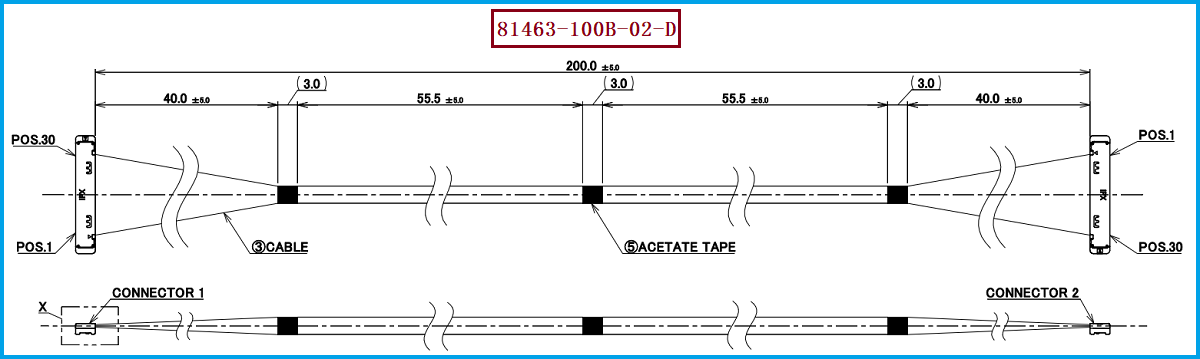
What structure does I-PEX 81463-100B-02-D use? How do high-speed applications view the shielding issue?The I-PEX 81463-100B-02-D introduced this time belongs to the CABLINE®-SS 30P ultra-thin coaxial cable assembly. The engineering drawing clearly specifies the use of Micro-Coaxial Cable, AWG #40, 50Ω, 200mm, and 1-N structure. The wire end connector is 20373-R30T-06, which corresponds to a CABLINE®-SS connector with 30PIN and 0.4mm spacing. The engineering drawing also stipulates the reverse correspondence of the two ends' pins and provides requirements such as AC250V voltage resistance, insulation resistance of more than 50MΩ, and a maximum working temperature of 80°C.
For such extremely fine coaxial cable bundles, the anti-interference capability of high-speed signals cannot be simply attributed to "single shielding or double shielding." The coaxial cable itself, with its central conductor, insulating layer, and external shielding structure, forms a controlled transmission environment. When the cable bundle enters the connector area, the shielding continuity, termination method, and grounding path between the connector and PCB also affect EMI and signal integrity. Especially for high-speed differential signals, if there is a significant change in the reference ground or shielding structure near the connector end, even if the cable itself is strongly shielded, impedance discontinuity, crosstalk, or radiation issues may still occur. Therefore, engineers should evaluate the "shielding structure" within the context of the complete signal chain when selecting components, rather than deciding whether double shielding is necessary in isolation.
Under what circumstances is it more worthwhile to consider using a double-shielded ultra-fine coaxial cable?If there are high-power DC-DC converters, motors, wireless RF modules, high-speed processors, clock signals, or other strong interference sources inside the device, and high-speed signal lines need to pass through complex internal spaces, a double shielding structure may become a scheme that needs to be evaluated. Especially in cases where the EMI test margin is small, the cable length is long, the signal rate is high, or multiple groups of high-speed signals are densely parallelly routed, enhancing shielding can be one of the means to reduce crosstalk and electromagnetic coupling.
But dual shielding may also bring changes in wire diameter, flexibility, termination technology, cost, and space occupancy. Therefore, for devices such as laptops, tablets, camera modules, which are sensitive to space and bending performance, it is not advisable to pursue "dual shielding" directly without considering the actual structure. I-PEX CABLINE®-SS itself emphasizes narrow design, and its official data shows that the connector depth is 3mm, which can be used in small pivots and other confined spaces after combining with the cable harness, and it provides a variety of pin count options from 10P to 50P.
For specific high-speed links, a more reasonable approach is to perform EMI and signal integrity verification based on the actual system, such as observing insertion loss, return loss, crosstalk, eye diagrams, and the EMI performance under actual operating conditions. If a single shielding structure is already capable of meeting the system requirements, adding a second layer of shielding may not be a necessary condition. If testing reveals obvious external interference or radiation issues, further evaluation of double shielding, grounding optimization, routing adjustments, or improving the shielding continuity at the connector ends can be considered.
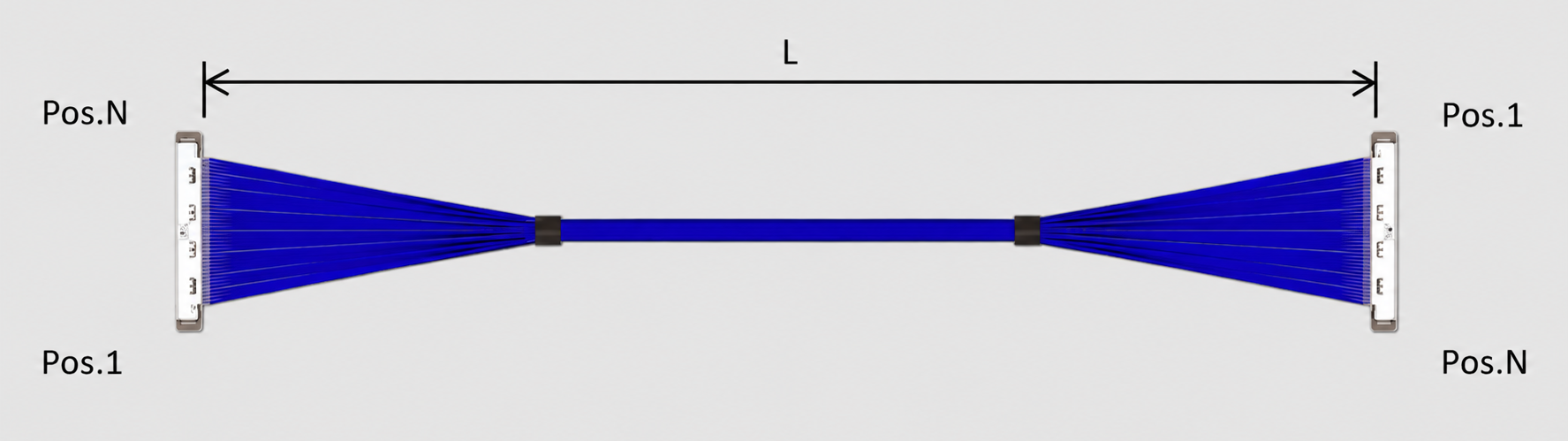
Selection, compatibility, and alternative solutions reference and suggestionsFor procurement and engineering personnel, when choosing the I-PEX 81463-100B-02-D compatible replacement cable, it is recommended to first confirm the complete product information rather than just confirming the "30Pin high-speed cable". This model corresponds to 30PIN, 0.4mm pitch, 20373-R30T-06, AWG40 Micro-Coaxial, 50Ω, 200mm, 1-N, among which 200mm is the specific cable length, and 1-N is the wire sequence definition. During alternative development, if the customer's equipment has a specific impedance requirement for high-speed signals, it is also necessary to further confirm the actual characteristic impedance of the alternative cable material as well as the impedance continuity of the finished cable assembly.
In terms of shielding schemes, they should be determined based on the actual EMI environment of the equipment, and it is not recommended to mechanically alter the original structure in pursuit of "double shielding." For compatible replacement products, it is advisable to maintain consistency in the original product's connector interfaces, pin count, spacing, wire sequence, cable length, and terminal structure, and then confirm the shielding structure according to the actual application requirements of the customer. If it is necessary to upgrade to a double shielding scheme, it should be verified in parallel for cable outer diameter, bend radius, termination size, connector assembly, and EMI effect to ensure that the improvement in electrical performance does not cause problems in mechanical installation.
Our company can provide an I-PEX 81463-100B-02-D compatible cable harness solution, which can be developed for compatibility with the 20373-R30T-06 connector, 30PIN, 0.4mm spacing, AWG40 ultra-fine coaxial cable, 50Ω, 200mm length, and 1-N wire sequence. We can also match the solution according to the customer's equipment requirements for high-speed signals, EMI, space, and cable harness structure.
High-speed signal line selection cannot be simply equated to "must be double shielding."High-speed signal lines may or may not require double shielding, which should ultimately be determined by the actual application environment and test results, rather than solely based on the term "high-speed." For I-PEX 81463-100B-02-D type CABLINE®-SS ultra-fine coaxial cable sets, the specific engineering drawings clearly specify AWG40, 50Ω, 200mm, 30P, 1-N structure, with the cable ends using 20373-R30T-06, and connectors as 30PIN with 0.4mm spacing. Meanwhile, the official CABLINE®-SS documentation also clearly indicates that Full EMI Shielding (ZenShield®) is No. Therefore, engineers should pay more attention to impedance control, shielding continuity, connector termination, PCB reference ground, signal integrity, and overall EMI performance when selecting high-speed cable sets. For procurement personnel, it should be based on specific material numbers and engineering specifications as the basis for alternative procurement, rather than simply using "double shielding" as the sole criterion for judging the quality of high-speed cable sets. I am
[3W Electronic Components Network], professionally provide mature alternative solutions for high-speed ultra-thin coaxial cables and connectors, along with engineering and product support. If needed, please contact:
Manager Zhang 18913228573 (WeChat number the same)Only by determining the appropriate shielding scheme based on actual system verification can a reasonable balance be achieved between high-speed performance, EMI, space, reliability, and cost.