


Categorization:Harness Component
For industrial robots, collaborative robots, machine vision robots, and precision motion mechanisms, the internal joints often contain motors, encoders, vision modules, sensors, and control signals simultaneously. Traditional cables, with larger outer diameters and larger bending radii, are prone to occupy limited joint space and may be affected by mechanical stresses from repeated movement. **Is the extremely thin coaxial cable suitable for wiring within robot joints?** The answer is not a simple "all robots are suitable," but rather depends on the signal type, bending radius, movement frequency, cable fixing method, and life validation requirements. For robot joints that are particularly compact and require the transmission of high-speed differential signals, extremely thin coaxial cables have significant application value. The I-PEX CABLINE®-UX II itself is a 0.25mm Pitch, 90° exit vertical structure connector for space-limited small electronic devices, and its official materials also specifically demonstrate the application scenarios of extremely thin coaxial cable bundles passing through shafts or small-diameter pipes, indicating that this "fine, flexible, and able to pass through narrow spaces" cable structure has reference significance for internal wiring within motion mechanisms.
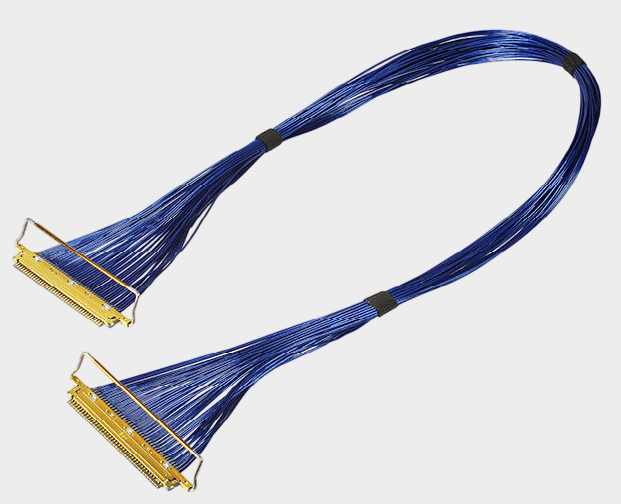
The product introduced this time is the I-PEX 83057-100B-01-D ultra-fine coaxial cable assembly, which belongs to the CABLINE®-UX II 50Pin 1-1 cable assembly, with a nominal length of 300MM and using the Micro-Coaxial Cable scheme. According to the I-PEX official model data, 83057-100B-01-D corresponds to 50Pin, 46AWG Micro-Coaxial, 300mm, and 1-1 structure; the配套的 cable end connector model is 20532-050T-02-1, and the same series also matches the 20531-050T-02-1 Plug Cable Assembly and 20533-250E Receptacle components, etc. For engineers, this 50-channel independent coaxial channel can complete multi-way signal connections in a smaller space, especially suitable for the internal layout of encoders, vision, sensors, or other high-speed signals in robot joints; for purchasing personnel, specifying the information such as 83057-100B-01-D, 20532-050T-02-1, 300MM, 50Pin, and 1-1 can reduce communication costs caused by inconsistencies in model, length, or Pin number during the inquiry of alternative cable assemblies.
Robot joint cables are different from ordinary fixed equipment, as they may experience continuous bending, swinging, twisting, and spatial compression. Therefore, selection cannot be based solely on wire diameter. The CABLINE®-UX II uses a 0.25mm contact spacing, approximately 1.04mm mating height, supports 30/34/40/50Pin, and provides multiple grounding paths; the official documentation provides a reference transmission speed of 5Gbps/lane NRZ, and lists reference applications such as USB 3.1 Gen1, V-By-One HS 1.4, HDMI 1.3, eDP, and MIPI. This means that in high-speed signal scenarios such as robot vision, display, and sensor data, extremely thin coaxial cables not only need to meet the "fitting" requirement but also need to pay attention to impedance consistency, insertion loss, return loss, crosstalk, shielding continuity, and signal integrity after dynamic bending. It is particularly important to note that the transmission speed in the I-PEX official documentation is a reference value, and whether the actual robot system can meet specific high-speed protocols needs to be confirmed by combining the whole machine chain, wire length, connector, PCB, and SI test results, and cannot be judged solely based on the connector model.
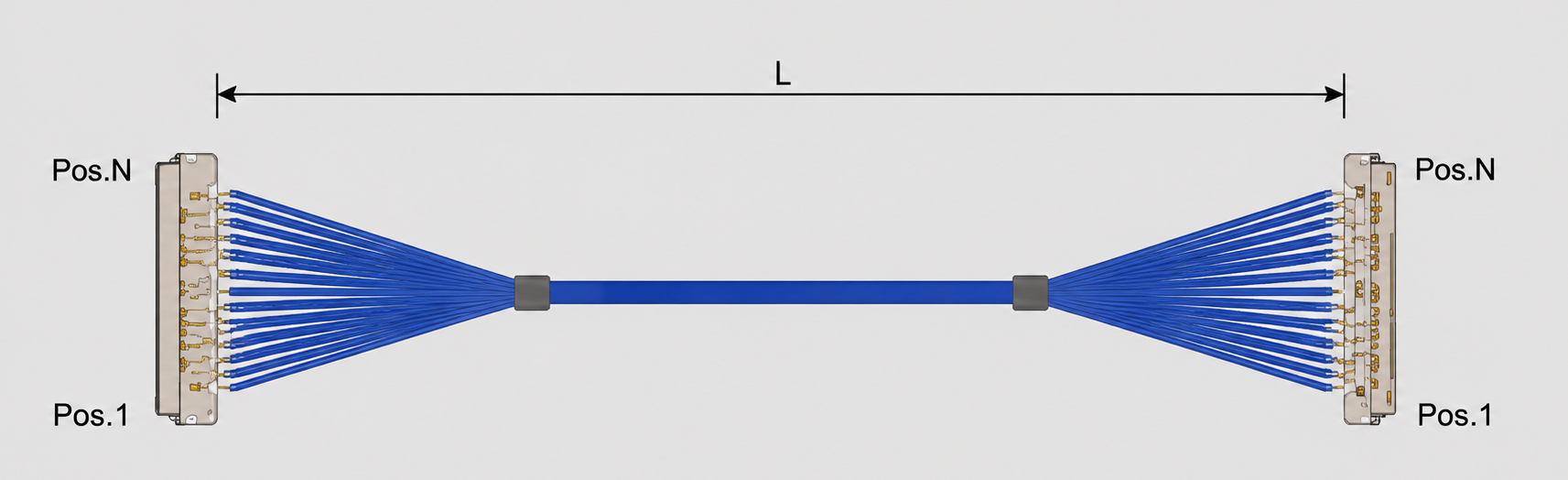
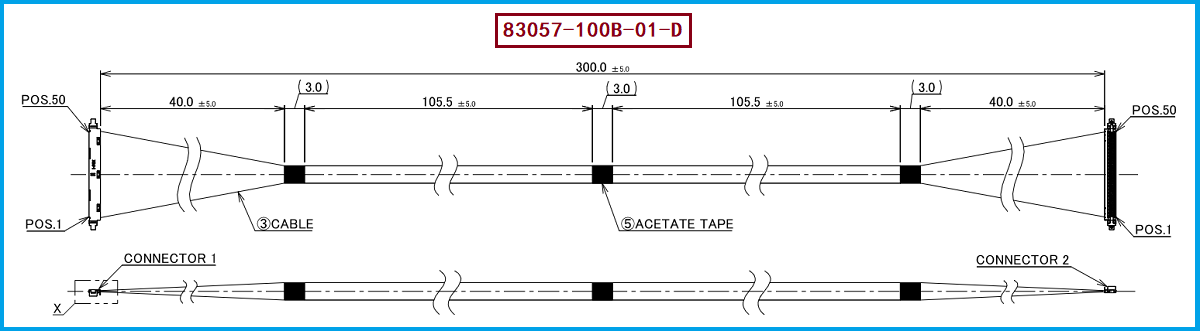
If the engineering project requires a replacement for I-PEX 83057-100B-01-D, it is recommended to prioritize confirmation in the order of "Connector Model + Pin Count + Wire Specification + Length + Wire Sequence + Structural Dimensions." This product is a 50-Pin, 1-1, 300MM structure, with the wire end using 20532-050T-02-1, and the original standard cable evaluation using 46AWG Micro-Coaxial Cable. If the robot joint has special requirements for mechanical strength, bending life, or cable outer diameter, it is necessary to further confirm the wire structure and dynamic bending performance according to the actual motion trajectory, and cannot simply replace it with other AWG cables. For engineering verification, it is recommended to simultaneously conduct tests for conductivity, insulation, voltage resistance, and high-speed signal integrity, and combine them with the actual joint movement state for bending, swinging, and life verification. Our company can provide: I-PEX 83057-100B-01-D compatible replacement cable solutions, which can be customized for production according to customer equipment space, Pin count, wire length, wire sequence, connector model, and ultra-fine coaxial cable specifications, providing compatible replacement and customized ultra-fine coaxial cable bundles for robot joints, machine vision, and other high-density electronic equipment.
“Without the consent or authorization of this site, no one shall reproduce, reprint, distribute, cite, change, broadcast or publish the content in whole or in part in any form, nor shall there be any other violation of the copyright of this site.