


Categorization:Harness Component
For engineers, "What is the typical attenuation rate of a very thin coaxial cable assembly?" cannot be answered simply with a fixed dB value. Attenuation is a parameter that varies with frequency and usually requires considering factors such as insertion loss, operating frequency, cable length, conductor material, insulating medium, impedance, and connectors to make a judgment. Taking the I-PEX product 82659-100B-02-D as an example, this model is a CABLINE®-UX II 50Pin very thin coaxial cable assembly, using 50Ω Micro-Coaxial Cable AWG #46, with a length of 200mm, and both ends of the cable assembly are equipped with the 20532-050T-02-1 matching structure. The I-PEX official reference transmission speed for CABLINE®-UX II is 5 Gbps/lane NRZ, but the official product page does not define this value as the cable attenuation at a specific frequency. Therefore, in actual projects, the actual attenuation performance of the cable assembly should be determined by specific frequency points through S-parameters or insertion loss tests.
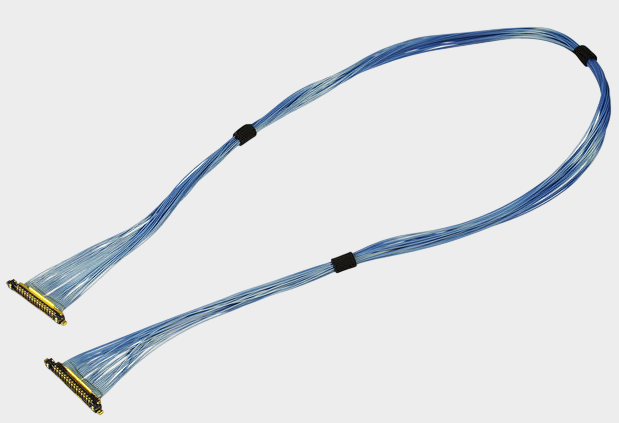
The extremely thin coaxial cable, although having a good high-frequency transmission structure, still produces signal loss during transmission. The higher the frequency, the more attention is usually needed for conductor high-frequency loss, dielectric loss, and the reflection effect caused by connectors and impedance discontinuities; at the same time, the longer the cable, the more obvious the cumulative transmission loss is typically. Therefore, it cannot be simply considered that "the thinner the AWG, the greater the attenuation will be," and it is necessary to comprehensively consider the cable structure and specific frequency. The 82659-100B-02-D uses 50 cores of 50Ω AWG#46 Micro-Coaxial Cable, with a nominal length of 200mm, belonging to the internal short-distance high-speed interconnection scenario of the equipment; in such applications, engineers should pay more attention to the overall insertion loss, return loss, and impedance continuity of the entire chain, rather than just looking at the conductor cross-sectional area. The I-PEX official page also provides an entry for the CABLINE®-UX II single-ended and differential signal integrity test data, indicating that high-speed applications require evaluation combined with actual SI testing.
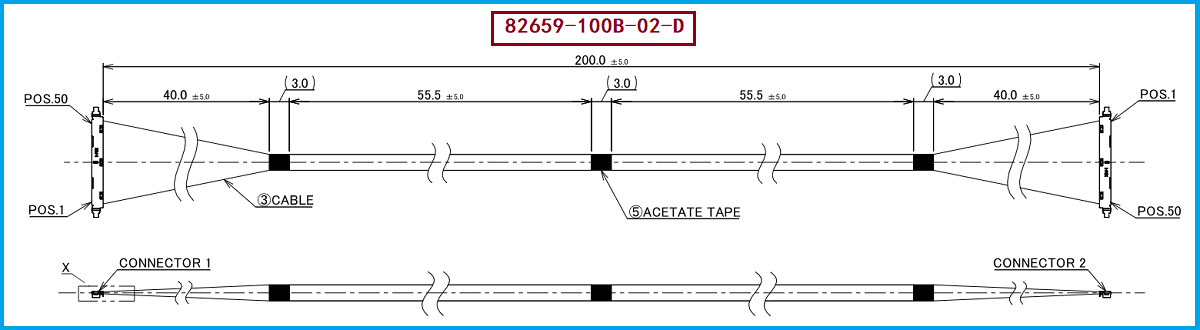
Engineering selection: In addition to asking "how much attenuation in dB," what else should we consider?
If evaluating a very thin coaxial cable assembly from the perspective of a research and development engineer, it is recommended to consider "attenuation" within the complete signal integrity framework. For 82659-100B-02-D, it is first necessary to confirm that the 50Ω Micro-Coaxial, AWG#46, and 200mm length are consistent with the original design. Then, further attention should be given to the impedance continuity at the connector end, insertion loss, return loss, crosstalk, and the actual high-speed eye diagram. The I-PEX CABLINE®-UX II uses a 0.25mm Contact Pitch and Vertical/Right Angle structure, offering 30, 34, 40, and 50Pin specifications, and provides a 5 Gbps/lane NRZ reference transmission speed; therefore, in actual projects, if the customer needs to determine whether the "attenuation meets the requirements of high-speed signals," a more reasonable approach is to determine the target frequency and data rate and then conduct the corresponding SI tests, rather than directly applying a universally accepted "typical attenuation rate."
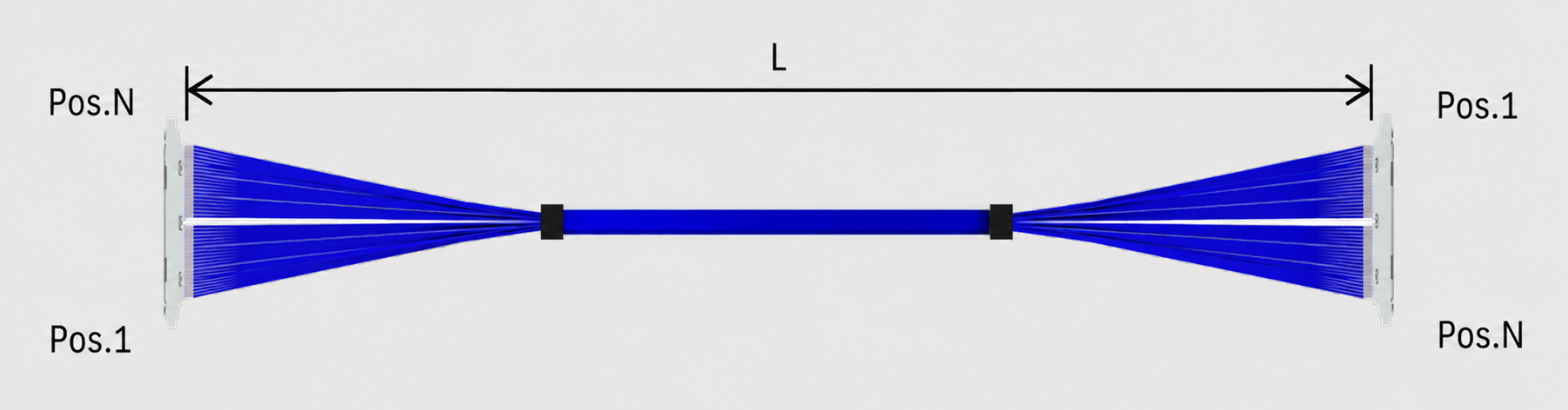
For procurement personnel and hardware engineers seeking alternative products for the 82659-100B-02-D, it is recommended to confirm the complete combination of "connector + wire + length + wire sequence + electrical performance". This model corresponds to CABLINE®-UX II 50Pin, AWG#46, 50Ω, 200mm, 1-N thin coaxial cable assembly, with the connector component model used at the wire end being 20532-050T-02-1; the 50Pin Plug Cable Assembly recommended by I-PEX is 20531-050T-02-1, and the Plug Metal Cover is 2799-0501, corresponding to the Receptacle 20533-250E. In addition to matching appearance and Pin count, the alternative product should also focus on verifying wire length, wire sequence, impedance, wire material outer diameter, connector mating dimensions, as well as insertion loss and return loss at the target frequency. Our company can provide: 82659-100B-02-D compatible alternative cable assembly solutions, which can be developed, prototyped, and mass manufactured for thin coaxial cable assemblies based on customer drawings and actual application requirements.
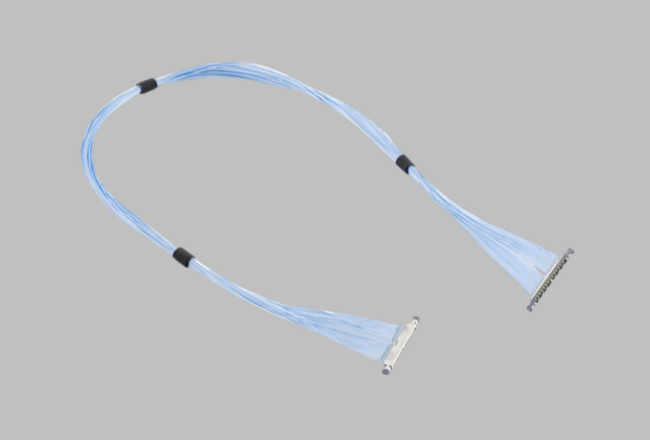
“Without the consent or authorization of this site, no one shall reproduce, reprint, distribute, cite, change, broadcast or publish the content in whole or in part in any form, nor shall there be any other violation of the copyright of this site.