


Categorization:Harness Component
In notebook computers, tablets, display modules, camera modules, and other space-limited electronic devices, internal high-speed signal connections not only require small cable sizes but also need to consider signal integrity, shielding performance, bend reliability, and connector assembly space. The I-PEX 83050-100B-01-D introduced this time belongs to the CABLINE®-UX II series 34P ultra-thin coaxial cable assembly, with the cable end connector model being 20532-034T-02-1. According to the provided CABLINE®-UX II product information, this series of connectors uses a 0.25mm Pitch ultra-small structure and can correspond to specifications such as 30P, 34P, 40P, 50P, etc.; among which, the 34P corresponds to the Plug Housing material number 20532-034T-02-1. For engineers, the value of such products is not just "making the wire thinner," but achieving multi-channel, high-density, controlled impedance, and shielded transmission within limited space; for purchasers, it is necessary to pay attention to connector models, Pin numbers, wire diameter, impedance, wire length, termination processes, and batch consistency, and not just replace them with ordinary ribbon cables or single coaxial cables.
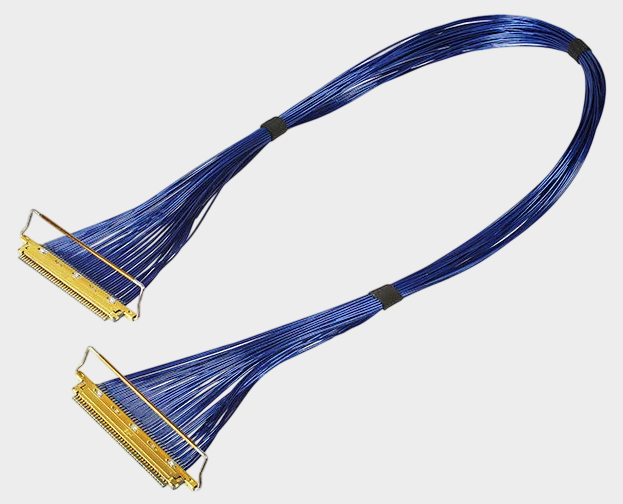
Why is PTFE sheath commonly used for ultra-fine coaxial cables? This is a very worthy issue to pay attention to in engineering selection. Strictly speaking, whether PTFE in the actual cable structure specifically assumes the function of insulation/dielectric material or outer sheath, needs to be determined according to the specific cable specification sheet, and cannot be assumed that PTFE outer sheath is always used just because of "ultra-fine coaxial cable". PTFE is often used in high-frequency coaxial structures mainly because of its lower and stable dielectric properties, good heat and chemical resistance, and its contribution to controlling dielectric loss and impedance stability in high-frequency transmission; in coaxial structures, the dielectric material directly affects the signal propagation characteristics, so material selection is related to impedance control and high-speed signal integrity. Industry materials also show that PTFE is widely used in the dielectric structure of 50Ω coaxial connectors, for example, TE Connectivity's relevant coaxial connector materials explicitly list PTFE as a dielectric material. For ultra-fine coaxial cables, due to the very small wire diameter, the relationship between insulation layer size, concentricity, dielectric constant, shielding layer structure, and conductor size is more sensitive, so choosing an appropriate low-loss dielectric material helps maintain stable high-frequency transmission performance under limited outer diameter. However, it needs to be emphasized that the publicly available 2D cable assembly drawing 83050-100B-01-D specifically stipulates Micro-Coax, AWG, impedance, and cable assembly structure, but does not explicitly specify PTFE as the sheath material in this drawing. Therefore, when actually replacing production, the final basis should still be the customer-specified cable specification sheet and material requirements.
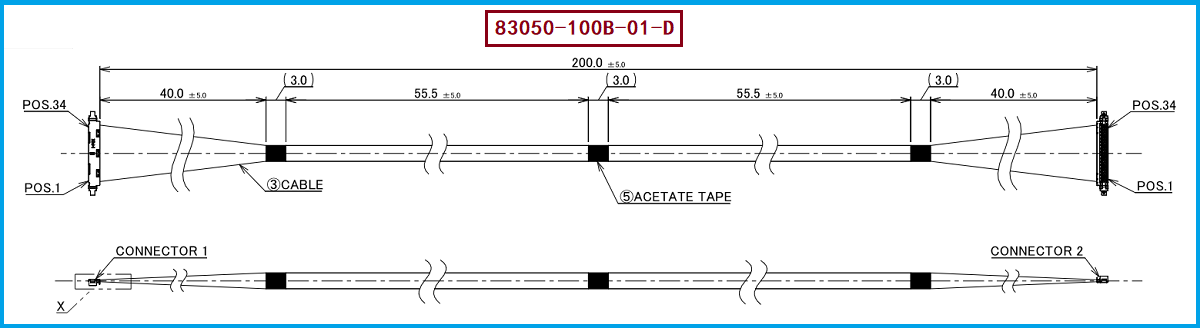
For the alternative development of I-PEX 83050-100B-01-D-01, it is recommended that the engineering department establish an overall matching approach of "connector + wire + processing + testing". This project specifies the wire end connector model as 20532-034T-02-1, corresponding to CABLINE®-UX II 34Pin Plug Housing; the materials also list Housing models with different Pin numbers such as 30P, 34P, 40P, and 50P, so the 34P product cannot be simply replaced with other Pin number connectors. In terms of material compatibility, this project specifies that 20532-034T-02-1 is compatible with AWG#40 wire, which should be an important input parameter for the development of alternative solutions; at the same time, the original Micro-Coax specification marked on the provided 83050-100B-01-D cable harness drawings is AWG#46, 50Ω. Therefore, if the customer's actual project requires the use of AWG#40, it is necessary to further confirm whether the connector termination window, wire outer diameter, impedance, shielding structure, termination size, and high-speed signal test results meet the design requirements. In other words, AWG#40 is an important condition for this connector compatibility solution, but it cannot be directly equivalent to the AWG#46 specification in the original 83050-100B-01-D drawings. This difference needs to be particularly confirmed by the engineering department in domestic alternative projects to avoid simple replacement based on connector material numbers or AWG numbers.
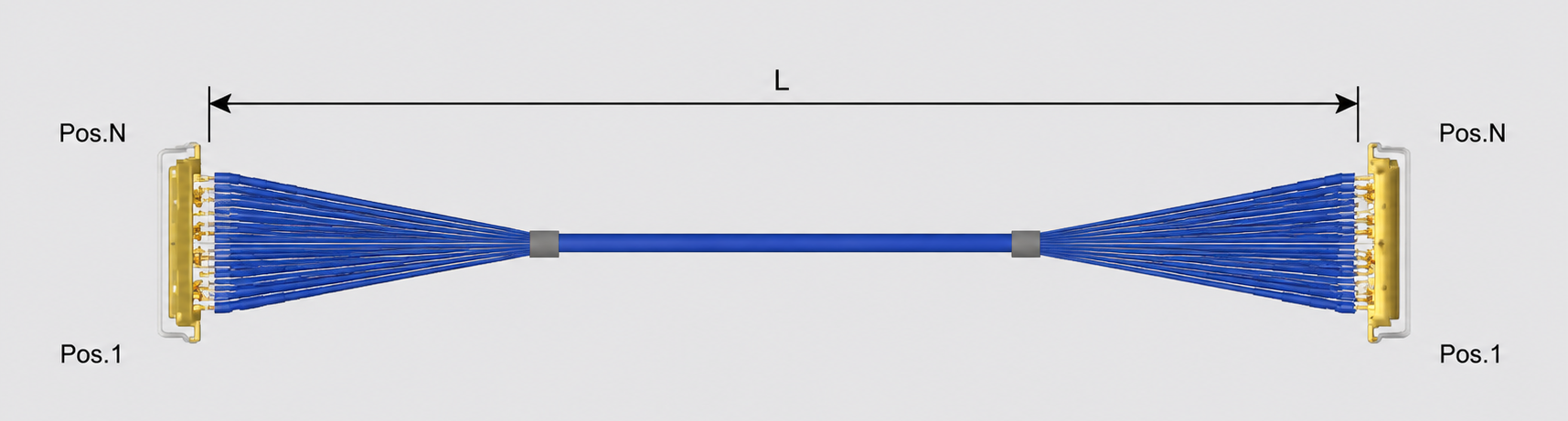
For the compatibility alternative of I-PEX 83050-100B-01-D-01, engineers should first confirm the 34P structure and the wire end connector 20532-034T-02-1; secondly, confirm the actual specifications of the ultra-fine coaxial cable, including AWG, characteristic impedance, outer diameter, insulation/dielectric material, shielding layer structure, and conductor structure; then confirm the cable length, wire sequence, connection methods at both ends, tape or fixation method, and terminal dimensions. For purchasers, it is recommended not to only provide the condition "CABLINE®-UX II 34P" when inquiring for quotes, but also provide the target material number 83050-100B-01-D, connector model 20532-034T-02-1, target wire AWG#40, and specific length and electrical performance requirements. Especially when there is a difference between AWG#40 and the AWG#46 on the original drawing, the supplier should be required to provide impedance, conduction, insulation, voltage resistance, and necessary high-speed signal integrity verification data. Our company can provide: I-PEX 83050-100B-01-D-01 compatible alternative cable harness solutions, which can customize and manufacture ultra-fine coaxial cable harnesses and alternative development based on the customer's samples, drawings, connector models, wire specifications, and application requirements, helping the engineering team to further realize "cable harness availability" and "performance verification" from "connector availability".
“Without the consent or authorization of this site, no one shall reproduce, reprint, distribute, cite, change, broadcast or publish the content in whole or in part in any form, nor shall there be any other violation of the copyright of this site.