


Categorization:Harness Component
In notebook computers, tablets, display modules, and other high-speed electronic devices with limited space, ultra-fine coaxial cables not only undertake the signal connection function but also need to consider wiring space, flexibility, impedance consistency, and signal integrity. The I-PEX 82657-100B-02-D belongs to the CABLINE®-UX II 34Pin ultra-fine coaxial cable. Official data shows that it uses 46AWG Micro-Coaxial Cable, with a standard length of 300mm and wire positioning defined as 1-N. The wire end uses the CABLINE®-UX II Plug Housing model 20532-034T-02-1, which is matched with a 34Pin structure and is suitable for internal connections in devices with high requirements for connector size and cable space. The I-PEX CABLINE®-UX II itself uses a 0.25mm Contact Pitch and Vertical (Right Angle) structure, with a height of about 1.04mm, and provides 30, 34, 40, and 50Pin specifications.
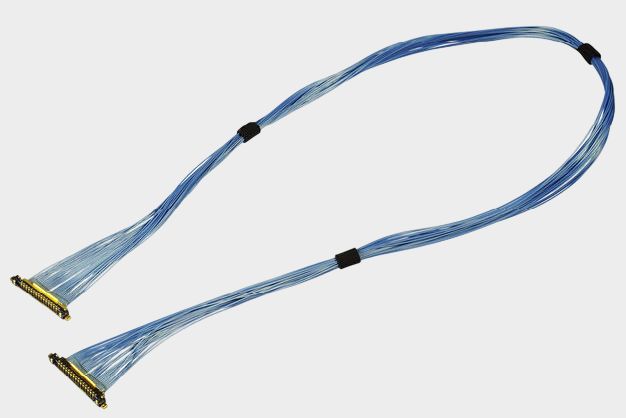
For engineers, "the shorter the wire, the better the signal" is not a simple absolute conclusion, but in scenarios with extremely fine wire diameters and high-speed signal transmission, the length of the wire indeed directly affects insertion loss, return loss, delay, and overall signal integrity. As the cable length increases, the propagation distance of the signal in the cable becomes longer, and conductor losses and dielectric losses accumulate gradually, with more significant attenuation of high-frequency components. At the same time, if the wire impedance, connector transition area, or shielding structure is not well controlled, impedance discontinuity and reflections may occur. Taking the 300mm length of the 82657-100B-02-D as an example, when designing alternative cables, it is not enough to simply copy the appearance and dimensions; it is more important to pay attention to the impedance, outer diameter, shielding structure, termination quality, and impedance transition in the connector area of the 46AWG Micro-Coax. The CABLINE®-UX II officially provided the reference transmission speed as 5Gbps/lane NRZ, and listed reference applications such as USB 3.1 Gen1, V-By-One HS 1.4, HDMI 1.3, eDP, and MIPI. Therefore, for such high-speed cables, after the length increase, it is more important to verify the insertion loss, return loss, and eye diagram indicators through actual SI testing, rather than just judging the cable qualification based on the conductance test.
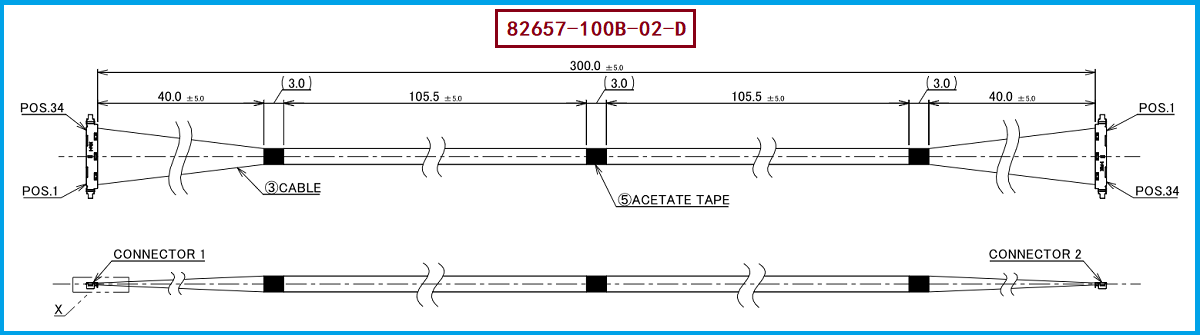
For engineers and procurement personnel who need to carry out domestic substitution, supplier switching, or long-term inventory, the substitution of I-PEX 82657-100B-02-D cannot be simply understood as "34Pin connector + 300mm cable". The actual selection must at least ensure the consistency of connector series, pin count, cable specification, length, wire position definition, and termination structure. The key configuration of this model is 34Pin, 46AWG Micro-Coax, 300mm, 1-N, where the wire position definition is 1-N, meaning the wire sequence at both ends is arranged in a 1-N manner; the cable connector uses 20532-034T-02-1. At the same time, CABLINE®-UX II adopts a super-small structure with a 0.25mm pitch, and the official materials also emphasize that the Plug size is suitable for passing through narrow spaces such as shafts, therefore, the alternative cable harness should also consider the finished product shape, wire exit direction, bending space, and shielding grounding continuity to avoid situations where "electrical parameters seem consistent, but actual assembly is unusable."
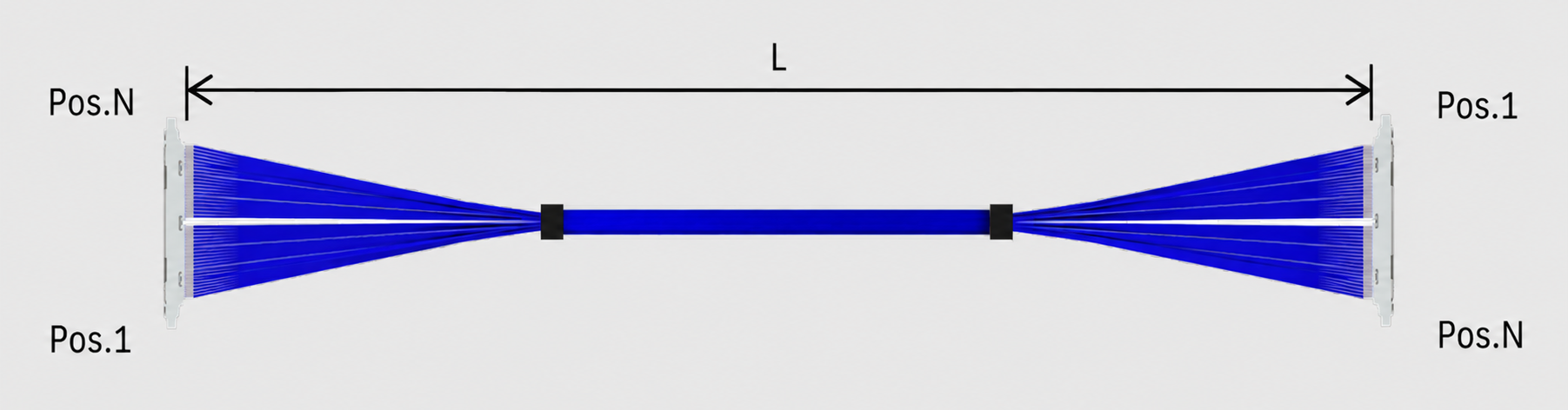
For customers seeking I-PEX 82657-100B-02-D-02 compatible products, it is recommended that engineering teams prioritize locking in the core configuration of "34Pin + 46AWG Micro-Coax + 300mm + 1-N + CABLINE®-UX II structure", and then confirm the wire diameter, bend radius, routing method, and terminal processing dimensions based on the actual internal space of the device. Purchasing teams should focus on confirming the connector model and cable assembly part number to avoid confusing the material numbers of Plug Housing, Plug Cable Assembly, and the entire Harness. The current I-PEX official data indicates that the CABLINE®-UX II 34Pin corresponds to the Plug Cable Assembly as 20531-034T-02-1, Plug Housing as 20532-034T-02-1, Plug Metal Cover as 2799-0341, and the matching Receptacle as 20533-234E; while the 82657-100B-02-D is a 34Pin, 46AWG, 300mm, 1-N Sample Harness. Our company can provide: I-PEX 82657-100B-02-D-02 compatible alternative cable assembly solutions, which can be matched and developed according to the connector model, Pin count, wire diameter, impedance, length, wire position definition, and installation space of the customer's original cable assembly, providing corresponding ultra-fine coaxial cable products for engineering verification, sample replacement, and bulk procurement.
“Without the consent or authorization of this site, no one shall reproduce, reprint, distribute, cite, change, broadcast or publish the content in whole or in part in any form, nor shall there be any other violation of the copyright of this site.