


Categorization:Harness Component
In laptops, high-speed display devices, industrial vision, camera modules, and high-performance electronic devices, the signal rate is constantly increasing. The harness not only needs to meet the structural requirements of "miniaturization and lightweight" but must also solve problems such as crosstalk, external electromagnetic interference, and degradation of signal integrity during high-speed signal transmission. Traditional multi-core harnesses, in high-speed signal environments, have a relatively close distance between conductors, which are prone to form electric field and magnetic field coupling. When adjacent channels simultaneously transmit high-speed signals, crosstalk may occur, leading to waveform distortion, degradation of eye diagrams, and even communication errors. The extremely fine coaxial harness, through the coaxial structure of "center conductor + insulating layer + shielding layer," makes the signal have a relatively independent and controlled transmission path, reducing the probability of external interference entering the signal channel and the mutual influence between adjacent channels at the structural level. For engineers, this means that under the restriction of harness size, they can still obtain a more stable high-speed signal transmission environment; for purchasers, it means that when choosing extremely fine coaxial harnesses, they cannot only look at the wire diameter and price, but also need to focus on impedance, structure, connector matching, and overall processing consistency.
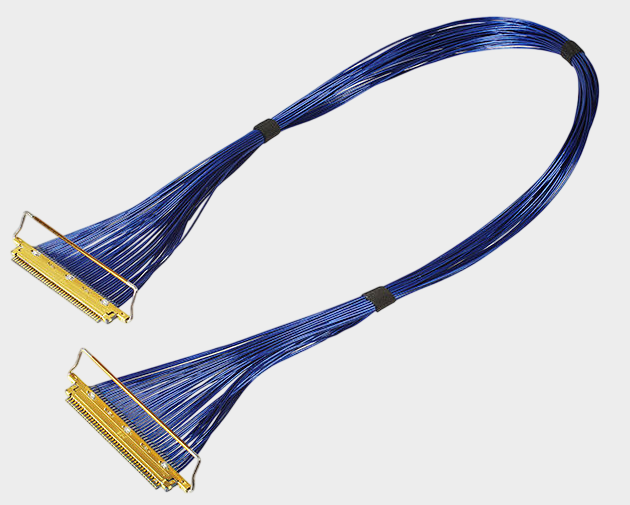
The core of the ultra-fine coaxial cable束 in reducing interference is not solely reliant on "thinner wire," but rather on its special coaxial transmission structure. High-speed signals mainly propagate along the central conductor, while the outer insulation layer is responsible for maintaining a stable electrical structure. The shielding layer can isolate external electromagnetic fields and also help control the propagation range of the signal energy. When multiple ultra-fine coaxial cables are densely arranged, each signal channel has a relatively independent shielding structure, thereby effectively reducing electromagnetic coupling between adjacent lines compared to ordinary parallel wires. On the other hand, high-speed signals are very sensitive to impedance continuity. If there is a significant impedance discontinuity between the chip, PCB, connector, and cable束, signal reflections are likely to occur, and the combination of reflections and crosstalk will further affect signal quality. Therefore, engineers need to consider "shielding, impedance, routing, connector, and terminal processing" simultaneously when designing high-speed cable束, rather than merely increasing the thickness of the shielding layer. The I-PEX CABLINE®-VS uses a 0.5mm spacing, horizontal insertion structure, and can be paired with Micro-Coaxial Cable, providing a compact connector and cable束 combination solution for high-density high-speed signal connections.
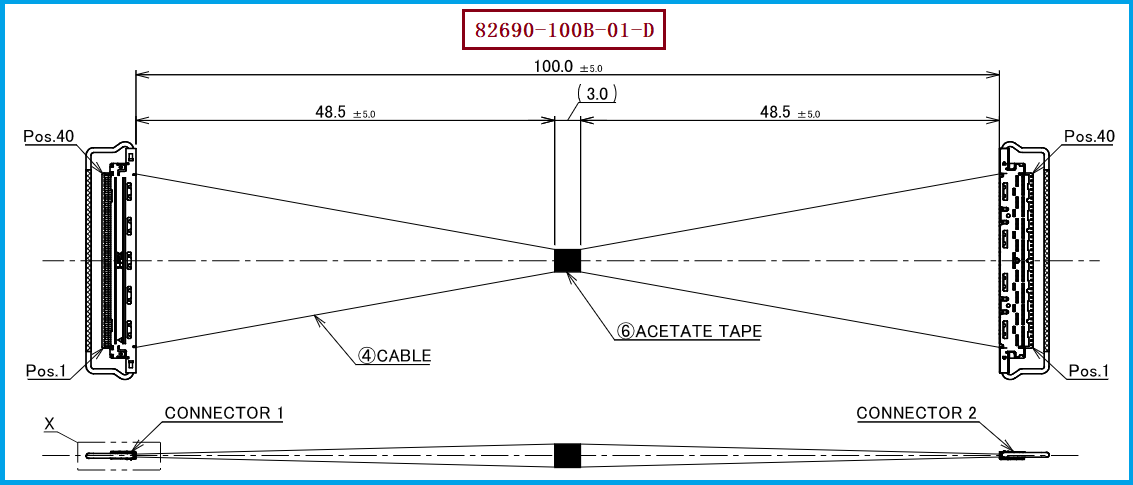
The specific product introduced this time is I-PEX 82690-100B-01-D, corresponding to CABLINE-VS 40P HARNESS. According to the official engineering drawings of I-PEX, this harness uses 40Pin Micro-Coaxial Cable, AWG#40, 50Ω specifications, with a total of 40 extremely fine coaxial wires, each 100.0±5.0mm in length, using a 1-1 straight-through structure, i.e., Connector 1's Pin 1 to Pin 40 correspond to Connector 2's Pin 1 to Pin 40 respectively. The connector models used at the wire material end are 20454-240T, and the engineering drawing also marks the CABLINE-VS Plug P/N as 20453-240T-03, with a matching connector of 20455-040E-66. For engineers, the focus of this harness is not just "40Pin+100mm", but the combination of AWG#40 extremely fine coaxial cable and 50Ω electrical characteristics, which requires consistency in the material, termination, shielding processing, and connector assembly process; otherwise, even if the material parameters are the same, actual high-speed signal performance may vary due to processing differences. The engineering drawing of this model also clearly gives specific requirements such as AC 250V voltage resistance, maximum leakage current of 2.0mA, insulation resistance above 50MΩ under DC100V conditions, and a rated voltage of 30V, which can serve as an important reference for engineering verification and alternative development.
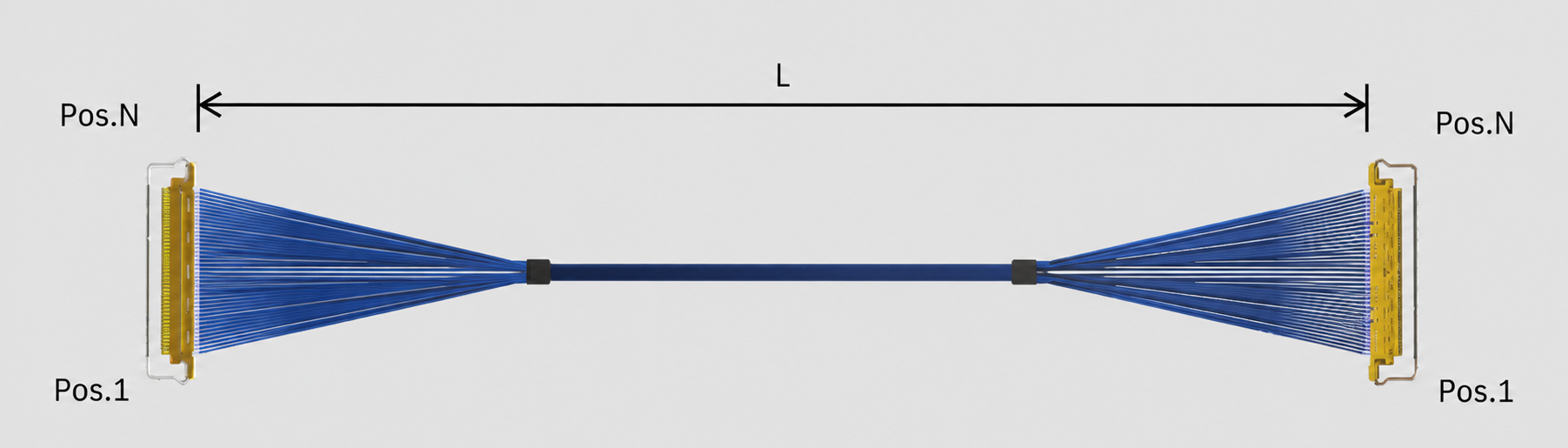
For engineers and procurement personnel who are currently selecting I-PEX CABLINE-VS series, seeking domestic alternatives, or introducing suppliers, it is recommended not to judge whether the harness can be directly replaced solely based on "the connector appearance is consistent." Instead, they should focus on checking the Pin count, AWG wire gauge, characteristic impedance, harness length, Pin Assignment, connector model, end structure, and actual installation space. Taking 82690-100B-01-D as an example, its key combination is 40Pin, AWG#40, 50Ω, 100MM, and 1-1 structure, and it is matched with connector components such as 20454-240T. If used for domestic compatibility replacement, it should be developed according to the original product's connector interface, wire specification, and size requirements, and further verified through tests such as conductivity, insulation, voltage resistance, impedance, and high-speed signal integrity. For the procurement side, this approach can avoid the problem of "the connector can be plugged in, but the high-speed performance or long-term reliability cannot meet the requirements" due to the sole pursuit of low price. Our company can provide: I-PEX 82690-100B-01-D compatible replacement harness solution, which can carry out compatibility development and production of extremely thin coaxial harnesses around core specifications such as 40Pin, AWG#40, 50Ω, 100MM, and provide customers with a reference for alternative solutions from wire, connector termination to finished harness.
“Without the consent or authorization of this site, no one shall reproduce, reprint, distribute, cite, change, broadcast or publish the content in whole or in part in any form, nor shall there be any other violation of the copyright of this site.