


Categorization:Harness Component
In the design of high-speed electronic devices, engineers often encounter a question: Who is faster, the extremely thin coaxial cable bundle or the HDMI cable? In fact, the two are not completely the same product types, so it cannot be directly determined by a "maximum Gbps" number. HDMI is usually a standard interface for external audio and video connections of devices, while the extremely thin coaxial cable bundle is more often used for internal high-speed signal connections in laptops, display modules, cameras, AI devices, and other electronic products. According to the technical documentation related to the I-PEX CABLINE®-CA platform, its connectors support high-speed transmission of up to 32 Gbps/Lane PAM4 and can be used for high-speed signal applications such as USB4, DisplayPort, eDP, and HDMI 2.1. This means that the extremely thin coaxial cable bundle itself is not meant to be compared in terms of speed with the HDMI interface, but rather serves as the physical transmission channel within the high-speed interface. For engineers, what truly needs to be focused on is specific protocols, Lane numbers, signal rates, cable length, impedance control, insertion loss, crosstalk, and connector matching factors; for purchasers, it should be whether the complete cable assembly can meet the high-speed transmission requirements of the target device, rather than simply comparing the promotional speeds of the two products.
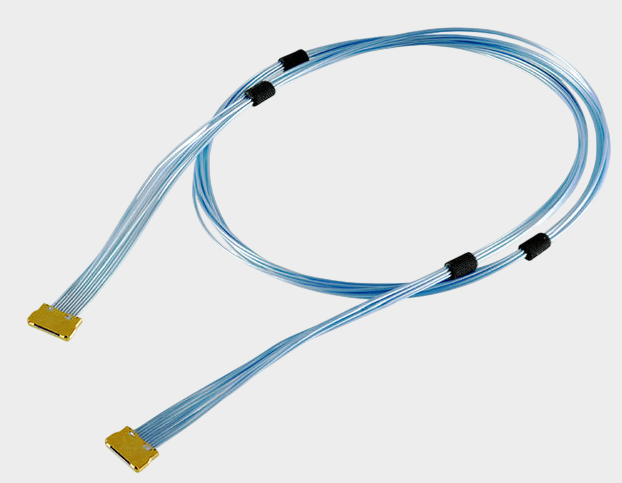
This product focuses on the part number/model I-PEX 82985-100B-01-D, which belongs to the I-PEX CABLINE®-CA series ultra-thin coaxial cable solution. According to the relevant product information, this model is a 50PIN, 0.4mm pitch Micro-Coaxial ultra-thin coaxial cable solution with a cable length of 300mm, 40AWG, and a 1-1 end connection method, suitable for multi-channel high-speed signal connections inside equipment. In terms of the wire end connector, the connector model used is 20634-150T-02, corresponding to a 50PIN, 0.4MM Pitch structure. The 0.4mm ultra-fine pitch can achieve high-density signal connections within a limited PCB space, while the ultra-thin coaxial cable itself has independent conductors, insulating layers, and shielding structures, which are conducive to controlling the impedance, crosstalk, and electromagnetic interference during the high-speed signal transmission process. For engineers who need to complete multi-channel high-speed signal wiring in narrow spaces, this type of 50PIN ultra-thin coaxial cable solution can balance high density, miniaturization, high-speed transmission, and internal wiring flexibility, especially suitable for internal connections of high-resolution displays, cameras, machine vision, AI equipment, and other high-speed electronic devices.
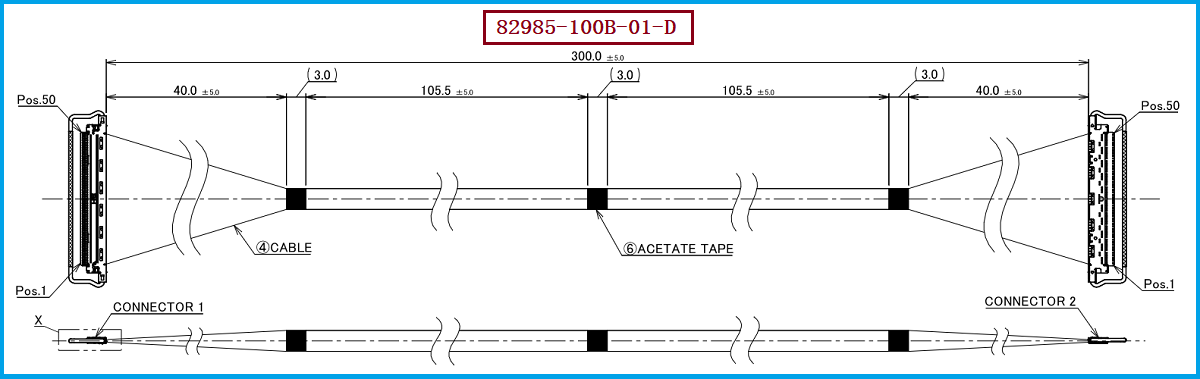
Many engineers may worry: "The thinner the wire, the more likely it is to bend and break?" In fact, the bending resistance of extremely thin coaxial cable bundles is not simply determined by the size of the wire diameter, but is closely related to the conductor structure, insulating material, shielding layer structure, wire manufacturing process, bending radius, and cable assembly molding method. Extremely thin coaxial cables use a coaxial structure, which makes the high-speed signal channel have a clearer electrical structure; during internal wiring of the equipment, the cable assembly can be bent and routed according to the space, which is easier to adapt to complex spatial layouts between the screen pivot, camera module, mainboard, and display components compared to some rigid connection schemes. Of course, "bending resistance" does not mean that it can be bent indefinitely; actual design must still be verified according to the minimum bending radius, dynamic bending times, and application environment specified by the wire supplier. For engineers, it is recommended to determine the routing path in the early stage of structural design and avoid sharp bends at the connector root, repeated folding, and local stress concentration; for purchasers, it is necessary to confirm that the wire materials, termination processes, and reliability tests provided by the supplier can match the final application scenario. Our company can provide I-PEX 82985-100B-01-D compatible alternative cable assembly solutions, which can match extremely thin coaxial cable assembly schemes according to the length, Pin number, termination form, and actual installation space of the customer's equipment, providing a domestic alternative choice for engineering development and mass procurement.
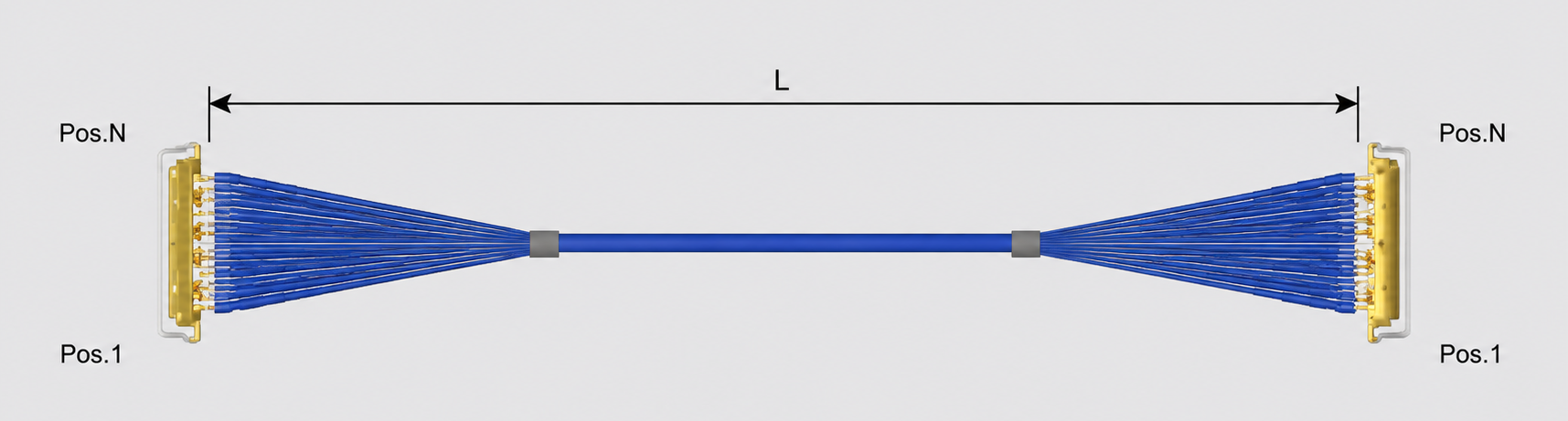
For projects requiring replacement of I-PEX 82985-100B-01-D, engineers are advised not to make a simple replacement based on "50PIN" alone, but to also confirm the connector type, PIN count, 0.4MM pitch, wire specification, wire length, Pin Assignment, termination direction, bending requirements, and high-speed signal performance. The corresponding wire end connector model for this scheme is 20634-150T-02, with a 50PIN connector and a 0.4MM pitch. Therefore, during domestic replacement, the mechanical dimensions, electrical performance, and mating reliability of the connector and PCB plug-in should be verified. At the same time, high-speed signal impedance, insertion loss, return loss, and crosstalk should also be verified. For procurement personnel, if the project is currently undergoing domestic replacement, second supplier introduction, or cost optimization, it is recommended to prioritize supplier selection based on the思路 of **"connector compatibility + wire specification matching + cable size matching + high-speed performance verification + reliability verification"**, rather than just comparing unit prices. We continue to focus on research and development of domestic replacement solutions for ultra-thin coaxial cable束 and market application. If you are looking for a compatible replacement product for I-PEX 82985-100B-01-D, or have a procurement need for 50PIN, 0.4MM pitch ultra-thin coaxial cable束, please contact us for specific specification confirmation and solution evaluation.
“Without the consent or authorization of this site, no one shall reproduce, reprint, distribute, cite, change, broadcast or publish the content in whole or in part in any form, nor shall there be any other violation of the copyright of this site.