


Categorization:Harness Component
In laptops, high-definition display devices, industrial cameras, machine vision, AI vision equipment, and other high-speed electronic devices, the internal space of the devices is becoming increasingly compact, while the transmission rate of high-speed signals is constantly increasing. Traditional cables are finding it increasingly difficult to meet the requirements of "miniaturization, high density, high-speed transmission, and reliable connection" simultaneously. ultra-fine coaxial cables, with their thinner wire diameter, good shielding structure, and high-speed signal transmission capabilities, are gradually becoming an important solution for internal connections in high-density electronic devices. The target product introduced in this article is I-PEX 82860-100B-02-D, which belongs to the I-PEX CABLINE®-CA series 12Pin Micro-Coaxial ultra-fine coaxial cable. Its typical configuration is 12Pin, AWG#40, length 300mm, 1-N connection relationship. The connector model used with this cable is 20634-112T-02, which belongs to the CABLINE-CA Plug Housing and can be matched with AWG#40 ultra-fine coaxial cable. For engineers and purchasers, when confirming substitute products, they should not only look at product names such as "CABLINE-CA" or "12Pin" but also check the complete material number, Pin number, wire diameter AWG, wire length, Pin Assignment, termination structure, and connector model. Only when all these key parameters match, can the reliability of compatibility and substitution truly be improved.
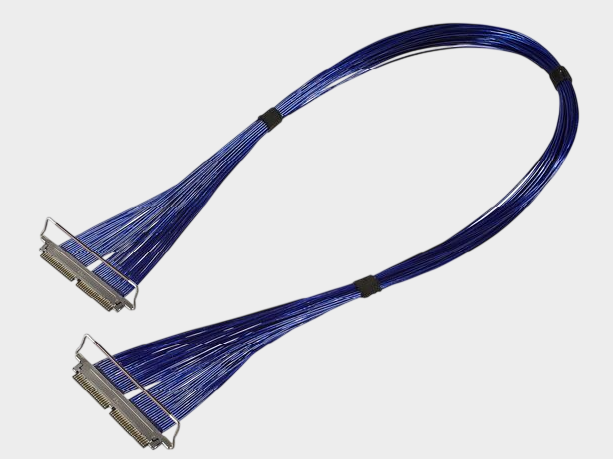
"How to choose a 30Pin ultra-thin coaxial cable assembly?" is a common question in the process of engineering design and procurement selection. Firstly, it needs to be clarified that "30Pin" does not simply represent "30 ordinary wires", but rather means that the connector needs to provide 30 corresponding signal/electrical connection positions. Therefore, when choosing a 30Pin ultra-thin coaxial cable assembly, it is necessary to determine the number of Pins according to the actual signal quantity, signal type, and interface definition of the equipment. In the I-PEX CABLINE®-CA series, in addition to 12Pin, there are also 10Pin, 20Pin, 30Pin, 40Pin, 50Pin, 60Pin, and other specifications. Therefore, 30Pin products are usually more suitable for display, camera, machine vision, high-speed data, and other high-density internal connection scenarios with more signal channels. Secondly, attention should be paid to the wire diameter, and it should not be simply believed that "the thinner the wire, the better". The CABLINE®-CA platform supports various Micro-Coaxial wire material specifications, and AWG#40 is one of the common specifications in the standard ultra-thin coaxial cable assembly series. When choosing 30Pin products, if the equipment has higher requirements for space, flexibility, and high-speed signal transmission, the AWG#40 solution can be evaluated; if the equipment has special requirements for current-carrying capacity, mechanical strength, or impedance matching, then the wire diameter needs to be further determined in combination with the specific application. At the same time, attention should also be paid to the connector's 0.4mm Pitch, high-density terminal arrangement, shielding structure, and high-speed signal integrity. That is to say, the selection logic for 30Pin ultra-thin coaxial cable assembly should be a comprehensive judgment of "Pin number + wire diameter + length + connector + wire sequence + electrical performance + mechanical dimensions", rather than purchasing based solely on the Pin number.
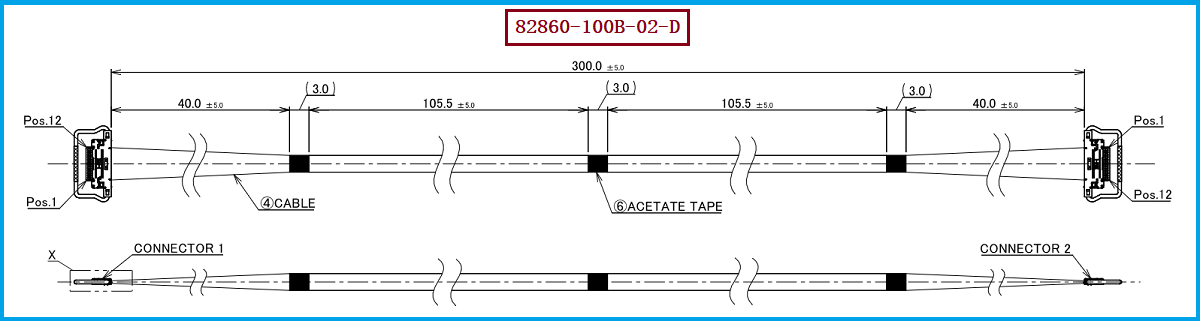
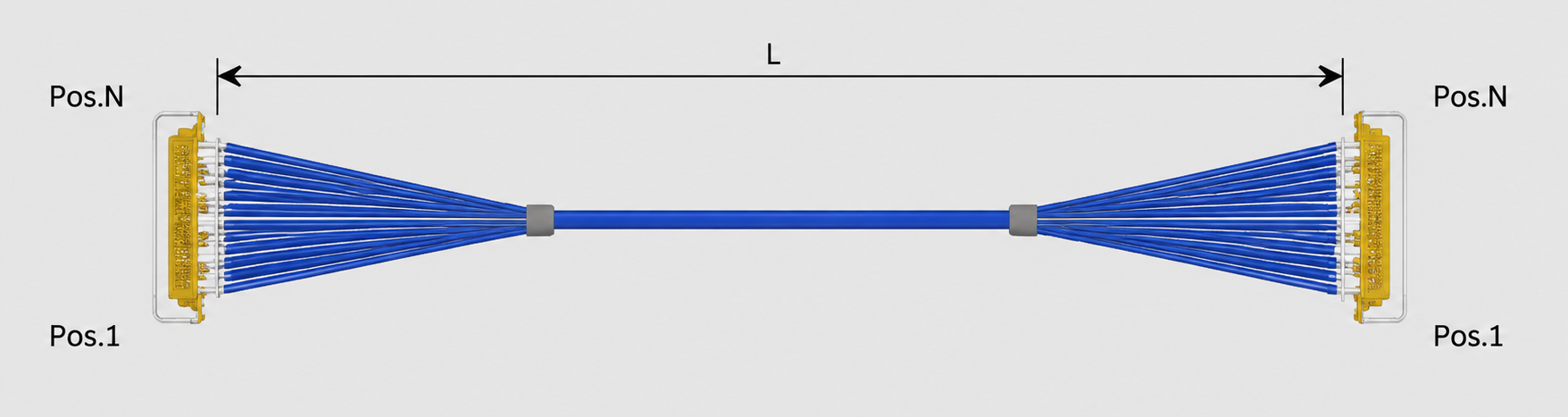
For engineers, the selection of extremely fine coaxial cable assemblies is actually a system matching issue. Taking I-PEX 82860-100B-02-D as an example, its matching cable end connector model is 20634-112T-02, which is compatible with AWG#40 extremely fine coaxial cable. The connector belongs to the CABLINE®-CA series, adopts a 0.4mm Pitch high-density design, and is paired with mechanical lock and shielding structure. CABLINE®-CA is positioned for high-speed, miniaturized internal connection applications. The official product documentation covers high-speed interfaces including USB4, Thunderbolt, DisplayPort, HDMI, eDP, MIPI, etc. Therefore, when engineers are introducing alternative cable assemblies, they need to pay attention to characteristics such as characteristic impedance, insertion loss, return loss, crosstalk, shielding continuity, and signal integrity in the termination area, especially for 30Pin high-speed cable assemblies. This is because as the number of pins increases, the overall width, termination density, and electromagnetic coupling between adjacent channels of the cable assembly become more noteworthy. In addition, the actual bending state, fixing method, cable exit direction, and mating status with the connector after the cable assembly is installed may also affect long-term reliability. Therefore, for R&D engineers, it is recommended to conduct structural dimensions, insertion and extraction coordination, wire sequence conduction, high-frequency performance, and whole machine actual operation testing at the same time during the sample verification stage, rather than simply judging that the product can be replaced by confirming the conduction with a multimeter.
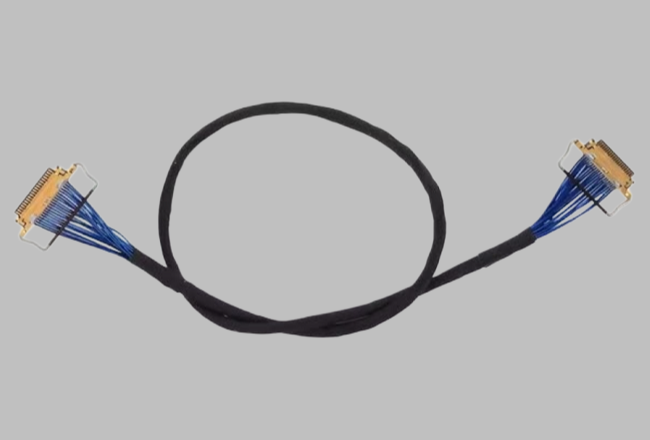
For the compatible substitute of I-PEX 82860-100B-02-D, it is recommended that engineering and procurement personnel first confirm whether the target product is indeed a CABLINE®-CA 12Pin scheme, and then confirm the core conditions of 12Pin, AWG#40, 300mm, and 1-N. Secondly, confirm the wire end connector as 20634-112T-02, and confirm the termination relationship between the connector and the AWG#40 thin coaxial cable. On this basis, further check the connector shape, terminal arrangement, wire sequence, shielding structure, cable exit direction, end size, and the overall length and tolerance of the cable assembly. If it is a 30Pin thin coaxial cable assembly, it cannot be directly applied to the material number of the 12Pin product in this document. Instead, reselection should be based on the actual 30Pin connector, target equipment interface definition, cable AWG, wire length, and connection relationships such as 1-N or 1-1. For high-speed applications, it is also recommended to perform actual signal integrity verification before compatibility substitution, including high-speed transmission tests, impedance consistency, loss, crosstalk, and EMI-related tests. Our company can carry out compatible substitute design for thin coaxial cable assemblies based on the original material number of I-PEX, connector model, product drawings, samples, or actual installation requirements. And provide corresponding manufacturing solutions for different Pin counts and wire lengths. For engineers and procurement personnel who are looking for domestic substitutes for I-PEX 82860-100B-02-D, the connector model 20634-112T-02, AWG#40, 12Pin, 300mm, and 1-N connection relationship can be used as the core basis for pre-technical communication to reduce selection deviation caused by incomplete specification information.
“Without the consent or authorization of this site, no one shall reproduce, reprint, distribute, cite, change, broadcast or publish the content in whole or in part in any form, nor shall there be any other violation of the copyright of this site.