AI computing power continues to upgrade, and extremely fine coaxial cable bundles are becoming an important choice for internal connections in high-speed equipment.With the continuous development of large AI models, edge AI, high-performance computing, machine vision, and intelligent terminals, the amount of data that needs to be transmitted within electronic devices is increasing. For engineers, the equipment not only needs to "compute quickly" but also solve the problem of how to stably transmit high-speed signals within limited space; for purchasers, they need to further consider the stability of cable supply, specification consistency, batch delivery capability, and the feasibility of domestic compatibility and substitution. Against this backdrop, ultra-fine coaxial cables, with their thin diameter, lightweight, high-speed transmission, good impedance control, and strong anti-electromagnetic interference ability, are gradually extending from traditional applications such as laptops and display devices to more high-speed electronic devices like AI servers, industrial vision, robots, and intelligent terminals.
From the internal data flow of AI servers, there is a need for a large amount of high-speed data interaction between GPUs, AI accelerators, high-speed storage, network communication modules, and management control modules. Although there are various connection methods within the server, traditional connection schemes may face challenges in terms of wiring space, signal integrity, EMI control, and structural assembly in some space-limited, high-density, and high-speed signal transmission scenarios. The extremely thin coaxial cable bundle provides a relatively stable transmission environment for high-speed signals through the "coaxial structure + shielding layer" method, and can realize multi-channel dense wiring in a limited space. Therefore, from AI servers and edge computing devices to industrial cameras, robot vision systems, laptops, AR/VR devices, and smart terminals, extremely thin coaxial cable bundles are creating more and more application opportunities.
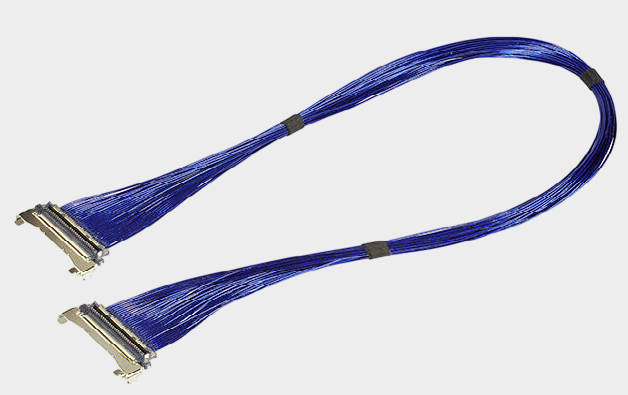
I-PEX 82859-100B-02-D: ultra-fine coaxial cable assembly solution with 12Pin, AWG40, and 1-N line position definition
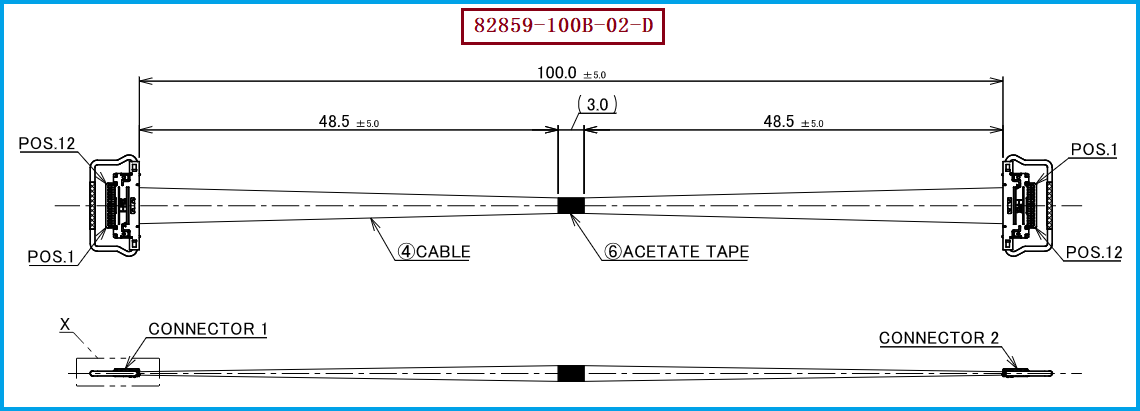
The product to be introduced this time is I-PEX 82859-100B-02-D. According to the corresponding product information, this model belongs to the CABLINE®-CA series 12Pin ultra-thin coaxial cable assembly, using the ultra-thin coaxial Micro-Coaxial scheme, cable specification of AWG40, length of 100mm, and wire position defined as 1-N, meaning that the cable assembly is connected at both ends according to the 1-end to the N-end. For engineers, the 1-N wire position definition means that when designing the PCB, connector, and cable assembly as a whole, it is necessary to confirm the correspondence between the two ends according to the actual pin arrangement and system signal definition; for purchasers, it should be clarified in inquiries, samples, and bulk purchases the model, pin count, wire diameter, length, and wire position definition to avoid mixing or mismatching between different wire position schemes.
The connector model used at the end of this product line is 20634-112T-02, which corresponds to the CABLINE-CA series 12Pin Plug Housing. CABLINE®-CA utilizes a 0.4mm contact spacing, horizontal insertion structure, and mechanical lock design, combined with shielding and multi-point grounding solutions, targeting high-speed, miniaturized, and high-density internal connection applications. Its product platform supports various high-speed interface applications, including USB4, DisplayPort, eDP, HDMI, MIPI, and other high-speed signal scenarios. For devices that require multi-channel high-speed signal transmission within a smaller structural space, the combination of this extremely thin connector with extremely thin coaxial cables can balance space utilization and high-speed signal connection requirements.
Therefore, in the actual selection of project types, the I-PEX 82859-100B-02-D should not be understood merely as a "12Pin cable assembly model with a length of 100mm", but should be confirmed as a whole from "connector + wire material + wire position definition + length + high-speed signal requirements + equipment structure". Especially in high-speed AI vision, camera, display module, and smart device projects, engineers need to pay attention to indicators such as impedance, insertion loss, return loss, crosstalk, EMI, and bending paths; purchasing personnel need to simultaneously confirm sample verification, specification consistency, batch delivery time, and supply chain substitution capability.
From AI servers to smart terminals, extremely thin coaxial cable束is opening up more application opportunities.Opportunities for ultra-fine coaxial cable bundles essentially come from two trends: the ever-increasing data transmission rates and the increasingly compact internal space of electronic devices. In AI servers and high-performance computing equipment, the continuous improvement in high-speed data processing capabilities results in an increasing demand for data exchange between internal modules; in industrial cameras and machine vision equipment, high-resolution images mean larger real-time data streams, and stable and high-speed signal connections are required between camera modules and main control boards; in robots and intelligent manufacturing equipment, the data interaction between vision, sensors, and control systems is becoming increasingly complex, while also facing vibration, spatial constraints, and EMI environments; in laptops, tablets, AR/VR, and smart terminals, there is a greater focus on thinning, high-density wiring, and high-speed display signal transmission.
For engineers, these applications mean that wire harness design cannot only focus on "whether it can conduct," but also needs to re-understand extremely thin coaxial harnesses from the perspective of high-speed signal integrity. The extremely thin coaxial structure can utilize the outer shielding layer to reduce external electromagnetic interference, while also reducing the mutual influence between adjacent high-speed signals; reasonable wire diameter, dielectric material, conductor structure, shielding structure, and termination technology collectively determine the performance of high-speed signals in actual transmission. Especially as devices gradually develop from 10Gbps-level signals to higher data rates, the wire harness itself has become an important part of the high-speed link.
For purchasing personnel, the increase in application opportunities also means that the supply chain needs to be planned in advance. If the project originally used import brand standard harnesses and there is a need for further optimization in terms of product life cycle, cost control, delivery stability, or supply chain security, then seeking a domestic supplier of mature manufacturing capabilities for ultra-thin coaxial harnesses may become a solution to reduce comprehensive purchasing risks. Our company can provide an I-PEX 82859-100B-02-D compatible replacement harness solution, which can be developed to match customer's actual connector model, pin count, cable length, wire position definition, and application requirements, providing support for manufacturing of ultra-thin coaxial harnesses for engineering verification, sample prototyping, and mass production.
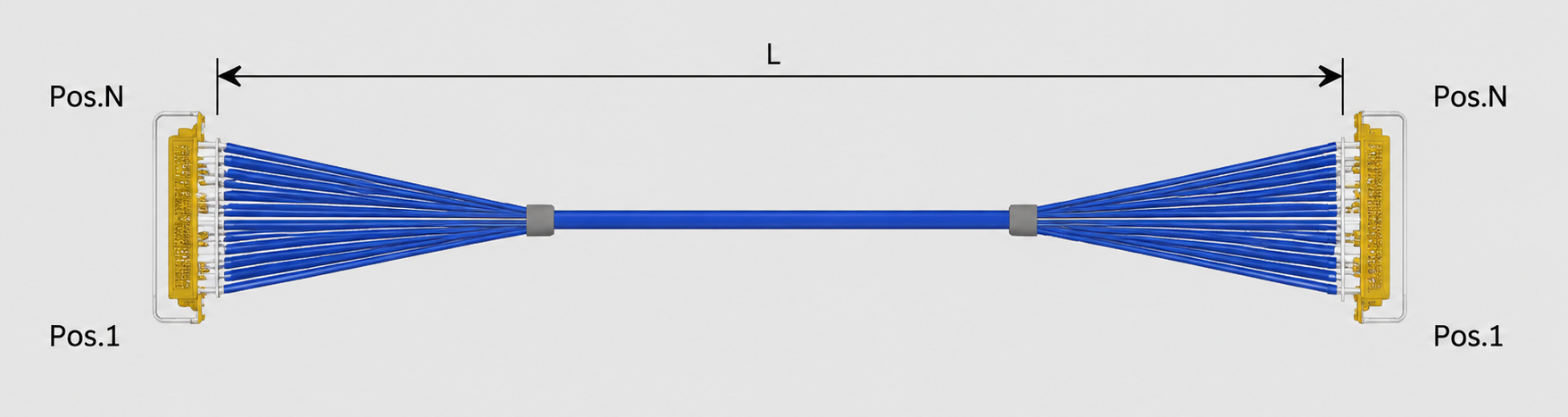
Selection and compatibility as well as alternative solutions reference and suggestions: what parameters should engineers and purchasing personnel focus on confirming?For the selection, compatibility, and alternative of I-PEX 82859-100B-02-D, it is recommended that engineers first confirm whether the connector interface matches, that is, whether the 20634-112T-02 used at the cable end is the 12Pin CABLINE-CA Plug Housing required by the project, and at the same time, confirm the matching connector on the PCB, installation direction, and actual mechanical space. Secondly, it is necessary to confirm the cable specification; this model corresponds to AWG40 ultra-thin coaxial cable. If the project has higher current, different impedance, or different high-speed signal requirements, it cannot be simply replaced by changing the wire diameter. Instead, it should be judged comprehensively by considering the connector compatibility, impedance requirements, attenuation, crosstalk, and whole machine SI/PI verification. Thirdly, it is necessary to confirm the length and wire position definition; this model has a length of 100mm and a 1-N wire position definition. If the actual equipment requires 200mm, 300mm, or other schemes such as 1-1, it should be re-confirmed for the corresponding model and Pin Assignment to avoid system failure due to different wiring sequence.
In terms of domestic compatibility and substitution, it is recommended not to judge whether a substitute can be used solely based on "the same connector appearance," but rather to verify from multiple dimensions such as connector matching, terminal contact, ultra-fine coaxial cable specifications, impedance control, shielding structure, wire position definition, length tolerance, termination technology, and high-speed signal testing. For R&D engineers, it is suggested to first carry out sample cable assembly and high-speed signal testing, and then confirm the final solution based on test results such as eye diagrams, insertion loss, return loss, and crosstalk; for procurement personnel, it is recommended to focus on the supplier's ultra-fine coaxial cable assembly capability, termination consistency, quality control ability, mass production capacity, and delivery stability during the supplier introduction stage. **Our company can provide compatible and substitute cable assembly development and production services for I-PEX 82859-100B-02-D and can confirm schemes such as length, wire position, and connector configuration according to customer project requirements.** For equipment projects with existing imported cables, domestic substitution can also be gradually promoted through methods such as sample comparison, installation verification, and performance testing.
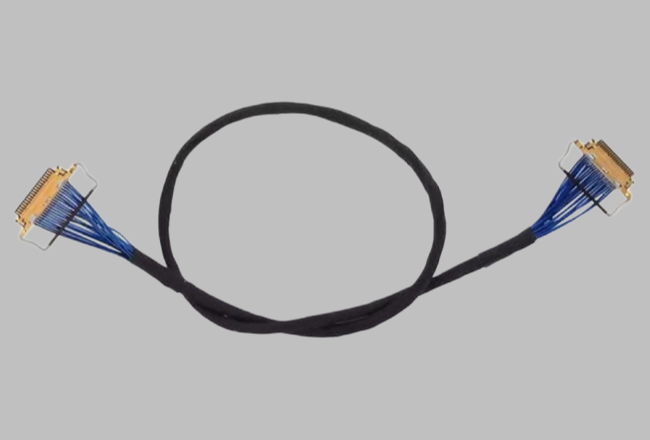
High-speed equipment continues to develop, bringing new market space for ultra-fine coaxial cable束From AI servers, high-performance computing devices, to industrial cameras, machine vision, and robots, and even to laptops, AR/VR, and smart terminals, the amount of data inside the devices is constantly increasing. Meanwhile, the product structure is continuously developing towards thinness, miniaturization, and high-density. This makes high-speed internal connection technology increasingly prominent. The ultra-fine coaxial cable束, with its features such as thin diameter, high density, shielded transmission, and high-speed signal connection, is expected to take on the task of high-speed data connection in more new electronic devices.
I-PEX
Model 82859-100B-02-D is a very thin coaxial cable assembly for the CABLINE®-CA series, with a 12Pin, AWG40, 100mm length, and 1-line position definition. Its matching connector model is 20634-112T-02, suitable for product designs requiring compact high-speed internal connections. Engineers should pay attention to high-speed signal integrity, connector matching, line position definition, and mechanical space; for purchasing personnel, they can further consider domestic compatibility and replacement, cost optimization, delivery stability, and mass production capacity. I am
[3W Electronic Components Network]Our company has a complete production system and technical team for ultra-fine coaxial cable assembly, capable of meeting customized and replacement needs for various coaxial cable assemblies; welcome to contact:
Manager Zhang 18913228573 (WeChat number the same)As AI computing power, machine vision, intelligent robots, and high-speed intelligent terminals continue to develop, ultra-fine coaxial cable束 is gradually moving from traditional internal connection solutions in electronic products to a wider high-speed data transmission application market.