


Categorization:Harness Component
In notebook computers, high-performance display devices, industrial vision, AI computing equipment, and high-speed data processing terminals, the internal interconnect space is becoming increasingly compact. At the same time, interfaces such as USB4, Thunderbolt 5, and high-speed display have higher requirements for signal integrity. The I-PEX 83044-100B-01-D is a 60Pin, 40AWG, 200MM long ultra-thin coaxial cable assembly, and its matching cable end connector model is 20878-060T-01, which belongs to the I-PEX CABLINE®-UM series connection solution. CABLINE®-UM uses a 0.4mm contact spacing, vertical right-angle structure, and has ZenShield® full EMI shielding and mechanical locking design, which can be used for high-density, high-speed internal connections of equipment. From the perspective of engineers, such ultra-thin coaxial cable assemblies not only require attention to wire diameter, length, Pin number, and connector structure, but also need to comprehensively consider impedance, signal attenuation, crosstalk, EMI, and assembly reliability; for purchasers, it is necessary to further confirm whether the product part number, terminal configuration, cable specification, length, tolerance, and batch consistency meet the whole machine BOM and alternative supply requirements.
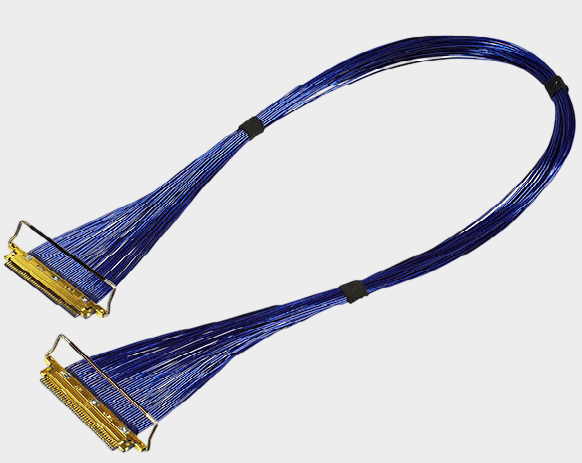
For extremely thin coaxial cable assemblies, the connector's mating life is not just a matter of "how many times it can be mated," but it directly affects the connector's structure, contact stability of the terminals, cable retention method, and the overall maintenance design of the entire machine. During the process of equipment assembly, maintenance, replacement of display modules, or module debugging, if the connector needs to be mated and unmated repeatedly, the mating action will cause mechanical wear in the contact area of the terminals, and it will also produce certain mechanical stresses on the extremely thin coaxial cable and the terminal crimping area. Therefore, when engineers design I-PEX 83044-100B-01-D type 60Pin extremely thin coaxial cable assemblies, they need to fully consider the mechanical lock, mating direction, retention force, as well as cable bending and tensile force control of the connector. CABLINE®-UM adopts a Mechanical Lock structure, which can enhance the retention reliability after mating and reduce the risk of equipment vibration or connection loosening after assembly; however, in actual product design, it should still be avoided to use the connector as a point of force for the cable, especially in the layout of 200MM long extremely thin coaxial cable assemblies. It is necessary to reasonably plan the cable direction, bending radius, and fixed position to ensure that the mechanical force generated by mating is not transmitted to the connection area of the extremely thin coaxial cable and the terminals. For equipment that requires frequent maintenance, it is advisable to prioritize confirming the actual application conditions of the connector, the number of mating and unmating operations, and the requirements for assembly tools. For consumer electronics or industrial equipment that is assembled once and used for a long time, more emphasis should be placed on the contact stability and vibration resistance after a single assembly.
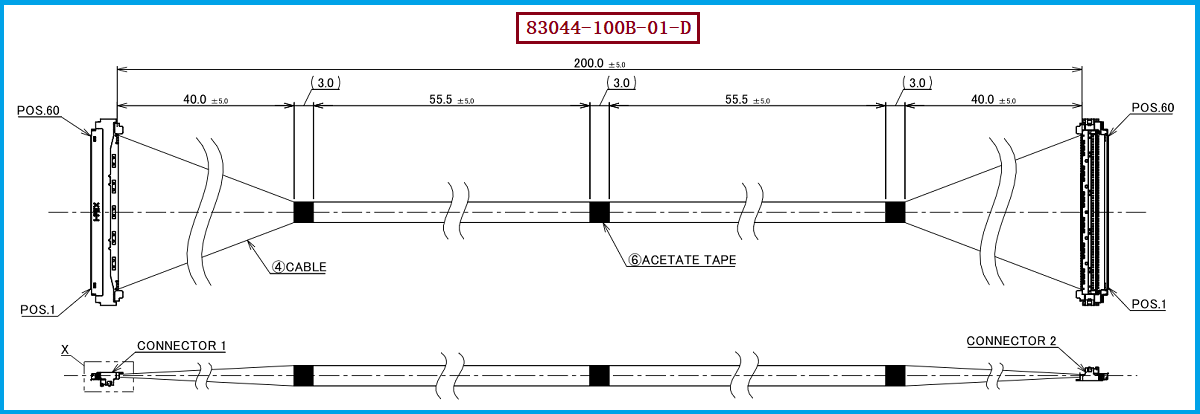
I-PEX 83044-100B-01-D corresponds to a 60Pin ultra-thin coaxial cable scheme, with the matching cable end connector being 20878-060T-01, and the cable length being 200MM. The CABLINE®-UM connector uses a 0.4mm contact pitch, and the official product series supports 30, 40, 50, 60Pin specifications, and supports ultra-thin coaxial cable specifications such as AWG36, AWG38, AWG40, AWG42, AWG44; among them, 40AWG is one of the important specifications of this evaluation cable series. For engineers, when selecting models, they cannot simply replace based on "60Pin+200MM" and should further check Pin Assignment, signal definition, connector mating relationship, cable characteristic impedance, high-speed differential pair routing, and shielding structure. Especially when the application involves USB4, Thunderbolt, high-speed DisplayPort, eDP, or other high-speed signals, changes in cable length, termination technology, and structural consistency of the connector area may affect the final signal integrity. For purchasers, it should be further implemented to connect the "material number consistency" to actual specifications such as connector model, Pin number, wire diameter, length, Pin Assignment, termination method, and key size tolerances, to avoid judging that two cable sets can be directly interchangeable solely based on similar appearance or the fact that the connectors can be mated.
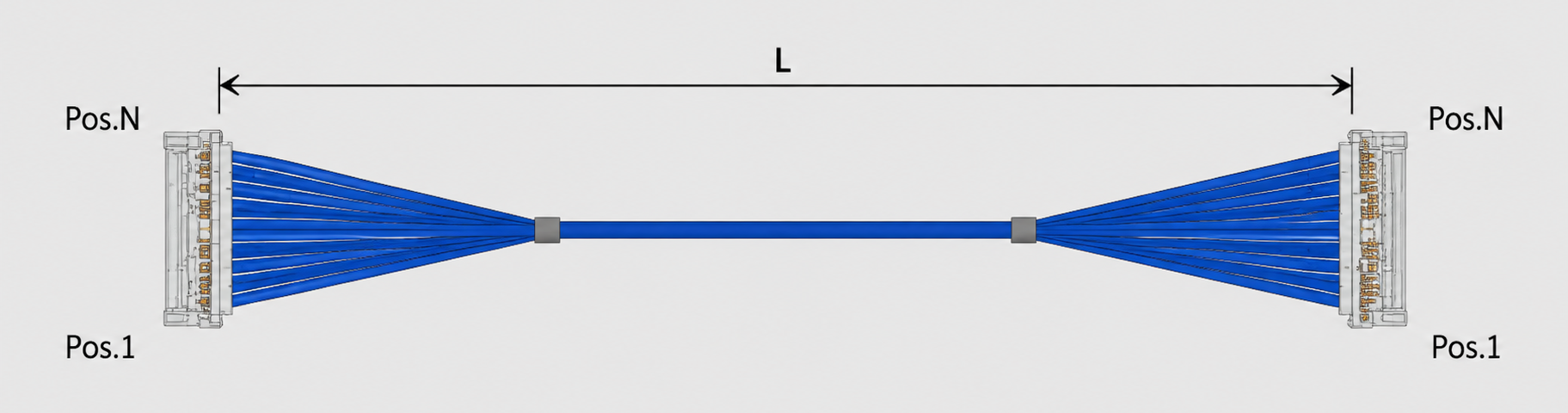
In actual projects, if the original design uses I-PEX 83044-100B-01-D, engineers are advised to first confirm that the original cable's 60Pin configuration, 40AWG wire, 200MM length, and 20878-060T-01 cable end connector are fully matched with the device PCB connector and mechanical space. Then, according to the actual high-speed signal requirements, confirm impedance, insertion loss, crosstalk, and shielding performance. If the project enters the stages of domestication, supply chain optimization, cost control, or second supplier introduction, it is not recommended to only use "the connector model is the same" as the basis for substitution judgment. Instead, verification should be carried out through connector matching dimensions, terminal arrangement, wire structure, crimp quality, conductivity performance, impedance, and high-speed signal testing. For projects that need to maintain the original equipment structure and assembly method, one-to-one development can be carried out around the original cable's Pin count, length, wire diameter, connector, and Pin Assignment, and the cable outlet and molding method can be adjusted according to the customer's PCB space and routing direction. Our company can provide: I-PEX 83044-100B-01-D compatible alternative cable solutions, which can confirm the specifications of extremely thin coaxial cables according to the actual equipment requirements of customers, connector termination, length, and structural matching, and provide corresponding alternative manufacturing solutions for sample verification and mass production requirements. For the procurement department, this approach also helps to establish a stable alternative supply channel while maintaining the original interface and assembly logic.
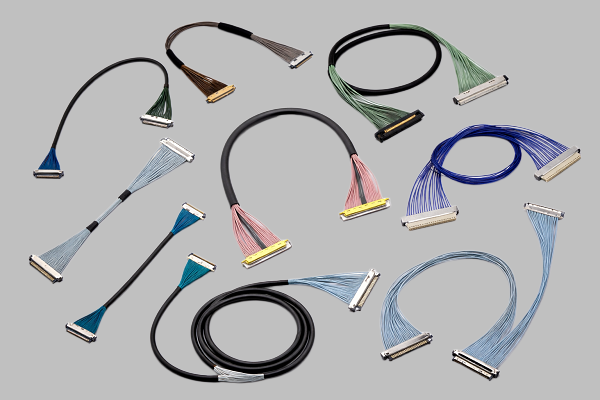
“Without the consent or authorization of this site, no one shall reproduce, reprint, distribute, cite, change, broadcast or publish the content in whole or in part in any form, nor shall there be any other violation of the copyright of this site.