


Categorization:Harness Component
With the continuous upgrading of AI computing, edge AI, high-performance vision, intelligent terminals, and high-speed data processing equipment, the data throughput inside the devices is increasing while the PCB space is becoming more compact. For engineers, AI devices not only require higher data transmission rates internally but also need to complete stable multi-channel high-speed signal transmission within limited space, which poses multiple challenges to traditional connection methods, including signal integrity, crosstalk, EMI, and wiring space. Therefore, **extremely fine coaxial cable harnesses (Micro-Coaxial Cable Harness)** are increasingly attracting the attention of high-speed electronic equipment designers. Compared with ordinary wires, extremely fine coaxial cables use a coaxial structure to form a more controlled high-speed signal transmission path through the center conductor, insulating layer, shielding layer, and external structure, which has obvious advantages in high-speed differential signals, display signals, image data, and internal connections for high-speed interfaces. For AI devices, a seemingly very thin cable harness actually plays a crucial role as a "high-speed data channel": it needs to minimize space occupation while maintaining signal integrity and electromagnetic compatibility performance as much as possible.
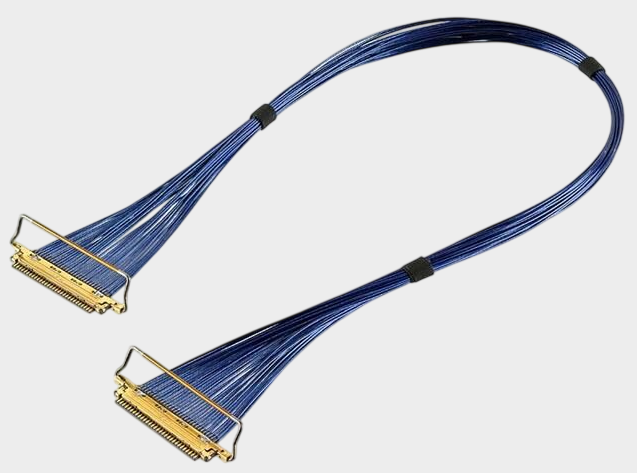
From the perspective of engineering design, high-speed data transmission is not simply about increasing "cable speed," but requires the entire signal chain to maintain stable impedance, low loss, minimal crosstalk, and good shielding performance. The I-PEX CABLINE®-UM series connectors adopt a 0.4mm ultra-fine contact spacing, vertical right-angle wiring structure, ZenShield® full EMI shielding, and mechanical locking design, catering to high-speed, high-density internal connections for devices. The product specifications indicate that they can support up to 40Gbps/lane PAM3 level high-speed transmission and can be applied in high-speed interface scenarios such as USB4, Thunderbolt 5, DisplayPort, eDP, HDMI, MIPI, etc. In such a connection system, the extremely thin coaxial cable bundle is not just responsible for the "conductive" function, but together with the connector, PCB, and terminal chip, it forms a complete high-speed signal chain. Taking the I-PEX 83042-100B-01-D introduced this time as an example, this product belongs to a 50Pin, 40AWG, 300MM, 1-1 Pin Assignment ultra-thin coaxial cable bundle solution. The connector model used at the cable end is 20878-050T-01. For engineers, the 40AWG ultra-thin wire diameter is conducive to reducing the space occupied by the cable bundle inside the device, while the 50Pin multi-channel structure can meet the signal connection requirements of higher density; for procurement personnel, the 300MM length provides greater application flexibility for space wiring between mainboards, display modules, computing modules, and other high-speed modules inside different devices.
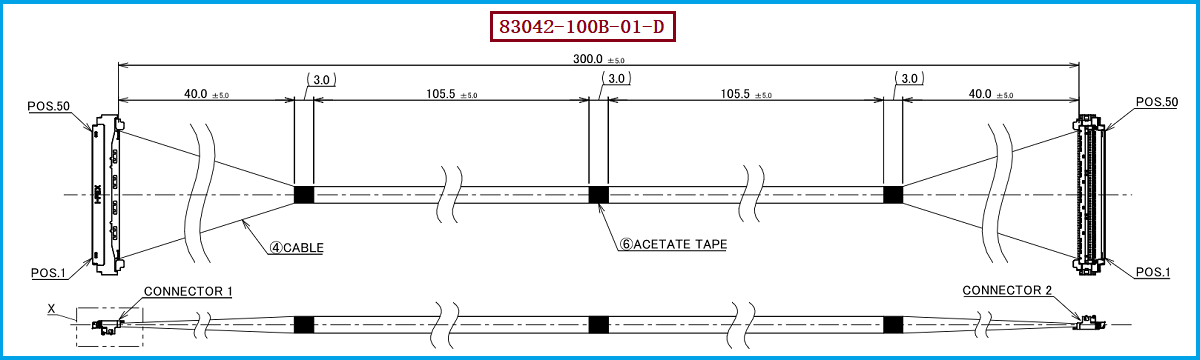
In actual project selection, engineers usually need to pay attention to Pin quantity, wire diameter, cable length, connector ends, Pin Assignment, and internal routing space of the device. This I-PEX 83042-100B-01-D corresponds to a 50Pin ultra-thin coaxial cable assembly, using a 40AWG Micro-Coaxial Cable, with a length of 300MM. Both ends use a 1-1 matching connection method, and the connector model used at the cable end is 20878-050T-01. When combined with the application requirements of high-speed equipment, this combination of 50Pin multi-channel, 40AWG fine wire diameter, and 300MM length is more suitable for devices that require a large number of high-speed signal channels while also having requirements for internal space and cable flexibility. Especially in AI computing equipment, industrial vision equipment, high-speed camera equipment, smart terminals, high-performance display equipment, and other high-density electronic devices, ultra-thin coaxial cables can help designers reliably route high-speed signals from one functional module to another, while reducing the structural space occupied by traditional thick cables. For purchasing personnel, in addition to confirming the material number, they should focus on checking the matching relationship of connectors, wire diameter specifications, Pin quantity, length, male and female end structures, and Pin Assignment to avoid situations where "connectors look the same but cannot be directly matched."
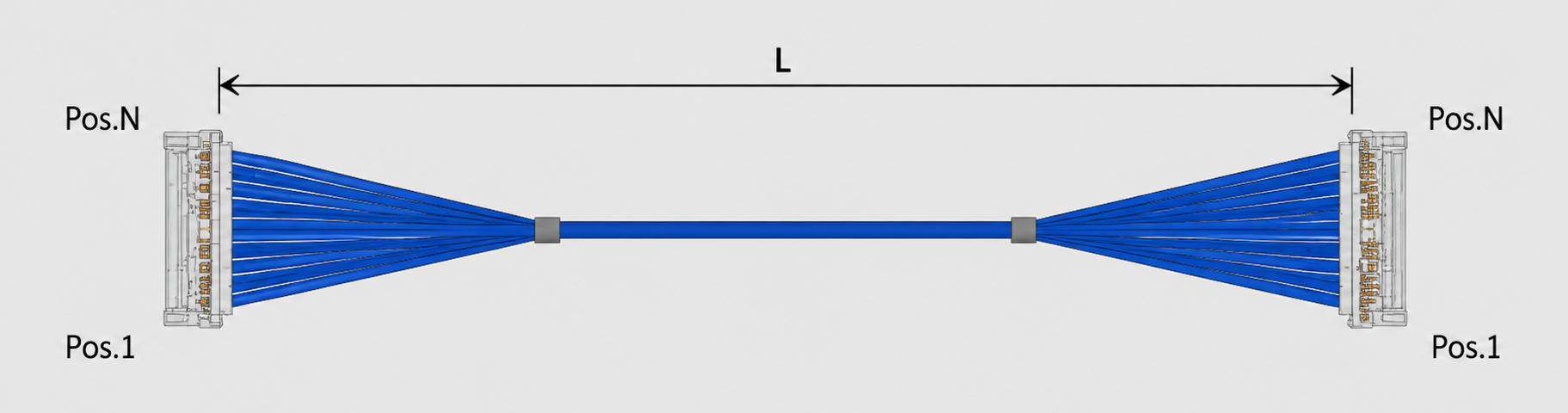
For engineers and purchasers, if the existing equipment or BOM uses I-PEX 83042-100B-01-D, it is recommended to first confirm each item according to the original product's key parameters such as 50Pin, 40AWG, 300MM, 1-1 Pin Assignment, and the terminal connector 20878-050T-01. Then, evaluate the compatibility based on the actual space, impedance requirements, high-speed signal type, and connector matching structure of the equipment. It is particularly important to note that the "compatible replacement" of extremely thin coaxial cable束 cannot be solely based on cable length and Pin count; it also requires attention to the electrical performance of the cable material, characteristic impedance, shielding structure, terminal crimping/connection method, connector matching, Pin definition, and overall signal integrity. Therefore, in actual replacement projects, the sample verification and performance confirmation should be based on the original manufacturer's connector matching relationship and the actual interface definition of the customer's equipment. For projects that require domestication, supply chain optimization, cost control, or the introduction of a second supplier, our company can provide a compatible replacement solution for extremely thin coaxial cable束 of I-PEX 83042-100B-01-D. We can match the cable scheme based on the original cable sample, drawings, connector model, cable length, Pin count, and application requirements provided by the customer, and provide the corresponding support for extremely thin coaxial cable束 manufacturing for engineering development, sample verification, and bulk purchasing.
“Without the consent or authorization of this site, no one shall reproduce, reprint, distribute, cite, change, broadcast or publish the content in whole or in part in any form, nor shall there be any other violation of the copyright of this site.