


Categorization:Harness Component
With the continuous development of laptops, AI terminals, high-performance display devices, industrial vision devices, VR/AR devices, and high-speed computing platforms towards high-speed, high-density, and thin designs, internal connections of devices must not only meet the transmission needs of more signal channels but also balance signal integrity, anti-interference capability, connection reliability, and assembly efficiency within limited spaces. Traditional wiring schemes face higher requirements for impedance control, crosstalk suppression, and spatial layout when dealing with high-speed differential signals, high-frequency signals, and complex electromagnetic environments. Micro-Coaxial Cable (Micro-Coaxial Cable) has gradually become an important choice for internal interconnection of high-speed electronic devices due to its single-channel shielding, miniaturization, high-density wiring, and good high-speed signal transmission capabilities. This time, the corresponding product is the I-PEX 83040-100B-01-D Micro-Coaxial Cable assembly, which belongs to the CABLINE®-UM series 50Pin, 40AWG Micro-Coaxial Cable solution. It uses the 20878-050T-01 connector at the wire end, and the connector has a 50PIN, 0.4MM pitch structure, which is suitable for electronic device applications that have high requirements for internal space, transmission performance, and connection density.
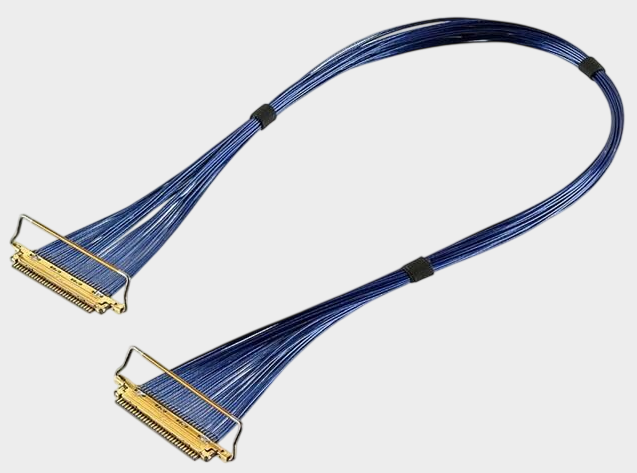
From the perspective of engineer selection, ultra-fine coaxial cable assemblies have become an important solution in the high-speed connection field, not just because of their "thin wire diameter", but more importantly because they can combine high-speed transmission, signal isolation, and space utilization. Compared with ordinary cables or traditional FPC solutions, ultra-fine coaxial cables can allow for more precise structural design for high-speed signals. Each coaxial cable has an independent signal transmission and shielding structure, which is conducive to reducing crosstalk between adjacent channels and helps engineers design high-speed signal integrity. The I-PEX CABLINE®-UM connector uses a 0.4mm Contact Pitch ultra-fine spacing and features ZenShield® full EMI shielding and mechanical locking structure. The product line supports 30Pin, 40Pin, 50Pin, 60Pin and other specifications; among them, 83040-100B-01-D corresponds to a 50Pin, 40AWG Micro-Coaxial Cable solution, which can be used for high-density internal high-speed interconnections. For engineers, this means that in space-limited areas such as motherboards, display modules, cameras, and high-speed computing modules, more flexible routing and connection design can be achieved through ultra-fine coaxial cable assemblies, while also considering high-speed signal transmission and EMC design requirements.
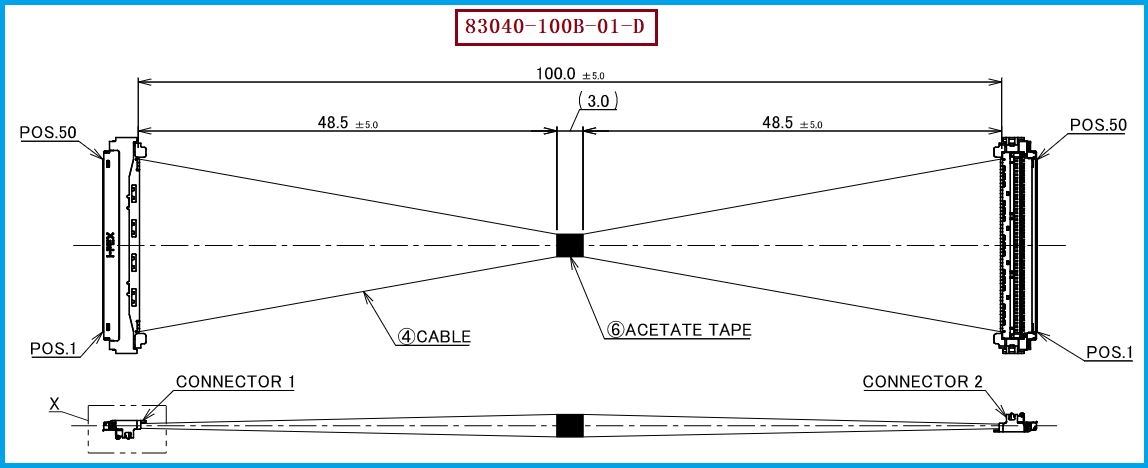
For purchasers and project managers, when selecting high-speed ultra-fine coaxial cable assemblies, it is not enough to simply confirm that the connector models are consistent; they also need to pay close attention to the connector PIN count, contact spacing, cable specifications, wire sequence definition, cable length, termination technology, impedance requirements, and batch consistency. The wire end connector model for this product is 20878-050T-01, with a 50PIN count and 0.4MM spacing, while the product part number I-PEX 83040-100B-01-D corresponds to a 50Pin, 40AWG, 100mm specification 1-1 connection scheme. For actual project substitutions, even if the connector appearance is the same, if there are differences in wire AWG, wire sequence, shielding structure, terminal crimping, welding/termination quality, or electrical performance, it may affect the overall high-speed signal performance of the unit. Therefore, it is recommended during the procurement stage to further implement "connector compatibility" into "complete ultra-fine coaxial cable assembly compatibility" and confirm the substitution scheme through methods such as sample verification, size confirmation, continuity testing, impedance/signature integrity verification, and reliability testing. Our company focuses on the research, development, production, and manufacturing of ultra-fine coaxial cable assemblies and can customize according to the customer's connector configuration, cable specifications, PIN count, length, wire sequence, and application requirements. We can also provide I-PEX 83040-100B-01-D compatible substitution cable assembly solutions to help customers reduce supply chain procurement costs while meeting project development and mass production requirements.
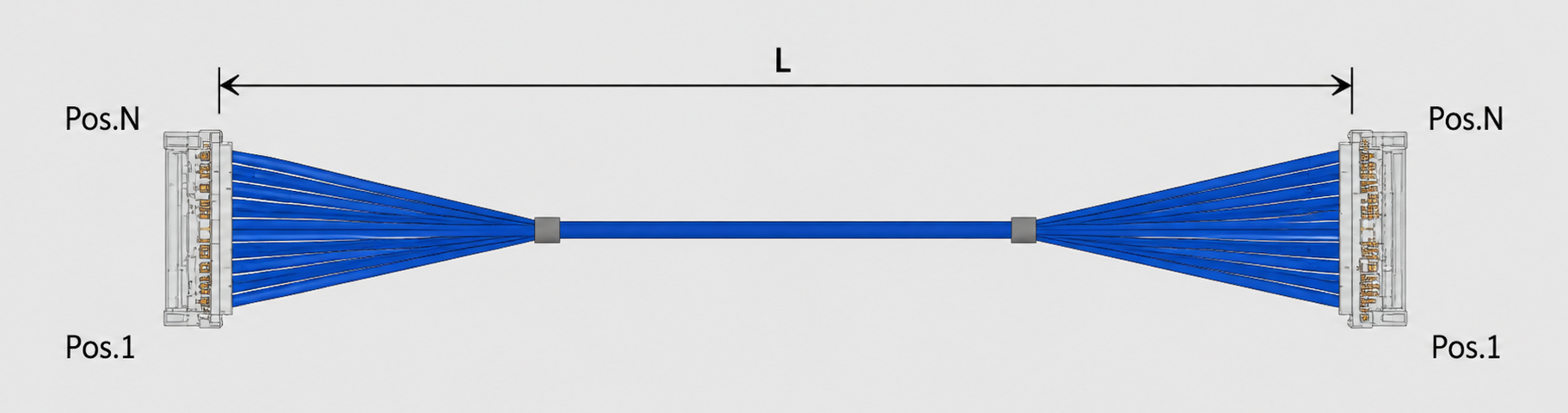
For 50Pin high-speed ultra-fine coaxial cable assemblies like I-PEX 83040-100B-01-D, engineers are advised to prioritize confirmation of the match between six aspects: "connector + cable + termination process + wire sequence + size + electrical performance." The connector end needs to focus on key conditions such as 20878-050T-01, 50PIN, and 0.4MM spacing; the cable end requires confirmation of the 40AWG ultra-fine coaxial cable specification and corresponding high-speed transmission performance. At the same time, determine the cable length, cable direction, and bending path according to the internal space of the equipment. If the original equipment uses the I-PEX CABLINE®-UM series solution, it is recommended to prioritize compatibility design according to the original connector structure and PIN definition, and then optimize the cable, length, and termination process based on actual application requirements. For the purchasing department, it is better to require suppliers to carry out one-to-one compatibility verification according to the original product's key dimensions and electrical requirements, rather than simply searching for "similar models" of cables, as this is more conducive to reducing the risk of re-development after introducing alternative products. Our company can develop and mass-produce ultra-fine coaxial cable assemblies compatible with I-PEX 83040-100B-01-D based on the original factory samples, drawings, or technical parameters provided by customers, providing cable solutions from sample production to mass delivery for engineering research and development and procurement.
“Without the consent or authorization of this site, no one shall reproduce, reprint, distribute, cite, change, broadcast or publish the content in whole or in part in any form, nor shall there be any other violation of the copyright of this site.